
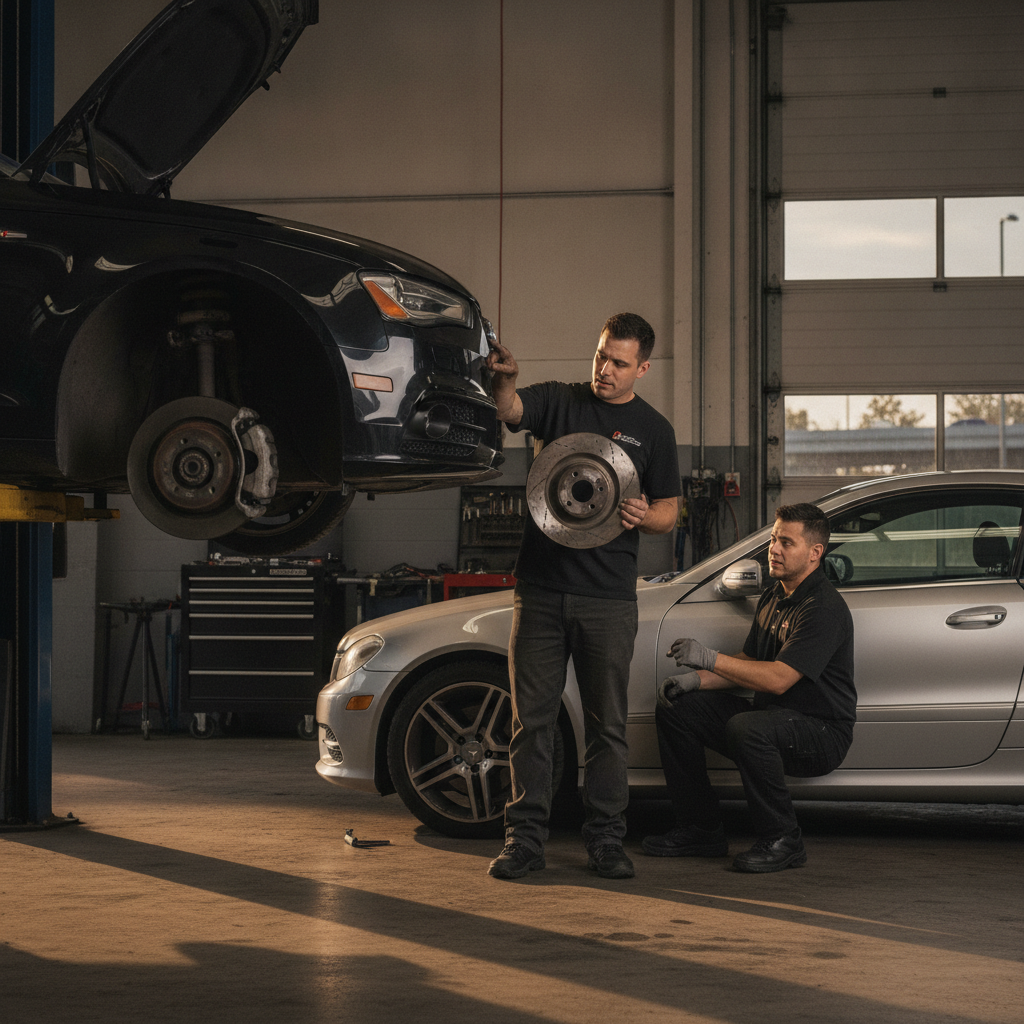
Why Is My Audi or Mercedes Brake Pedal Pulsating When I Stop? What Roswell Owners Should Know About Warped Rotors and European Brake System Service
That rhythmic shudder through the brake pedal when you slow down for a light on GA-400 isn’t something to chalk up to road texture or tire wear. If your Audi or Mercedes brake pedal pulses, vibrates, or feels like it’s grabbing and releasing in quick cycles every time you apply pressure, the most likely culprit is rotor distortion — commonly called warped rotors — or uneven rotor surface deposits. It’s one of the more common brake complaints we see at Solo Motor Sports in Roswell, and it’s one that gets worse quickly if you put it off.
What’s Actually Causing That Pedal Pulsation?
The term “warped rotor” gets thrown around a lot, but the mechanics are worth understanding. True geometric warping — where heat physically bends the rotor disc — is less common than most people think. What’s far more frequently happening is uneven pad material transfer. When brake pads deposit friction material unevenly across the rotor face, thick and thin patches create microscopic height variations. As the rotor spins against the caliper pistons, those variations translate directly into the pedal feedback you feel.
On an Audi A4, A6, or Q5, or a Mercedes E-Class, GLE, or C-Class, the braking systems are engineered to extremely tight tolerances. Even small deviations in rotor thickness — sometimes as little as 0.003 to 0.005 inches of lateral runout — are enough to trigger noticeable pedal pulsation. These vehicles aren’t forgiving of sloppy brake work or mismatched parts.
Why This Problem Is Especially Common in the Atlanta Metro Area
Stop-and-go traffic along the GA-400 corridor between Roswell, Alpharetta, and Sandy Springs puts brake systems through more frequent heat cycles than many other driving environments. You’re not descending a mountain pass, but you are making dozens of slow, loaded stops in commuter traffic — exactly the kind of repetitive thermal stress that accelerates pad transfer and surface glazing on rotors.
Add to that the fact that many European vehicle owners in North Fulton County are running performance brake packages — bigger rotors, higher-friction pads — that generate even more heat. Those systems are outstanding when maintained correctly and genuinely harmful to rotors when they’re not.
We also see pulsation problems develop after budget brake jobs. If a shop resurfaces rotors on a lathe without checking for hub runout, or installs low-grade aftermarket pads with inconsistent friction compounds, the pulsation often returns within months. On an Audi or Mercedes, that’s not a minor inconvenience — it’s a safety issue and a waste of money.
Rotor Resurfacing vs. Replacement: What’s Right for Your Vehicle?
This is where a lot of general repair shops and even some European specialists cut corners or give vague answers. Here’s the straightforward version.
Every brake rotor has a minimum discard thickness — a number stamped or cast into the rotor itself by the manufacturer. Once a rotor has been resurfaced or worn down to within a certain margin of that number, it can no longer safely absorb and dissipate braking heat. On most Audi and Mercedes applications, rotors are engineered with relatively modest resurfacing allowances. Many factory rotors, especially on sport trims and AMG/S-line models, come from the factory close enough to minimum spec that resurfacing isn’t a legitimate option after the first wear cycle.
At Solo Motor Sports, we measure rotor thickness at multiple points around the face before recommending anything. If the rotor has enough material and the runout is within spec, an on-car brake lathe can restore a true surface. If it doesn’t — and on most European vehicles that have pulsation significant enough to feel — replacement with OEM or OEM-equivalent rotors is the correct call. Genuine parts matter here. Cheap aftermarket rotors often have casting inconsistencies that introduce their own runout problems right out of the box.
Learn more about brake repair for European vehicles at Solo Motor Sports.
The Brake Pad Side of the Equation
Rotors rarely fail in isolation. If your rotors have developed uneven deposits, your pads are almost certainly part of the problem — either they’ve glazed over from heat cycling, they’ve worn unevenly, or they were the wrong compound for your vehicle from the start. Installing new rotors under worn, glazed, or mismatched pads defeats the purpose. The pads need to be evaluated and, in most pulsation cases, replaced at the same time.
For Audi owners — particularly those with the larger brake packages on S-line, S4, S5, or Q7 variants — pad compound selection matters more than people realize. A harder, high-temperature compound that performs well on a track generates excessive rotor stress in daily stop-and-go conditions. A technician who knows Audi’s brake specifications will match the pad compound to how you actually drive, not just to what fits.
The same applies to Mercedes owners. AMG vehicles especially have large, performance-biased brake systems that require pads and rotors designed for that application. Substituting generic pads to save money on an AMG C63 or GLC 63 is a false economy — you’ll be back for another brake job much sooner than you should be.
What Most Competitors Don’t Tell You About European Brake Caliper Issues
Here’s a gap that’s rarely addressed directly: on many Audi and Mercedes models, brake pedal pulsation isn’t just a rotor or pad issue. Sticky or seized caliper guide pins and slide pins are a common and often overlooked contributor. When a caliper pin corrodes or loses lubrication, the caliper can’t float freely across the rotor face. That causes one side of the pad to wear faster, creates uneven rotor contact pressure, and — over time — produces exactly the kind of pulsation you feel through the pedal.
On European vehicles with multi-piston fixed calipers (common on AMG, S-line, and Porsche applications), it’s not guide pins but piston seals and piston retraction that matter. Old, hardened piston seals cause calipers to drag slightly after release, heating the rotor unevenly. A complete brake service — not just a pad and rotor swap — means inspecting and servicing the caliper hardware as well.
If your brake job doesn’t include a caliper hardware inspection and lubrication with appropriate high-temp brake grease, it isn’t a complete brake service. That’s something owners in Johns Creek, Milton, and Alpharetta should ask about explicitly before any shop touches their brakes.
How Long Can You Drive with a Pulsating Brake Pedal?
That depends on the severity. Mild pulsation that you only notice under light braking at low speed is an early-stage problem — you have some time, but not unlimited time. If the pulsation is strong enough to feel through the steering wheel or to affect your stopping distance, it needs attention now. A brake system that’s vibrating under load is a brake system that isn’t operating at full efficiency.
The other risk is progressive damage. Rotor surface distortion causes brake pad contact to vary, which accelerates uneven pad wear, which worsens rotor distortion in a cycle that escalates. A repair that might have been straightforward at the pulsation stage becomes more extensive — and more expensive — after months of deferred service.
See how preventative maintenance keeps European brake systems operating correctly.
Frequently Asked Questions
Can a warped rotor fix itself?
No. Rotor distortion and uneven pad deposits don’t correct themselves. The problem will worsen under continued braking until the rotor or pads are serviced.
Why does my brake pedal only pulsate at certain speeds?
Rotor runout creates a pulsation frequency tied to wheel speed. It often feels most noticeable in a specific speed range — typically 40 to 60 mph — because that’s where the vibration frequency is most perceptible to the driver. The underlying problem is the same regardless of where you feel it.
Is it safe to drive my Audi or Mercedes with brake pedal pulsation?
It depends on severity. Mild pulsation may not immediately compromise safety, but any brake pedal irregularity on a European performance vehicle warrants prompt inspection. Don’t assume it’s minor without having it confirmed by a technician.
How often should I have my brakes inspected on a European vehicle?
At every oil service interval — typically every 10,000 miles or annually — brake pad thickness and rotor condition should be checked. Most European vehicles include a brake wear indicator system, but that only alerts you when pads are nearly exhausted. A visual and measurement-based inspection catches rotor issues and uneven wear well before the warning light appears.
Do I need to replace all four rotors, or just the ones causing the pulsation?
Axles should be serviced in pairs — both front or both rear at the same time. Replacing a single rotor creates uneven braking force across the axle, which can pull the vehicle and introduce new handling problems. Your technician will measure all four and recommend accordingly.
Get Your Brakes Inspected by European Specialists in Roswell
Brake pedal pulsation on an Audi or Mercedes isn’t a minor nuisance — it’s a signal that your braking system needs professional attention from technicians who understand how these vehicles are built and what they require. At Solo Motor Sports in Roswell, we service Audi, Mercedes-Benz, BMW, Porsche, and the full range of European and luxury makes with factory-trained expertise, OEM-quality parts, and honest pricing that doesn’t require a dealership visit.
If you’re noticing pedal pulsation, steering wheel vibration under braking, or any brake behavior that doesn’t feel right, contact us to schedule an inspection. We’ll give you a clear assessment, explain exactly what’s needed, and get it done right the first time.