
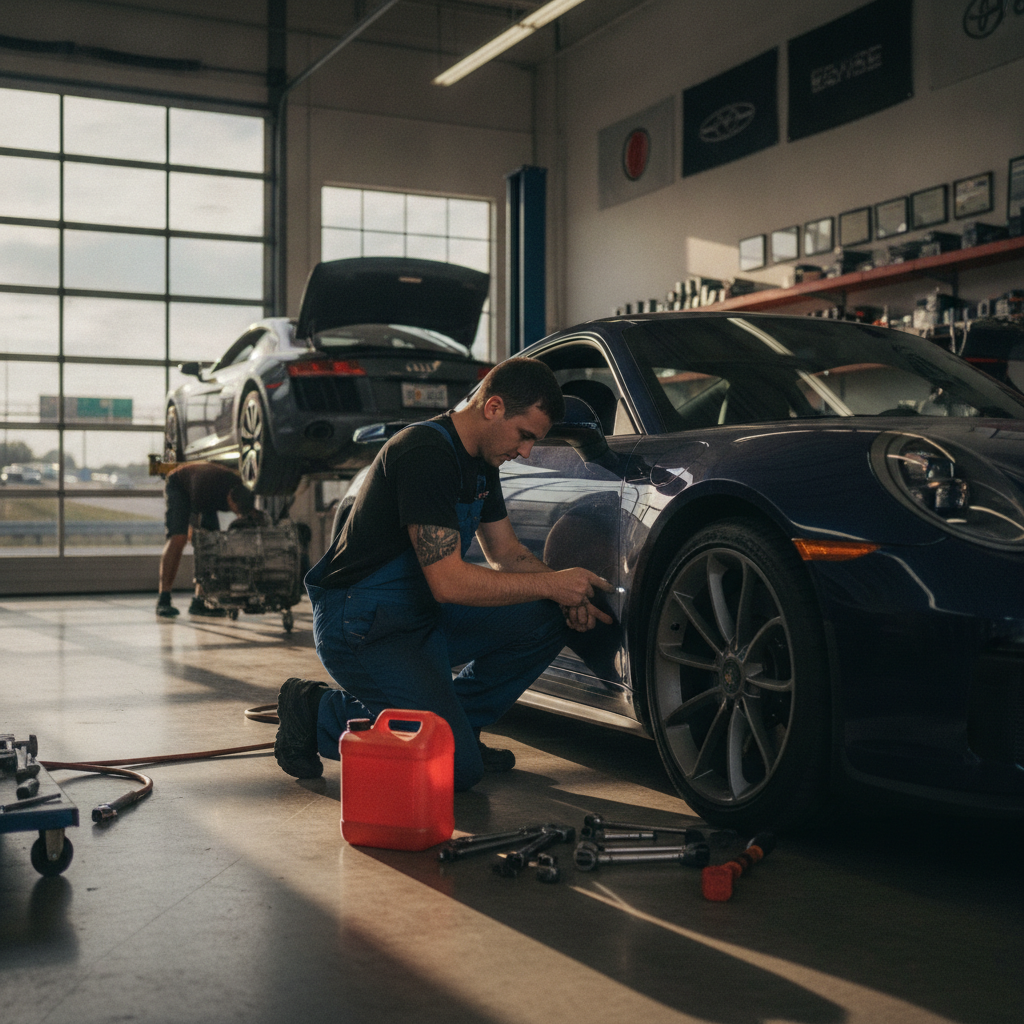
Why Is My Porsche or Audi’s Clutch Pedal Feeling Soft or Spongy? What Roswell Owners Should Know About European Hydraulic Clutch System Failure
If the clutch pedal in your Porsche 911, Cayman, Audi S4, or TT has started feeling soft, spongy, or like it needs to be pushed closer to the floor before the car actually engages, you’re not imagining things — and this is not a problem you want to defer. That change in pedal feel is nearly always a sign of something failing in the hydraulic clutch system. For Roswell owners who drive their manuals hard on GA-400 or enjoy weekend runs through the North Fulton back roads, catching this early is the difference between a straightforward repair and a much more expensive transmission removal job.
How the Hydraulic Clutch System Actually Works in European Performance Cars
Unlike older cable-operated clutch setups, Porsche and Audi use a fully hydraulic clutch actuation system — the same basic principle as your brake circuit. When you press the clutch pedal, you’re pressurizing fluid through a master cylinder, which transmits that force to a slave cylinder positioned at the bellhousing. The slave cylinder then actuates the clutch fork or release bearing, disengaging the clutch disc from the flywheel so you can shift gears cleanly.
It’s an elegant, precise system when it’s working correctly. The problem is that hydraulic systems depend entirely on two things: sealed components that hold pressure, and clean, uncontaminated fluid. When either of those conditions breaks down, the pedal feel degrades — sometimes gradually, sometimes very quickly.
What’s Actually Causing That Soft, Spongy Feel
There are several distinct failure modes that produce a soft clutch pedal in Porsche and Audi vehicles, and correctly identifying which one is present requires more than just topping off the reservoir and calling it done.
Air in the Hydraulic Line
The most common cause of a spongy pedal is air entering the hydraulic circuit. Clutch fluid — which is typically the same DOT specification brake fluid — is hygroscopic, meaning it absorbs moisture over time. As the fluid degrades, its boiling point drops. If you’ve ever ridden the clutch through Atlanta metro stop-and-go traffic or worked the pedal aggressively on a spirited drive, the heat generated can vaporize moisture-contaminated fluid and introduce air into the line. Air compresses. Fluid does not. That’s exactly what you’re feeling when the pedal goes soft.
Clutch Master Cylinder Failure
The clutch master cylinder contains internal rubber seals and a piston that must hold pressure every single time you press the pedal. In Audi platforms — particularly the B8 and B9 generation S and RS models — the master cylinder seals are a well-documented wear item. As those seals deteriorate, the cylinder begins bypassing internally. Fluid passes around the piston instead of building pressure, and you end up with a pedal that slowly sinks to the floor under steady pressure, or one that has to be pumped back up to get engagement.
Concentric Slave Cylinder Leak
Porsche 911 and Boxster models that use a concentric slave cylinder — mounted inside the bellhousing around the transmission input shaft — add a layer of diagnostic complexity. When these fail, they typically leak clutch fluid internally, which can contaminate the clutch disc itself and cause both a soft pedal and erratic engagement behavior. The bad news: accessing a concentric slave cylinder means dropping the transmission. This is a job that genuinely requires a European specialist with the right tooling and experience, not a general repair shop that sees the occasional manual transmission once a month.
External Fluid Leak
Less common but straightforward to diagnose — if the master cylinder reservoir is consistently low, or you’re seeing fluid weeping near the firewall or at the bellhousing, there’s an external leak somewhere in the system. This will eventually lead to complete loss of clutch function. Driving on a leaking hydraulic clutch is genuinely dangerous, particularly in traffic on Johns Creek Parkway or merging onto GA-400 during rush hour.
Why This Repair Deserves a European Specialist, Not a General Shop
This is the gap that most local competitors’ websites simply don’t address: the clutch hydraulic system on a current-generation Porsche or Audi is tightly integrated with the vehicle’s electronic architecture in ways that a standard shop isn’t set up to handle. Many modern Audi manuals use electronically-assisted clutch actuation and require factory-level scan tools to bleed the system properly and confirm no fault codes were generated during the repair. A shop that bleeds the system with a manual pressure bleeder and calls it done may leave air in the circuit or miss an underlying master cylinder fault entirely.
At Solo Motor Sports in Roswell, the technicians working on your Porsche or Audi have factory-trained experience with these platforms and use OEM-specification parts — not aftermarket master cylinders or generic slave cylinders from an overseas catalog. The difference in seal quality and dimensional tolerances matters enormously in a precision hydraulic circuit operating under high thermal load. Our Porsche service is built on that level of specificity, not generalist repair procedures adapted from a generic database.
What to Expect: Timeline and Process
A clutch hydraulic diagnosis and repair follows a clear sequence. First, a thorough visual inspection of the reservoir, master cylinder, clutch lines, and slave cylinder — looking for external leaks, contaminated fluid, or visible seal failure. Then a pedal feel evaluation with the engine running and off, along with a scan for any stored fault codes in the clutch or transmission control modules.
If the issue is isolated to the master cylinder or a line repair, the job is typically completed in a single day. If the concentric slave cylinder on a Porsche needs replacement, plan for a longer turnaround — transmission removal is involved, and that’s not a job to rush. Either way, the repair should include a proper hydraulic bleed with fresh DOT fluid to factory spec, followed by a road test that confirms engagement point consistency across all gears.
Georgia’s summer heat and humidity accelerate fluid degradation faster than you’d see in a cooler climate. If you can’t remember the last time the clutch fluid was serviced, that’s worth addressing even before a problem develops. It’s standard in our preventative maintenance recommendations for any manual-transmission European vehicle over three years old.
What Happens If You Ignore a Soft Clutch Pedal
This is worth being direct about. A gradually softening pedal that gets pumped back up and driven on will eventually fail completely — typically at the worst possible moment. When a master cylinder loses pressure entirely, you lose the ability to disengage the clutch and shift gears. If you’re on the highway, that means pulling over immediately. If the slave cylinder has been leaking internally long enough to contaminate the clutch disc, you’re now looking at a full clutch replacement on top of the hydraulic repair — a significantly larger job and a significantly larger bill.
Owners in Sandy Springs and Alpharetta who use their manual Porsches or Audis as daily drivers on the GA-400 corridor especially cannot afford that kind of roadside failure. The clutch hydraulics are a safety-critical system. Treat them accordingly.
Frequently Asked Questions
How often should clutch fluid be replaced in a Porsche or Audi?
Porsche and Audi generally recommend a clutch fluid flush every two years regardless of mileage, because the fluid degrades from moisture absorption over time rather than purely from use. In the Atlanta metro climate — with high summer heat and humidity — two years is the right interval to maintain both pedal feel and hydraulic component longevity.
Can I drive on a spongy clutch pedal while I wait for an appointment?
Briefly, and with caution. If the pedal still engages the clutch reliably and returns normally, you have some time — but don’t put it off more than a few days. If the pedal is sinking to the floor, or you have to pump it to get engagement, stop driving the vehicle and have it towed. Complete hydraulic failure can happen without additional warning once the system reaches that point.
Is a spongy clutch pedal always a hydraulic issue, or could it be the clutch disc itself?
A worn clutch disc typically presents as slipping under load — the engine revs climbing without a corresponding increase in vehicle speed — rather than a soft pedal feel. A spongy or low-engagement-point pedal almost always traces back to the hydraulic circuit. Both conditions deserve prompt diagnosis, but they’re distinct failure modes.
Will a Porsche or Audi dealership do this repair better than an independent specialist?
Not necessarily, and almost certainly not at a lower price. The repair procedures and parts specifications are the same. What matters is that the shop has factory-level diagnostic tools, technicians with direct experience on your specific platform, and uses OEM or OEM-equivalent parts. Solo Motor Sports in Roswell meets all three of those standards — without the dealership markup or the weeks-long service appointment lead time.
Does a soft clutch pedal affect my transmission?
It can, indirectly. If hydraulic pressure loss means you’re unable to fully disengage the clutch during shifts, you’ll be forcing gear changes with partial clutch engagement. Over time, that stresses synchronizers and can cause premature wear inside the gearbox. Getting the hydraulic system repaired promptly protects both the clutch and the transmission it’s connected to.
Get Your Clutch Diagnosed at Solo Motor Sports in Roswell
A soft clutch pedal on a Porsche or Audi is a precision problem that deserves a precision answer — not a guess, not a generic bleed job, and not a week at the dealership waiting for a service slot. At Solo Motor Sports, located on Alpharetta Highway in Roswell, the technicians working on your car have direct experience with these hydraulic systems, the diagnostic tools to identify the exact failure point, and access to OEM-specification parts that will restore the pedal feel your car was engineered to deliver.
If you’re in Roswell, Alpharetta, Johns Creek, Sandy Springs, or anywhere across North Fulton County, don’t wait for this to become a roadside problem. Contact Solo Motor Sports today to schedule a clutch inspection and get a straight answer about what your car actually needs.