
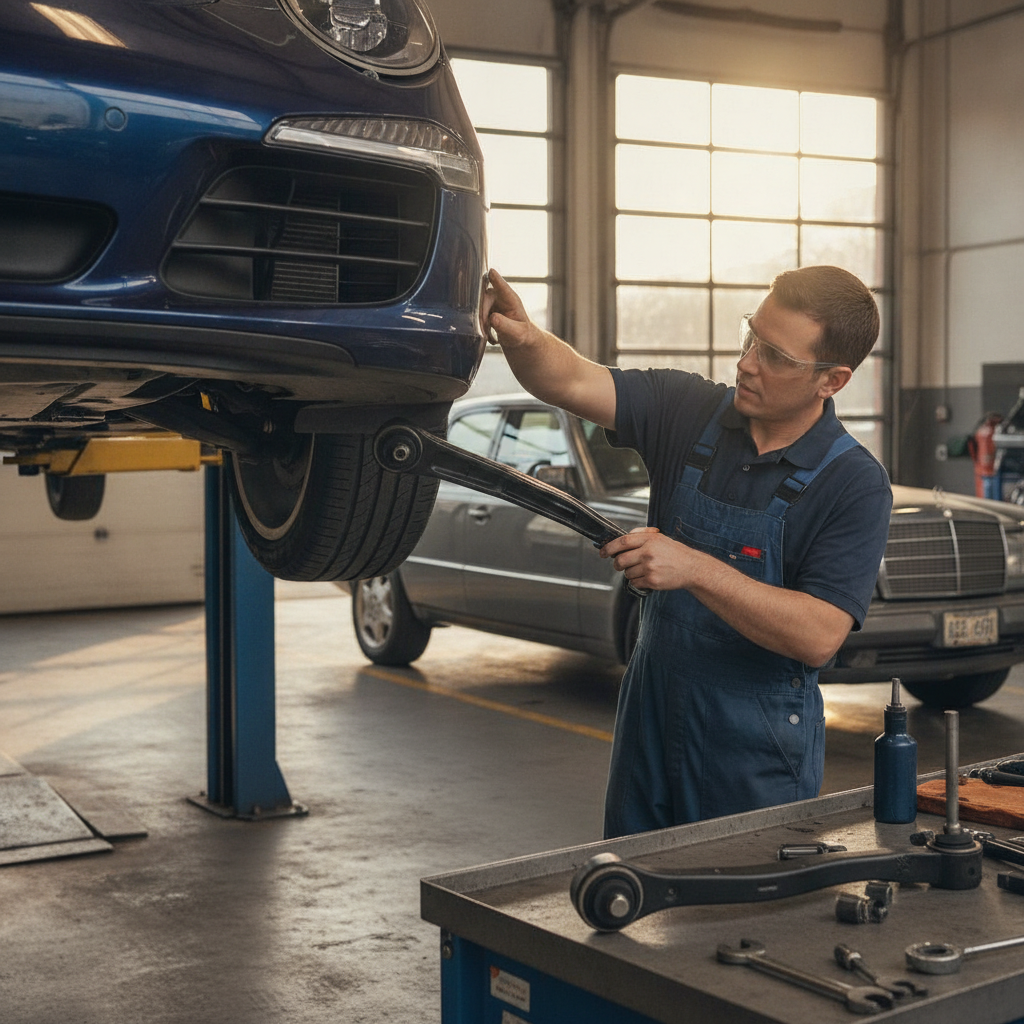
Why Is My Porsche or Mercedes Suspension Clunking Over Speed Bumps? What Roswell Owners Should Know About Control Arm and Bushing Failure
That hollow knock or clunk you feel through the floorboard every time you roll over a speed bump, a pothole, or an uneven railroad crossing isn’t something to ignore — and it almost certainly isn’t normal for a well-engineered Porsche or Mercedes-Benz. In most cases, what you’re hearing and feeling is a worn or failing suspension bushing, a deteriorating control arm, or both. For owners throughout Roswell and the surrounding North Fulton County area, this is one of the more common suspension complaints we diagnose — and one of the most frequently misunderstood.
The good news: when caught early, control arm and bushing replacement is a straightforward repair that restores the composed, planted feel your vehicle was designed to deliver. Left alone, it leads to accelerated tire wear, deteriorating alignment, and in advanced cases, unpredictable handling at highway speed on GA-400.
What Exactly Are Control Arms and Bushings — and Why Do They Wear Out?
Your suspension system is built around a network of metal arms and pivot points that allow each wheel to move independently over road imperfections while keeping the tire in contact with the pavement. Control arms are the structural links connecting your wheel hub assembly to the vehicle’s frame or subframe. They’re precision-engineered components, and on a Porsche Cayenne, a Mercedes E-Class, or a GLE, there may be multiple control arms per corner of the vehicle.
At each end of those control arms, rubber or polyurethane bushings act as cushioned pivot points. These bushings absorb vibration, reduce NVH (noise, vibration, and harshness), and allow controlled movement as the suspension cycles through bumps and body roll. Over time — typically between 60,000 and 100,000 miles depending on driving conditions — those bushings crack, compress, and lose their ability to hold the control arm in position.
When a bushing fails, the control arm moves more than it should. That excess movement is what creates the knocking or clunking sound. Your steering geometry shifts slightly with every bump, your tire contact patch becomes inconsistent, and the vehicle no longer tracks with the precision it was engineered to deliver.
Why Atlanta Metro Driving Accelerates Suspension Wear
North Fulton County and the broader Atlanta metro area aren’t kind to suspension components. If you’re driving through Roswell, commuting down GA-400 into Sandy Springs or Buckhead, or navigating the stop-and-go surface streets through Alpharetta and Johns Creek, your suspension is working constantly — and not always under ideal conditions.
Georgia’s roads feature a mix of smooth newer pavement and aging, patched surfaces with raised expansion joints and abrupt lane transitions. The stop-and-go braking patterns common on GA-400 during peak hours put repeated stress on front control arm bushings every time you brake and decelerate. Add the weight of a Porsche Cayenne, a Mercedes GLE, or a larger Mercedes S-Class, and it’s easy to understand why bushing wear shows up earlier than many owners expect.
Georgia’s heat and humidity also play a role. Extreme summer temperatures cause rubber bushings to harden and crack faster than in more temperate climates. We see this pattern consistently in vehicles that spend most of their lives in North Fulton — the combination of road stress and thermal cycling shortens bushing lifespan noticeably compared to manufacturer estimates based on European or Midwest driving conditions.
Symptoms That Point to Control Arm or Bushing Failure
The clunking noise over bumps is the most obvious sign, but it isn’t the only one. Here’s what to watch for in your Porsche or Mercedes:
- Knocking or clunking on one side when driving over speed bumps, dips, or uneven pavement
- Steering wheel pulling to one side even after a recent alignment — this often means the alignment can’t hold because the control arm is moving
- Vague or imprecise steering feel at highway speed, particularly noticeable on sweeping on-ramps
- Uneven or cupped tire wear on the inner or outer edge of the front tires
- Vibration through the steering wheel that worsens over rough surfaces
- The vehicle “tramping” or hopping under hard braking
If you’re experiencing more than one of these symptoms together, there’s a strong likelihood that one or more control arm bushings — or the entire control arm assembly — needs replacement. A proper suspension inspection will confirm it.
The Gap Most Shops Miss: Complete Suspension Assessment, Not Just the Noise
Here’s where many independent shops — and even some dealerships — fall short. A technician hears the clunk, identifies the failed bushing or worn ball joint, replaces that specific component, and sends the vehicle back out. The alignment isn’t rechecked with fresh eyes. Adjacent components that are approaching the end of their service life don’t get flagged. Three months later, the vehicle is back in the shop for another worn bushing on the opposite side.
At Solo Motor Sports, a suspension diagnosis isn’t limited to the part that’s making noise. Our ASE-certified technicians perform a complete suspension assessment — checking all control arm bushings, ball joints, tie rod ends, sway bar links, and end links for wear and play. We use OEM-spec or genuine parts, not budget offshore replacements that compress differently and wear faster. And after every suspension repair, we perform a four-wheel alignment to verify that your steering geometry is back within factory specifications.
That complete approach matters especially for vehicles like the Porsche Cayenne and Macan, which use multi-link rear suspension systems with multiple control arms per corner. Replacing one worn rear lower control arm without checking its counterparts is a partial fix at best. Porsche suspension systems are engineered with tight tolerances, and keeping that geometry correct directly affects how the vehicle handles, brakes, and wears tires.
Control Arm Replacement: What to Expect
For most Porsche and Mercedes-Benz models, control arm replacement is a same-day or next-day repair depending on parts availability and how many corners of the vehicle are involved. Front control arms on a Mercedes E-Class or C-Class, for example, can typically be completed within a few hours. A full set of front and rear control arms on a Porsche Cayenne is a more involved job that may require the vehicle for a full day.
Regardless of the scope, a four-wheel alignment must follow any suspension component replacement. Skipping alignment after control arm work is one of the most common mistakes made at general repair shops — and it’s why tires wear unevenly and vehicles still don’t track straight after the repair. Plan for alignment as part of the total cost, not an optional add-on.
As for parts, this is not an area where cutting corners makes financial sense. Genuine OEM control arms for European vehicles are engineered to match the original suspension geometry, deflection rates, and durability specifications. Aftermarket units from discount suppliers often use inferior bushing compounds that harden or crack prematurely — meaning you’re back in the shop sooner than you should be. All repairs at Solo Motor Sports are backed by a warranty, so you leave with confidence, not uncertainty. You can learn more about our full range of repair and service offerings on our services page.
Why Owners in Johns Creek and Milton Choose a Specialist Over a Dealership
Owners throughout North Fulton County — from Milton and Alpharetta down through Johns Creek and Sandy Springs — consistently tell us the same thing: they trust the dealership’s expertise, but not the dealership’s pricing or turnaround time. Suspension work, in particular, tends to carry steep markups at franchise dealerships. Labor rates are higher, and dealerships frequently recommend replacing entire assemblies when individual components are what actually need attention.
A specialist shop with factory-trained technicians and OEM-level diagnostic equipment offers a genuinely better alternative — not a compromise. You get the same depth of expertise, the same quality of parts, and honest communication about what actually needs to be done, without the service advisor upsell and the loaner car runaround.
Frequently Asked Questions
How do I know if it’s a control arm bushing or a sway bar link making the clunking noise?
Both can cause similar sounds, but there are differences. Sway bar link noise tends to be louder and more pronounced during body roll — when cornering or lane-changing. Bushing and control arm noise is usually more consistent and directly tied to vertical suspension movement, like bumps and dips. A proper hands-on inspection, where a technician can apply load to individual components, is the only reliable way to pinpoint the source.
Can I drive my Mercedes or Porsche with a worn control arm bushing?
Short distances to get the vehicle inspected — yes. Extended driving — no. Worn bushings compromise steering geometry and can cause your alignment to shift unpredictably. In a severely deteriorated bushing, the control arm can contact adjacent components, and in extreme cases, ball joints can be put under abnormal stress that accelerates their failure. This is a safety-related issue, not just a comfort complaint.
Do I need an alignment every time a suspension component is replaced?
Yes, without exception. Any time a suspension component that affects wheel position is removed and reinstalled — control arms, tie rod ends, ball joints — the alignment must be rechecked and corrected. Skipping this step virtually guarantees uneven tire wear and handling that doesn’t feel right even after the repair.
How long do control arm bushings typically last on a Porsche or Mercedes?
Under normal conditions, 60,000 to 100,000 miles is a reasonable range. In North Fulton County’s heat and stop-and-go traffic conditions, we often see bushing wear showing up closer to the 50,000–70,000 mile mark, particularly on front control arms that absorb the most braking and steering forces. Regular suspension inspections as part of preventative maintenance catch this early.
Will worn bushings cause my vehicle to fail its Georgia emissions inspection?
Not directly — but severely worn control arm bushings can trigger a safety inspection failure if the vehicle is tested and shows excessive play. More practically, the alignment issues caused by worn bushings will cause your tires to wear unevenly, which becomes an additional expense on top of the suspension repair itself.
Schedule a Suspension Inspection at Solo Motor Sports in Roswell
If your Porsche or Mercedes is clunking, wandering, or just doesn’t feel planted the way it used to, don’t wait for the problem to compound. Our team at Solo Motor Sports in Roswell serves owners throughout North Fulton County — including Alpharetta, Johns Creek, Milton, and Sandy Springs — with dealership-level expertise at honest, transparent pricing. We use genuine and OEM-grade parts, back our work with a warranty, and communicate clearly about what your vehicle needs before we start any repair.
Contact us today to schedule your suspension inspection and get your Porsche or Mercedes driving the way it was built to.