
Why Is My Porsche Cayenne or Macan Losing Power? What Alpharetta Owners Should Know
If your Porsche Cayenne or Macan has started feeling sluggish — hesitating under throttle, struggling to merge onto GA-400, or simply not pulling the way it used to — you’re dealing with a power loss issue that deserves a specialist’s attention, not a generic code reader and a parts swap. Power loss in Porsche SUVs is almost never a single-cause problem, and the wrong diagnosis can turn a manageable repair into a very expensive one. Here’s what’s actually going on, and what owners in Alpharetta, Roswell, Johns Creek, and the surrounding North Fulton area should do about it.
This Isn’t Just a “Sluggish Day” — Power Loss in a Porsche Is a Warning Sign
Porsche engineers the Cayenne and Macan to deliver strong, linear power delivery whether you’re driving a base 2.0T Macan or a Cayenne Turbo S E-Hybrid. When that delivery breaks down — when you press the accelerator and the response feels dull, uneven, or accompanied by a jolt or hesitation — the engine management system is telling you something is wrong. Sometimes the vehicle will enter limp mode, cutting power dramatically to protect the drivetrain. Other times the degradation is gradual enough that you might not notice until it’s significantly worse.
The tricky part is that power loss in a turbocharged European SUV can trace back to a half-dozen different systems, and they often overlap. Diagnosing it properly requires factory-level scan tools, not the kind of generic OBD-II scanner most chain shops or DIY enthusiasts use. Porsche’s PIWIS diagnostic system reads real-time data across the engine, transmission, boost circuits, and emissions systems in a way that consumer-grade tools simply cannot replicate.
The Most Common Causes of Power Loss in the Cayenne and Macan
1. Turbocharger Wear or Boost Leak
Both the Cayenne and Macan rely heavily on turbocharged engines — and the turbo is often the first place to look when power drops. Worn turbos lose the ability to build and hold boost pressure. You might notice the car pulls hard initially but then goes flat above 3,000 RPM, or you hear a faint whistle or whooshing sound under hard acceleration. A boost leak — where pressurized air escapes through a cracked intercooler pipe, failing diverter valve, or deteriorated charge pipe — produces a very similar symptom. Both require a pressurized boost system inspection, not just a visual check.
2. Intake Manifold Runner Flap Failure (Macan 3.0T and Cayenne V6/V8)
This is one of the most underreported causes of Porsche SUV power loss, and it’s one that most general repair shops completely miss. The intake manifold on several Porsche V6 and V8 engines uses variable-length runner flaps to optimize airflow at different RPM ranges. When these flaps fail — and they do fail, often due to plastic actuator breakage — you lose power in specific RPM bands, and the engine may feel flat or unresponsive in mid-range throttle applications. This often throws a specific fault code that only a factory scan tool will correctly interpret. Getting this misdiagnosed as a fuel or spark issue is a costly mistake.
3. Fuel Delivery Problems
The high-pressure fuel pump (HPFP) is a known wear item on several Porsche engines. When fuel pressure drops below specification, the engine pulls fuel trims to their limits trying to compensate, and power delivery becomes inconsistent. You may notice misfires at idle, rough running under load, or a hard-start condition alongside the power loss. Fuel injector fouling — particularly common in direct-injection Porsche engines that see a lot of stop-and-go traffic — can produce nearly identical symptoms. Both issues require precise pressure testing and injector flow analysis, not just a fuel system cleaner.
4. Mass Airflow Sensor or Throttle Body Contamination
The mass airflow (MAF) sensor measures exactly how much air is entering the engine so the ECU can deliver the right amount of fuel. When it reads incorrectly — due to contamination, age, or damage — the fuel-air mixture goes off, power drops, and fuel economy tanks. On Porsche engines with direct injection, carbon buildup on the throttle body is also a frequent culprit, particularly in vehicles with higher mileage or those that spend a lot of time in low-speed Atlanta metro traffic. A dirty throttle body can cause stumbling, surge at light throttle, and a noticeable power deficit.
5. Spark Plugs and Ignition Coils
It sounds basic, but worn spark plugs and failing ignition coils are among the most overlooked sources of power loss on turbocharged Porsche engines. Porsche recommends specific OEM or OEM-equivalent plugs with precise gap specifications. Using aftermarket plugs that are “close enough” can cause misfires under boost that the engine management system masks at light throttle — meaning you might not feel it until you’re accelerating hard. If your Cayenne or Macan is past its ignition service interval and you’re experiencing intermittent hesitation, this should be ruled out early.
Why Stop-and-Go GA-400 Traffic Accelerates These Problems
The daily commute reality for most Alpharetta and North Fulton Porsche owners isn’t exactly gentle on turbocharged engines. Stop-and-go GA-400 traffic keeps engines running at low speed and high heat for extended periods, which accelerates carbon buildup on intake valves and throttle bodies in direct-injection engines. It also stresses the turbo oil supply, particularly if owners aren’t giving the engine a cool-down period before shutting off after extended idling. Over time, these habits compound — and a Cayenne or Macan that wasn’t showing power issues at 40,000 miles can develop them quickly by 60,000 if maintenance intervals get stretched. This is a pattern we see regularly from owners coming in from Alpharetta, Milton, and Johns Creek.
What Competitors in the Area Often Miss on Porsche Power Loss Diagnoses
Most competitor shops in the Roswell and Alpharetta corridor that claim to service European vehicles don’t go deep enough on Porsche-specific diagnostics. Their approach is often to pull fault codes, identify the most obvious culprit, and replace it. That works on simpler vehicles. On a Porsche Cayenne or Macan, where multiple systems interact — where boost, fueling, ignition, and variable intake all talk to the same engine management system — a surface-level diagnosis frequently leads to unnecessary parts replacements without fixing the actual problem.
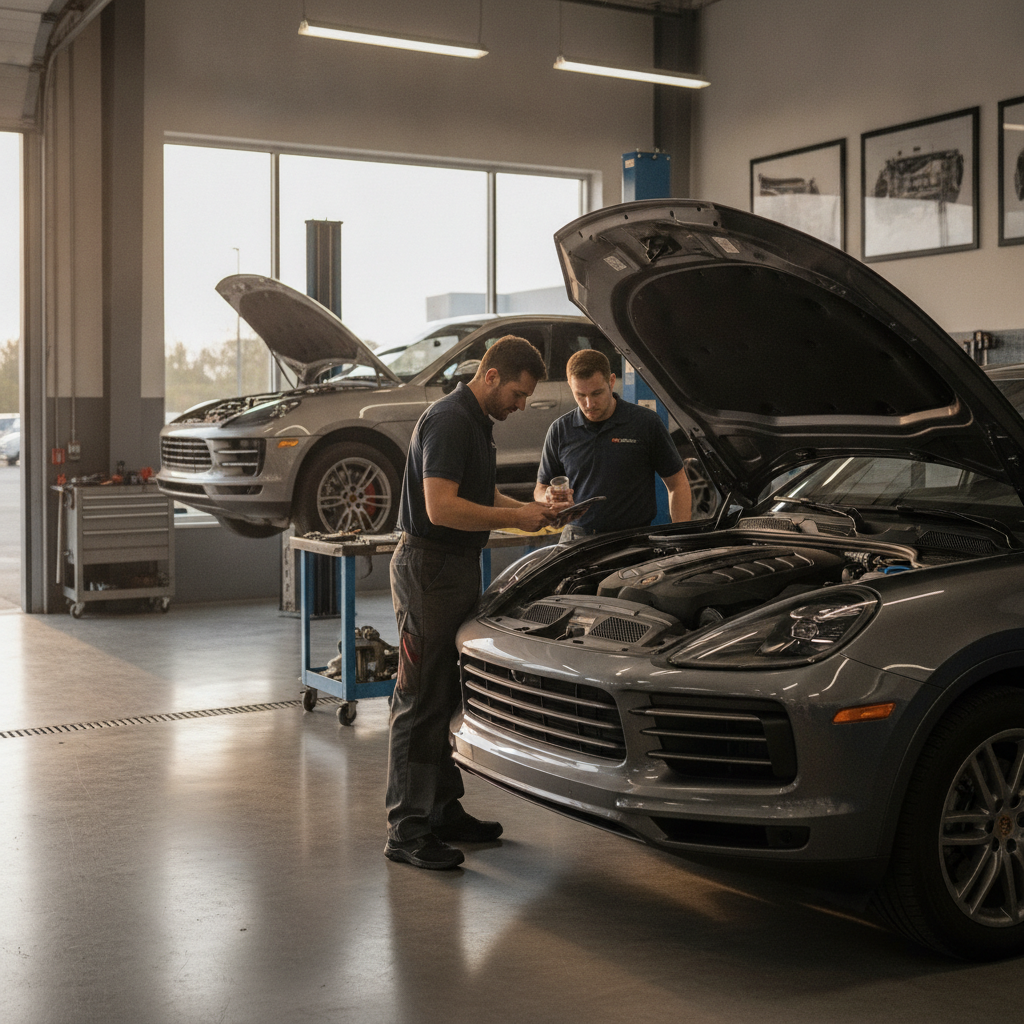
What’s needed is a methodical diagnostic process using Porsche-compatible factory tools, live data analysis across multiple systems simultaneously, and a technician who understands how these engines behave when multiple faults are present. That’s the approach at Solo Motor Sports — factory-trained technicians who specialize in Porsche service and know how to separate symptoms from root causes before a single part gets ordered.
When to Bring It In — Don’t Wait for Limp Mode
If your Porsche Cayenne or Macan is showing any of the following, bring it in before the problem escalates:
- Noticeable hesitation or flat spots under acceleration
- Power that builds then drops off at mid or high RPM
- A check engine light accompanied by reduced performance
- Unusual sounds under boost — whistling, whooshing, or a fluttering sensation
- Rough idle or stumbling at low speed in traffic
- Limp mode activation (vehicle limits itself to partial power)
Catching these issues early — before the turbo, fuel pump, or catalytic converters are damaged by the root-cause problem — is almost always significantly less expensive than waiting. A thorough multi-point inspection combined with a full diagnostic scan gives you a clear picture of what’s happening and what it will take to fix it properly.
Frequently Asked Questions
Can I drive my Porsche Cayenne if it’s in limp mode?
Technically yes, but it’s not advisable beyond getting to a safe location or repair shop. Limp mode is the vehicle protecting itself from further damage. Continuing to drive it risks worsening the underlying problem, particularly if it involves boost pressure or fueling issues.
How much does it cost to diagnose power loss on a Porsche SUV?
Diagnostic fees vary, but expect a proper Porsche-level diagnostic to take one to two hours of technician time with factory tools. The investment is worth it — a thorough diagnosis prevents misdiagnosis and unnecessary parts replacements that cost far more. Contact Solo Motor Sports directly for current diagnostic service information.
Is it safe to use aftermarket parts for Porsche Cayenne or Macan repairs?
For turbo, fuel, and ignition components, OEM or OEM-equivalent parts are strongly recommended. Porsche’s tolerances are tight, and off-spec parts — even ones that claim compatibility — can introduce new problems or fail prematurely under the demands of a turbocharged engine.
How often should a Porsche Cayenne or Macan have its spark plugs replaced?
Porsche generally recommends spark plug inspection around 40,000 miles and replacement based on condition, though driving patterns in heavy Atlanta traffic can accelerate wear. If you’re beyond that mileage and haven’t had them inspected, it’s worth adding to your next service.
Can Sandy Springs or Milton Porsche owners bring their vehicle to Solo Motor Sports?
Absolutely. Solo Motor Sports serves owners throughout North Fulton County and the surrounding Atlanta metro area, including Alpharetta, Sandy Springs, Milton, Johns Creek, and Roswell. Most diagnostic appointments can be scheduled promptly without the extended wait times common at dealerships.
Get Your Porsche Diagnosed Right — Without Dealership Pricing
Power loss in a Porsche Cayenne or Macan is a problem that demands precision — both in diagnosis and repair. At Solo Motor Sports in Roswell, our technicians have the factory-level tools, the make-specific knowledge, and the commitment to honest, transparent service that your Porsche deserves. We’ll tell you exactly what’s causing the issue, what it will take to fix it, and what it will cost — before any work begins.
Don’t let a power loss issue turn into a full engine or turbo replacement because it was caught too late or misdiagnosed by a shop without the right expertise. Contact Solo Motor Sports today to schedule your diagnostic appointment. We’re located on Alpharetta Highway in Roswell and serve Porsche owners throughout North Fulton County and the Atlanta metro area.