
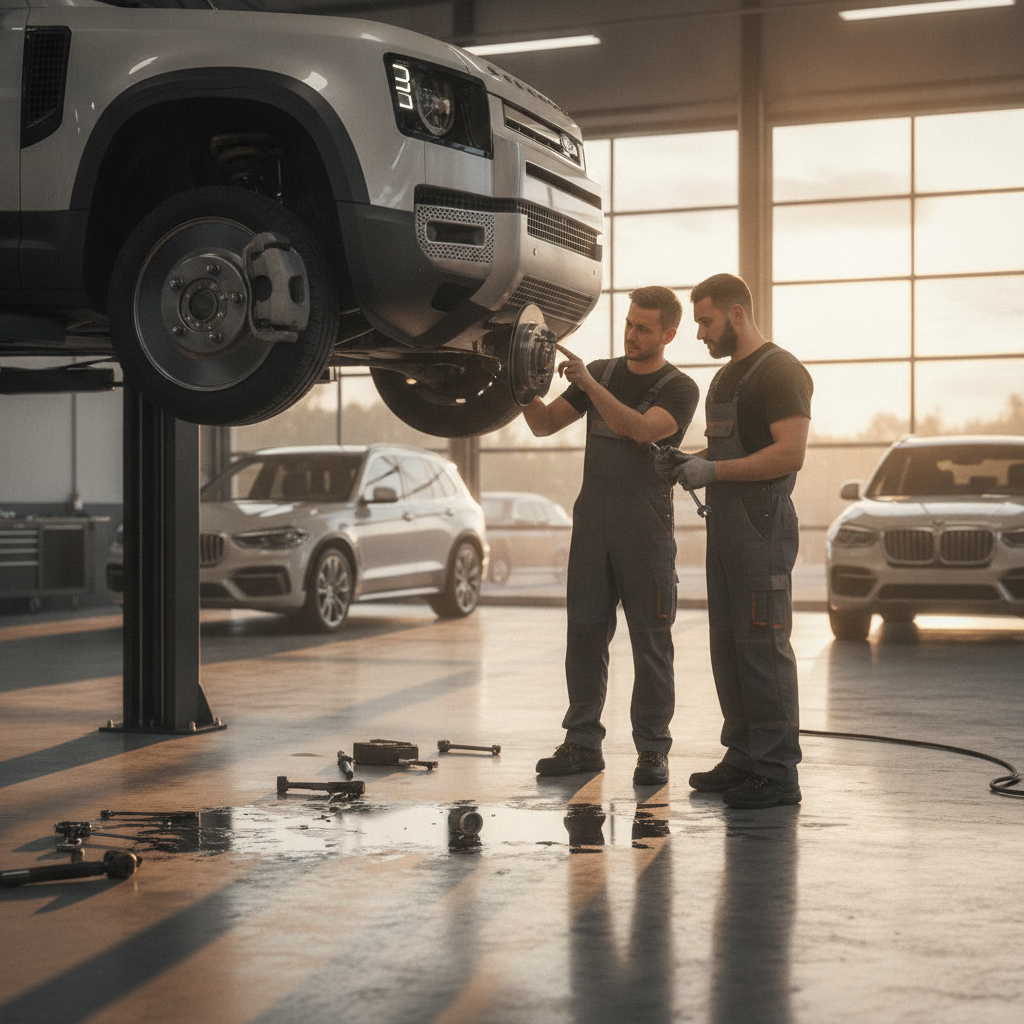
Why Is My Land Rover Discovery Sport or Range Rover Making a Grinding Noise? What Johns Creek Owners Should Know
If your Land Rover has started making a grinding noise — whether it’s during braking, turning, or just cruising down McGinnis Ferry Road on your way to GA-400 — it’s not something to file away as a mystery and revisit later. Grinding almost always means metal contacting something it shouldn’t, and on a vehicle as engineered as a Range Rover or Discovery Sport, that deteriorates quickly. The good news: most of the causes are straightforward to diagnose when you take it to someone who actually knows these trucks. Here’s what the noise likely means, how urgent it is, and where Johns Creek and North Fulton owners can get it properly sorted.
The Most Common Reasons a Land Rover Grinds
Land Rovers — especially the Discovery Sport, Range Rover Sport, and Range Rover Evoque — are sophisticated machines with complex suspension geometry, all-terrain drivetrain systems, and high-performance brake setups. That sophistication means when something goes wrong, it usually shows up as a sound or feel before it turns into a breakdown. A grinding noise typically traces back to one of four areas:
1. Worn Brake Pads Down to the Wear Indicators
This is the most common culprit and the most urgent. Land Rovers use electronic brake wear sensors on most models, but those sensors don’t always fire a warning light before you start hearing metal-on-metal contact. If the grinding happens primarily when you’re slowing down — stop-and-go on Medlock Bridge Road, rolling through a neighborhood, or decelerating on the highway — your brake pads have likely worn past the point where the sensors engage and are now grinding directly against your rotors.
Once you reach that stage, you’re no longer just replacing pads. You’re almost certainly looking at rotors too, and possibly calipers if the damage is severe. Brake service on European vehicles should always use OEM or OEM-equivalent components — aftermarket brake hardware on a Land Rover frequently causes pulsation, noise, and uneven wear that you’ll be chasing for months.
2. Suspension Component Wear
Land Rovers are heavier than most European SUVs, and that weight puts real stress on control arm bushings, ball joints, sway bar links, and wheel bearings. A grinding or growling that changes pitch with your speed — or shifts when you take a sweeping curve — usually points to a wheel bearing. A grinding that happens when turning at low speed in a parking lot is often a ball joint or CV axle beginning to fail.
In North Fulton County, where roads like Old Alabama Road and Haynes Bridge Road have their share of potholes and uneven pavement, suspension wear on older Discovery Sports and Range Rovers is a regular finding on multi-point inspections. If you’ve never had your suspension components inspected and your vehicle has more than 60,000 miles on it, that inspection is overdue.
3. Transfer Case or Differential Issues
This is the one most general repair shops miss, and it’s where Land Rover’s unique engineering separates it from a generic SUV. The Terrain Response system and active driveline components in these vehicles depend on properly maintained transfer case fluid and differential fluid. When those fluids break down — or when a bearing inside the transfer case begins to fail — you can get a grinding or clunking sound that feels like it’s coming from under the middle or rear of the vehicle. It’s often most noticeable when accelerating from a stop or during low-speed maneuvers.
This is a diagnostic problem that requires Land Rover-specific scan tools and a technician who understands how the Terrain Response system interacts with the drivetrain. It’s not something a general shop is equipped to diagnose confidently, and guessing at the fix is expensive on these vehicles.
4. Brake Caliper Sticking or Seized
A caliper that isn’t releasing properly will drag the brake pad against the rotor even when you’re not braking. You might notice the vehicle pulling slightly to one side, the wheel feeling warm after a normal drive, or a grinding that seems present even at highway speeds. Georgia’s heat and humidity — especially the brutal summer months — accelerate brake caliper corrosion on vehicles that sit for extended periods or are driven primarily in stop-and-go Atlanta metro traffic.
Why Land Rover Diagnostic Work Requires Specialist Tools
One of the most important things to understand about Land Rover ownership in the Johns Creek and Alpharetta area is that this isn’t a vehicle you can take to a general shop and expect a thorough diagnosis. The electronic architecture on modern Range Rovers and Discovery Sports — the air suspension control modules, the Terrain Response calibration, the electronic parking brake system — requires factory-level diagnostic software to read accurately. Generic OBD-II scanners give you fragments of the picture at best.
At Solo Motor Sports in Roswell, the team uses dealership-grade diagnostic equipment and has hands-on experience with the full Land Rover lineup. That matters when the difference between a $400 caliper replacement and a $2,000 drivetrain repair comes down to reading the right data and interpreting it correctly. You can learn more about the Land Rover models we service and what that specialist-level work looks like at our Land Rover repair page.
What Competitors in This Area Rarely Talk About: Drivetrain Service Intervals
Here’s a gap that most European repair shops in the Roswell-Alpharetta corridor don’t address clearly in their content or their service recommendations: Land Rovers have specific drivetrain fluid service intervals that most owners — and many shops — overlook entirely. The transfer case fluid, front and rear differential fluid, and haldex coupling fluid (on vehicles so equipped) all have replacement intervals that Land Rover specifies and that matter significantly for long-term reliability.
Skipping these services doesn’t usually cause immediate symptoms. But it accelerates internal wear in components that are extraordinarily expensive to replace. A transfer case rebuild on a Range Rover Sport can run several thousand dollars. Changing the fluid at the right intervals costs a fraction of that. If your Land Rover’s grinding noise is tracing back to drivetrain components and you’ve never had these fluids serviced, you now know why — and what to address going forward.
How Serious Is the Grinding, and How Quickly Do You Need to Act?
If the grinding happens during braking, you should treat it as urgent. Driving on metal-to-metal brakes degrades your rotors every mile and increases your stopping distance, which is a safety issue — not just a cost issue. Milton and Sandy Springs residents who commute regularly through GA-400 traffic know how quickly braking situations appear at highway speeds. Don’t put this off.
If the grinding is speed-dependent and doesn’t change with braking, a wheel bearing or drivetrain component is more likely. These can sometimes be driven on for a short period, but bearing failures can progress to sudden wheel lockup in severe cases. A same-day diagnostic appointment is the right call.
If the grinding is intermittent, shows up when turning, or you can’t clearly isolate when it occurs — bring it in for a full multi-point inspection. Intermittent noises on complex vehicles like Land Rovers are almost always easier and cheaper to address before they become consistent ones.
Frequently Asked Questions
How much does it cost to fix a grinding noise on a Land Rover?
It depends heavily on the cause. Brake pad and rotor replacement is a straightforward service. Wheel bearings are a moderate repair. Transfer case or differential work can be significantly more involved. A proper diagnostic is the first step — and at Solo Motor Sports, we give you a clear, honest estimate before any work begins.
Can I drive my Range Rover if it’s grinding when I brake?
You should not drive it beyond what’s necessary to get it to a shop. Metal-on-rotor contact means your braking performance is already compromised. The longer you drive it, the more components are damaged and the higher the repair cost.
Does Solo Motor Sports service Land Rovers from Johns Creek and Alpharetta?
Yes. We serve the entire North Fulton County area, including Johns Creek, Alpharetta, Milton, and Sandy Springs. Many of our Land Rover customers make the short drive to our Roswell location specifically because they want specialist expertise without dealership pricing.
Is a grinding noise always the brakes on a Land Rover?
Not always. Wheel bearings, CV axles, transfer case components, and even worn suspension bushings can all produce grinding or growling sounds. The location of the noise, when it occurs, and whether it changes with speed or braking are all diagnostic clues that a trained technician will evaluate.
How often should Land Rover drivetrain fluids be serviced?
Intervals vary by model and generation, but transfer case and differential fluids on most modern Land Rovers are typically recommended every 30,000 to 60,000 miles — sometimes sooner under severe use conditions like frequent towing or off-road driving. Check your owner’s manual and ask your technician to confirm what’s appropriate for your specific vehicle.
Get Your Land Rover Properly Diagnosed in Roswell
Grinding noises on a Land Rover don’t resolve themselves, and they don’t get cheaper with time. If you’re in Johns Creek, Alpharetta, Milton, or anywhere across North Fulton County, Solo Motor Sports is the specialist shop that gives your vehicle the same level of attention and equipment it would get at a dealership — without the dealership markup or the upsell pressure. Our ASE-certified, factory-trained technicians know these vehicles, use the right diagnostic tools, and explain exactly what they find before they do anything.
Schedule your appointment or reach out with questions at our contact page. We’ll get your Land Rover back to where it belongs.