
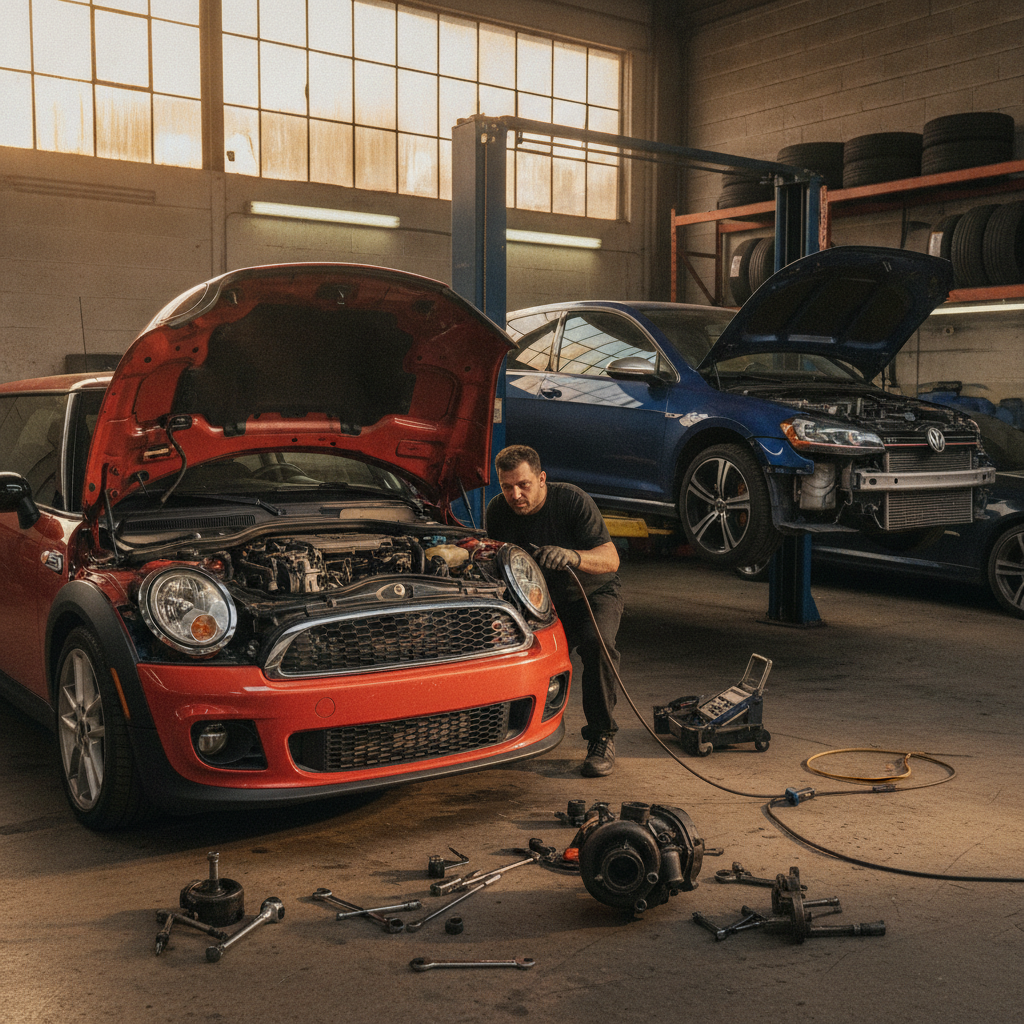
Why Is My Mini Cooper or Volkswagen’s Engine Losing Power on the Highway? What Roswell Owners Should Know About Turbocharger Failure and Boost Pressure Loss
If your Mini Cooper or Volkswagen suddenly feels like it’s running on half its cylinders — especially when you’re merging onto GA-400 or climbing a grade on the way back from Alpharetta — a failing turbocharger or boost leak is one of the most likely causes. Both Mini and Volkswagen rely heavily on small-displacement turbocharged engines to deliver their performance character. When that forced induction system starts breaking down, you lose power fast, and if you ignore it, you can end up with a much bigger engine repair bill than you bargained for.
At Solo Motor Sports in Roswell, we see turbocharged Mini Coopers and Volkswagens regularly — and turbo-related power loss is one of the more misdiagnosed problems on these vehicles, especially when owners take them to general repair shops that aren’t fluent in European forced induction systems. Here’s what’s actually happening under the hood, what to watch for, and why getting a proper diagnosis matters more than most people realize.
How Turbochargers Work — and Why European Turbos Are Different
A turbocharger forces compressed air into your engine’s combustion chambers, allowing a smaller engine to produce the power of a much larger one. Mini Coopers use turbocharged four-cylinder engines in virtually every trim — even the base Cooper S and the John Cooper Works models. Volkswagen’s lineup, from the Golf GTI to the Tiguan to the Passat, is built almost entirely around their turbocharged EA888 and EA211 engine families.
These aren’t the simple bolt-on turbos you find on older vehicles. Modern European turbo systems integrate tightly with the engine management software, intercooler routing, blow-off valves, and electronically controlled wastegates. When one component in that chain fails or develops a leak, the car’s ECU may try to compensate — which is why power loss on these vehicles can be gradual and easy to dismiss as a “quirk” rather than a real problem.
The Most Common Causes of Turbo Power Loss in Mini Coopers and Volkswagens
Not every case of sluggish acceleration means the turbocharger itself is destroyed. In fact, the majority of boost-related power loss we diagnose at our Roswell shop comes down to a handful of specific failure points:
- Boost leaks from intercooler pipes and couplers: On Mini Coopers especially, the rubber couplers connecting the intercooler to the intake plumbing are known to split or pull loose over time. Georgia’s heat cycles accelerate this. When a coupler fails, pressurized air escapes before it reaches the engine, and power drops sharply.
- Failing or stuck wastegate: The wastegate controls how much exhaust pressure drives the turbo. If it sticks open, the turbo never builds full boost. If it sticks closed, you risk overboosting. Both conditions trigger fault codes and power reduction modes.
- Worn turbocharger bearings: Oil-contaminated or oil-starved turbos develop bearing wear over time. You may hear a faint whine or notice blue smoke from the exhaust before the turbo shaft fails completely. At that stage, the turbo needs replacement — and often the oil feed line and return line need inspection as well.
- Clogged or damaged intercooler: The intercooler cools compressed air before it enters the engine. If it’s clogged with oil residue (common on higher-mileage turbocharged VWs) or damaged, intake temperatures rise and the engine management system pulls back power to protect itself.
- PCV (crankcase ventilation) system failure: On Volkswagen’s EA888 engines, a failing PCV system creates excessive crankcase pressure that can push oil into the intake, coat the intercooler, and cause turbo oil seal failure. This is a frequently overlooked root cause — and one that most general shops miss entirely.
What the Symptoms Actually Feel Like
Turbo-related power loss has a specific character that’s worth knowing. You’ll often notice that acceleration feels normal at low RPM around town — it’s only under full throttle, at highway speed, or during sustained high-load driving that the weakness becomes obvious. Some owners describe it as the car “running out of steam” above 3,000 RPM, or a flat spot where the power used to surge but now just plateaus.
In more advanced cases, you may see a check engine light with boost pressure or charge pressure fault codes. On VW models, the ECU may put the car into a reduced power or “limp mode” to prevent further damage. If you’re driving between Sandy Springs and Johns Creek on the expressway and the car suddenly feels like it’s fighting you, don’t just hope it goes away.
Why This Is One of the Most Misdiagnosed Problems at General Shops
Here’s where we see owners get burned: they take a turbocharged Mini or VW to a shop that isn’t fluent in European forced induction systems. The fault codes might point to a boost pressure issue, but the technician replaces the blow-off valve or clears the codes without doing a physical boost leak test. The car feels fine for a few days, the problem comes back, and now money’s been wasted without solving anything.
Proper diagnosis of turbo power loss on a Mini Cooper or Volkswagen requires a pressurized smoke test of the entire intake and boost system, a live data pull from the engine management system showing actual versus requested boost, and a physical inspection of the turbo shaft for play and oil contamination. Our Mini Cooper service and Volkswagen diagnostics at Solo Motor Sports use factory-level diagnostic tools — the same depth of data access that dealerships use, without the dealership markup.
Oil Quality Is Not Optional on a Turbocharged Engine
This is the section that most competitor shops in the Roswell and Alpharetta area gloss over, and it’s one of the most important things you can take away from this article. Turbochargers spin at speeds between 100,000 and 250,000 RPM. The only thing keeping the shaft from destroying itself is a continuous film of clean, high-quality engine oil.
When oil change intervals are stretched — or when the wrong viscosity oil is used — that protective film breaks down. North Fulton County’s summer heat makes this worse: high ambient temperatures stress the oil further, and stop-and-go traffic on surface roads means the turbo goes through more heat cycles per mile than highway driving would produce.
If you own a turbocharged Mini Cooper or Volkswagen, you should be using the manufacturer-specified oil grade and changing it on a schedule appropriate for your actual driving conditions — not just the maximum interval printed in the owner’s manual. In our experience, owners who maintain proper oil service intervals rarely face full turbocharger replacement. Those who don’t are often looking at a much more significant engine repair after a turbo shaft failure sends debris downstream.
Turbo Repair or Replacement: What to Expect
The cost and timeline for turbo-related repairs varies depending on what’s actually failed. A boost leak from a split coupler is a relatively straightforward fix. A full turbocharger replacement on a Mini Cooper JCW or a VW GTI involves more labor, and the repair should always include inspection and replacement of the oil feed and return lines to prevent the new turbo from being starved or contaminated immediately.
We always use OEM-specification or genuine parts for turbocharger work. Aftermarket turbos vary widely in quality, and a failed aftermarket unit can cause collateral engine damage that far outweighs any upfront savings. All of our turbo and boost system repairs are backed by a warranty, and we’re transparent about what the diagnosis reveals before any work begins.
Frequently Asked Questions: Mini Cooper and VW Turbo Failure in Roswell
How do I know if I have a boost leak versus a bad turbo?
A smoke or pressure test of the boost system is the most reliable way to tell. Boost leaks often produce a hissing sound under acceleration and may not trigger a check engine light immediately. A failing turbo typically produces bearing noise (whine or chirp), blue exhaust smoke, or oil consumption alongside the power loss. A proper diagnosis will distinguish between the two before any parts are ordered.
Can I keep driving my Mini or VW if the turbo is failing?
We strongly recommend against it. A worn turbo bearing can fail suddenly, and if the shaft disintegrates, metal debris can enter the engine’s oil system and intake — turning a turbo replacement into a full engine rebuild. If you’re experiencing persistent power loss or hearing unusual noises, get it diagnosed promptly.
Does turbocharger failure affect my Mini Cooper’s warranty?
If your vehicle is still under a manufacturer’s warranty, turbocharger repairs may be covered. If it’s out of warranty, a qualified independent specialist like Solo Motor Sports can perform the repair without affecting any existing extended warranty coverage, as long as we use appropriate parts and documentation.
How often should I change oil on a turbocharged Mini or VW?
Mini Cooper recommends oil changes approximately every 10,000 miles under their condition-based service system, but for turbocharged engines driven in stop-and-go conditions — which describes most driving in Roswell and North Fulton County — we typically recommend not exceeding 7,500 miles between changes and using the manufacturer-specified full synthetic oil grade.
Do you service both Mini Coopers and Volkswagens at Solo Motor Sports?
Yes. We specialize in European and import vehicles across a broad range of makes. Whether you’re driving a Mini Cooper S, a Golf GTI, a Tiguan, or a Jetta GLI, our technicians have the factory-level diagnostic tools and hands-on experience with these turbocharged platforms to get the diagnosis right the first time.
Get a Proper Turbo Diagnosis in Roswell — Not a Parts-Swap Guess
If your Mini Cooper or Volkswagen is losing power on the highway, don’t settle for a shop that clears a code and sends you on your way. Turbo system failures on these vehicles follow a pattern, and catching them at the boost leak or wastegate stage costs a fraction of what a full turbocharger replacement does — and far less than engine damage from a failed shaft.
Solo Motor Sports serves owners throughout Roswell, Alpharetta, Sandy Springs, Johns Creek, and across North Fulton County who want dealership-level expertise without the dealership experience. Our technicians know these platforms, use the right tools, and give you a clear picture of what’s wrong and what it will take to fix it — before any work begins.
Contact us today to schedule a diagnostic appointment and get your Mini Cooper or Volkswagen running the way it was built to.