
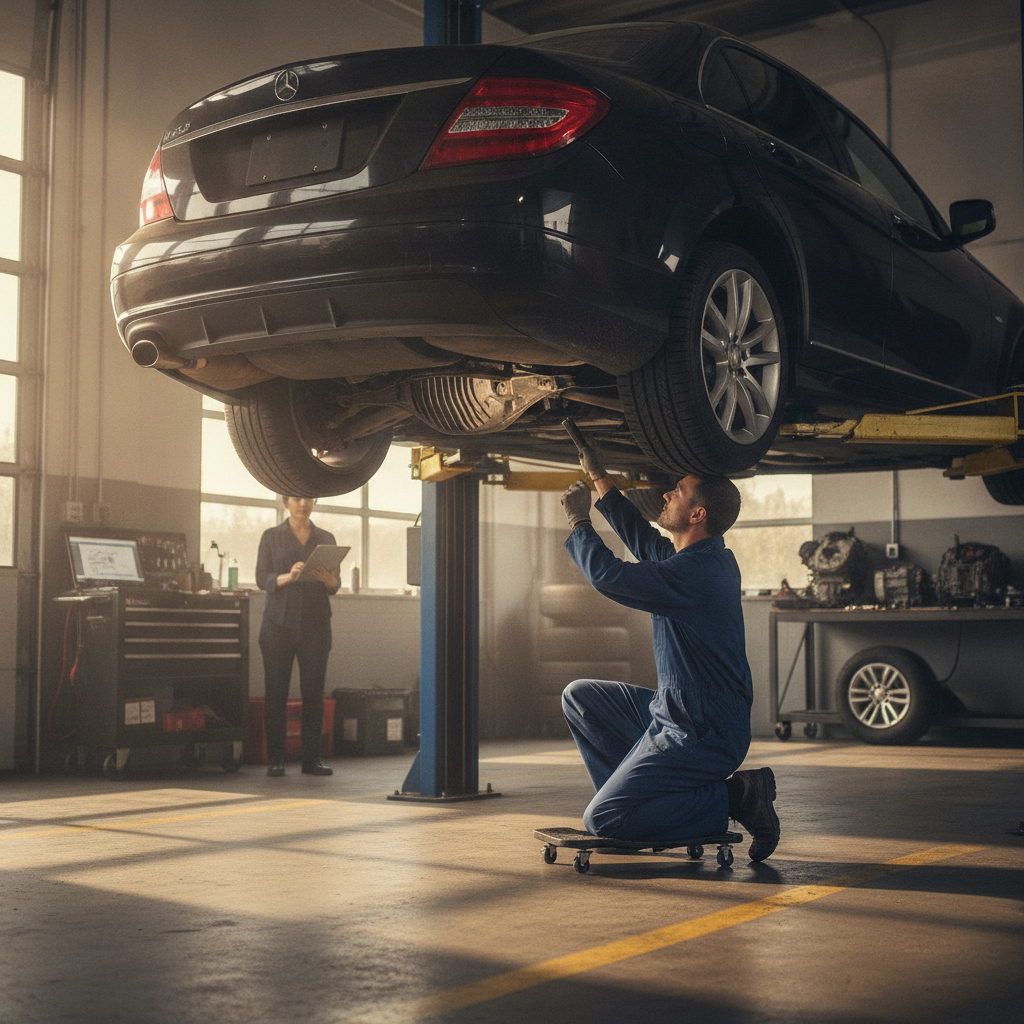
Why Is My Mercedes or BMW’s Differential Making a Whining Noise? What Roswell Owners Should Know About Rear Differential Failure
That high-pitched whine or low, cyclic howl coming from the rear of your BMW or Mercedes isn’t something you can drive through and hope it resolves on its own. In most cases, it’s your rear differential telling you it’s in trouble — and in Roswell, where highway commuting on GA-400 and stop-and-go surface roads put real stress on drivetrain components, ignoring it tends to get expensive fast. The good news is that when caught early, rear differential problems in European vehicles are very often serviceable without a full replacement. Here’s what’s actually happening inside that housing, why it matters specifically for your make, and what you should do next.
What the Rear Differential Actually Does — and Why BMW and Mercedes Units Are Different
Your rear differential sits between the two rear wheels and distributes power from the driveshaft while allowing each wheel to rotate at slightly different speeds — critical when cornering. On most rear-wheel-drive BMW 3, 5, and 7 Series models and rear-drive Mercedes C, E, and S-Class variants, the differential is a precision-machined unit containing ring and pinion gears, carrier bearings, and in many cases a limited-slip or electronically controlled locking mechanism.
BMW’s xDrive and Mercedes’s 4MATIC systems add a front differential and center transfer case into the equation, but the rear differential remains the highest-stress component in the drivetrain chain. These aren’t the simple open diffs you find on domestic trucks. BMW’s Active Limited Slip Differential (ALSD) and Mercedes’s rear differential units are built with significantly tighter tolerances, require specific fluid viscosities, and are sensitive to contamination and neglect in ways that generic shop technicians often underestimate.
What That Whining Noise Is Actually Telling You
The type and timing of the noise matters. Understanding it helps you describe the problem accurately and gives your technician a diagnostic head start.
- Whine that increases with vehicle speed: Usually points to worn ring and pinion gear teeth. The noise will rise and fall with road speed rather than engine RPM.
- Howling on acceleration only: Often indicates incorrect gear backlash — the spacing between the ring and pinion gears has drifted out of specification, either from wear or from a previous improper repair.
- Whine or rumble when coasting, not accelerating: Carrier bearings or pinion bearings are the most likely culprit. These are the bearings that support the gear assembly inside the differential housing.
- Clunking or thudding when pulling away from a stop: This is a different problem — typically worn differential mounts or a failing limited-slip clutch pack — but it can accompany bearing noise as the unit deteriorates.
- Grinding that gets worse on turns: In limited-slip differentials, this can indicate a worn spider gear or side gear inside the carrier. In an open differential, it’s more likely a bearing that’s progressed beyond early-stage wear.
If you’re noticing any combination of these symptoms, the differential is already in distress. Driving on it — especially through Atlanta metro traffic with its constant acceleration and deceleration cycles — accelerates the damage and dramatically narrows your repair options.
The Most Common Cause That Gets Overlooked: Differential Fluid Service
Here’s what most general repair shops and many dealership service writers don’t emphasize enough: rear differential fluid is a wear item, and skipping its service interval is the single most preventable cause of premature differential failure in BMW and Mercedes vehicles.
BMW specifies differential fluid changes on most rear-drive models at 30,000 to 50,000 miles depending on driving conditions — but lists it as a “lifetime fill” in some owner’s manuals, which leads owners to assume it never needs attention. In practice, Georgia’s heat and the thermal cycling from stop-and-go traffic on roads like Holcomb Bridge Road or the Alpharetta Highway corridor break down differential fluid faster than factory estimates account for. Once the fluid loses its viscosity and protective additives, metal-on-metal contact between the ring and pinion gears begins, and fine metallic particles contaminate the remaining fluid, compounding the damage.
Mercedes models — including AMG variants with their higher torque loads — face the same issue. The fluid in a heavily driven E53 AMG or a C43 doing regular GA-400 commutes should be inspected by 40,000 miles, regardless of what the owner’s manual suggests.
A differential fluid service at Solo Motor Sports uses the correct OEM-specified lubricant for your exact vehicle — not a generic gear oil. For limited-slip differentials, a friction modifier additive is required; using standard gear oil in an LSD causes chatter and accelerates clutch pack wear. This is a detail that matters and one that generic shops frequently miss.
Why This Repair Demands a European Specialist — Not a General Shop
Rear differential repair is one of those jobs where the gap between a proper repair and an improper one is almost invisible until it isn’t. Setting ring and pinion backlash requires specialized measuring tools and a technician who understands the specific tolerances BMW and Mercedes engineering calls for. Install the gears without verifying backlash and contact pattern, and the new unit will whine louder than the old one within a few thousand miles.
For BMW xDrive models and Mercedes 4MATIC vehicles, there’s an additional layer of complexity: the rear differential communicates with the ABS, DSC, and all-wheel-drive management systems. A replacement or rebuild that doesn’t account for the electronic integration can trigger warning lights or cause the AWD system to behave erratically — problems that only surface later and are difficult to trace back to the original repair.
At Solo Motor Sports in Roswell, our technicians work specifically on European and import vehicles. Mercedes repair and BMW-specific drivetrain work is what we do every day — not something we fit between oil changes on domestic trucks. That specialization makes a real difference when you’re dealing with a precision component like the rear differential.
What to Expect From a Differential Diagnosis and Repair
When you bring a BMW or Mercedes in for a differential noise concern, the diagnostic process should include a road test to characterize the noise, a fluid inspection (checking for metallic contamination and viscosity breakdown), and a physical inspection of the differential mounts and associated driveshaft components. In many cases, a borescope or drain-and-inspect procedure will reveal the extent of internal wear without requiring a full teardown.
If the fluid is contaminated but the gears and bearings show minimal wear, a fluid flush and refill with the correct OEM specification lubricant may resolve or significantly reduce the noise. If bearing wear is confirmed, bearing replacement is the next step — far less expensive than replacing the entire differential unit. Full ring and pinion replacement or a differential rebuild is reserved for cases where gear wear is significant or where the unit has been run to the point of metal contamination throughout.
Owners in Sandy Springs, Johns Creek, and Milton often ask whether the dealership is necessary for this type of repair. It isn’t. Solo Motor Sports uses factory-level diagnostic equipment and OEM or OEM-equivalent parts, with warranty-backed repairs — without the dealership’s service department overhead and pricing structure.
Frequently Asked Questions
How do I know if the noise is my differential or my wheel bearings?
Both can produce a whining or humming noise that increases with speed, but wheel bearing noise typically changes when you shift your weight during a lane change — it gets louder on one side and quieter on the other as load transfers. Differential noise tends to stay consistent regardless of steering input but changes with acceleration and deceleration. A proper road test and inspection will confirm which component is involved.
Can I keep driving my BMW or Mercedes if the differential is whining?
It depends on how advanced the wear is. Early-stage whining from degraded fluid may give you some time if you act quickly. If the noise is accompanied by clunking, vibration, or metal flakes in the fluid, continued driving risks catastrophic gear failure — which can lock up a rear wheel at speed. The safest answer is to get it inspected promptly rather than wait.
How often should I service my BMW or Mercedes rear differential fluid?
Every 30,000 to 50,000 miles is a reasonable interval for most driving conditions in the Atlanta metro area, regardless of what the owner’s manual says about “lifetime” fluid. Heat cycles from North Fulton County commuting and highway driving degrade fluid faster than laboratory testing conditions reflect. If you’ve never had it serviced and have more than 60,000 miles on the odometer, have it inspected now.
Is a rear differential replacement as expensive as it sounds?
It can be — which is exactly why early diagnosis matters. A differential fluid service is a relatively modest maintenance item. Bearing replacement is a moderate repair. A full differential replacement on a BMW M or Mercedes AMG model is significantly more expensive. Catching the problem at the fluid or bearing stage is almost always far more cost-effective than waiting until the gears are damaged.
Do you service differentials on AWD BMWs and 4MATIC Mercedes models?
Yes. xDrive and 4MATIC differentials require the same attention to fluid condition and bearing health as rear-drive units, plus proper integration with the AWD management electronics. We service all configurations, including performance variants with limited-slip and torque-vectoring differentials.
Schedule a Differential Inspection at Solo Motor Sports
If you’re hearing a whine, hum, or howl from the rear of your BMW or Mercedes, don’t wait for it to escalate. A differential that’s caught early is almost always a manageable repair. One that’s been driven to failure often isn’t. Solo Motor Sports serves Roswell, Alpharetta, Sandy Springs, Johns Creek, Milton, and the surrounding North Fulton County area with the kind of European drivetrain expertise that genuinely makes a difference in how these repairs turn out.
Contact us to schedule a diagnostic appointment or request a free consultation. We’ll tell you exactly what we’re seeing, what it will take to fix it, and what it will cost — before any work begins.