
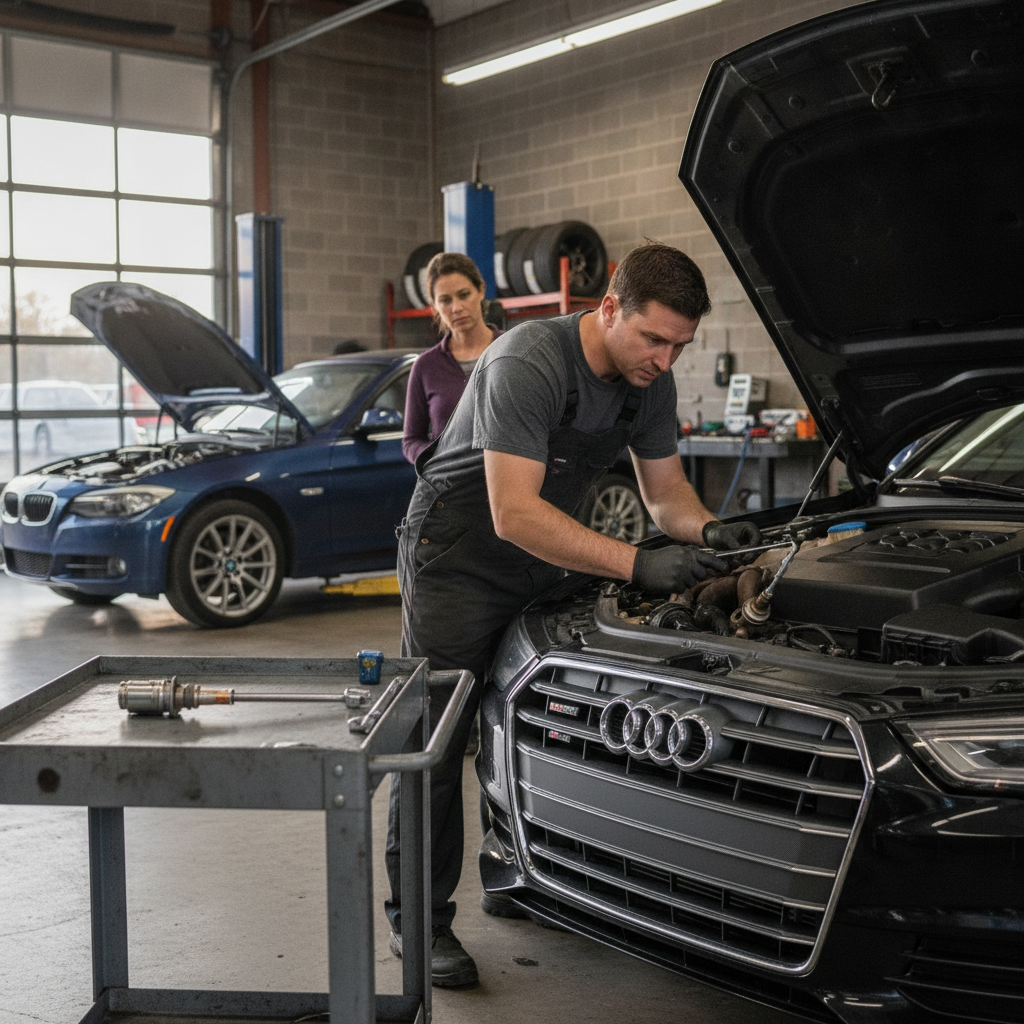
Why Is My Land Rover or BMW’s Oxygen Sensor Failing and What Does It Actually Cost to Fix in Roswell?
If your BMW or Land Rover has a check engine light on and you’ve been told it’s an oxygen sensor, there’s a good chance you’ve already made your first mistake — Googling the code, finding a $40 sensor on an aftermarket site, and wondering if you can just leave it alone. In Roswell and throughout North Fulton County, that’s one of the most common and most costly decisions European vehicle owners make. The short answer: yes, oxygen sensor failure matters, and no, you shouldn’t ignore it. Here’s what’s actually going wrong, what it will cost you, and why getting it diagnosed properly — not just code-cleared — is the only responsible move.
What Does an Oxygen Sensor Actually Do in a European Vehicle?
Your oxygen sensor — sometimes called a lambda sensor — measures how much unburned oxygen is present in your exhaust gases. That information feeds directly into your engine control unit (ECU), which uses it to continuously adjust the fuel-to-air mixture in real time. On most European vehicles, you’ll have at least two sensors per exhaust bank: one upstream (before the catalytic converter) and one downstream (after it). Together, they tell your ECU whether combustion is running rich, lean, or within range — and whether your catalytic converter is doing its job.
On a BMW inline-six or V8, and especially on a Land Rover’s V6 or V8 with twin exhaust banks, that means anywhere from two to four oxygen sensors, each with a specific function in a tightly calibrated system. When one fails, the ECU either defaults to a fixed fueling map or begins compensating in ways that stress other components. Neither outcome is good for your wallet.
The Symptoms Most Roswell Owners Ignore Until It’s Too Late
The frustrating thing about oxygen sensor failure is that your vehicle often keeps driving reasonably well — at least for a while. The symptoms tend to creep in gradually, which is why so many BMW and Land Rover owners in the Alpharetta and Johns Creek area end up living with the problem for months before acting.
- Check engine light (CEL) with a P0130–P0167 or similar code: These are the most common oxygen sensor fault codes across European platforms. The light comes on, you clear it, it comes back. That cycle is your ECU telling you something is genuinely broken.
- Fuel economy dropping noticeably: When the ECU can’t get accurate oxygen readings, it tends to run rich — dumping excess fuel to compensate. If you’re filling up more often than usual on your morning commute up GA-400, a failing O2 sensor is a realistic culprit.
- Rough idle or hesitation under load: Particularly on BMWs with Valvetronic systems or Land Rovers under the strain of stop-and-go Roswell traffic, a degraded sensor signal creates inconsistent combustion that you’ll feel as a stumble or surge.
- Failed emissions test: Georgia’s emissions program tests hydrocarbons and CO — exactly what an oxygen sensor helps regulate. A failed sensor almost always means a failed test.
- Catalytic converter damage: This is the big one. A failing upstream sensor that goes unaddressed long enough will cause your engine to run rich consistently, flooding the catalytic converter with unburned fuel. Catalytic converter replacement on a BMW or Land Rover runs into the thousands. An oxygen sensor replacement does not.
Why European Oxygen Sensor Diagnosis Is More Involved Than You Think
This is the part that most generic repair shops — and most auto parts store code readers — completely miss, and it’s a gap worth addressing directly. Pulling a P0136 code from an OBD-II scanner tells you which sensor circuit is out of range. It does not tell you why.
On a BMW or Land Rover, the root cause of an oxygen sensor fault can be any of the following: an aging sensor that genuinely needs replacement, an exhaust leak upstream of the sensor skewing the reading, a vacuum leak causing the ECU to see a false lean condition, a wiring harness issue (especially common on older Range Rovers and Discovery models), a failing fuel injector that’s disrupting the fuel mixture, or a catalytic converter that’s already degraded and throwing off the downstream sensor reading.
If a shop simply replaces the sensor without diagnosing the underlying cause, you may be back with the same code in six weeks — and you’ll have paid for a sensor you didn’t need. Proper European diagnostics means reading live sensor data streams, checking fuel trim values across multiple operating conditions, and using factory-level scan tools — not a generic $200 Bluetooth reader.
OEM vs. Aftermarket Oxygen Sensors: Why It Matters More on European Vehicles
BMW and Land Rover oxygen sensors are calibrated to very specific voltage and response time parameters. The ECU expects those parameters. Bosch, Denso, and NGK are legitimate OEM-grade suppliers — the same companies that supply the factory. What you find on the cheap end of Amazon or at a chain auto parts counter is often a universal-fit sensor that requires trimming, has looser tolerances, and may trigger the same fault code within months.
The labor cost to replace an oxygen sensor is largely the same regardless of whether you use an OEM-spec part or a budget replacement. Paying the difference for a quality part up front — and having it installed once correctly — is straightforwardly better economics. At Solo Motor Sports, we use genuine or OEM-equivalent parts and back repairs with a warranty, because cutting corners on a North Fulton BMW or Land Rover isn’t something we’re willing to do.
What Does Oxygen Sensor Replacement Actually Cost on a BMW or Land Rover?
Without inventing specific numbers, here’s the realistic framework. The sensor itself varies significantly by vehicle — a basic upstream sensor on a four-cylinder Mini Cooper or Volkswagen is considerably cheaper than a sensor on a BMW N63 V8 or a Land Rover 3.0 supercharged engine, where access requires more disassembly. Labor time depends on sensor location: some are accessible in twenty minutes, others involve removing heat shields or portions of the exhaust system.
What you should understand is that the cost of replacing an oxygen sensor is a fraction of what you’ll spend replacing the catalytic converter it damages when left unaddressed. On a BMW 5 Series or a Range Rover Sport, a single catalytic converter can cost as much as a used car payment. The comparison isn’t even close.
If you’ve been quoted an oxygen sensor repair and the price feels high, the right move is to ask what diagnostic process was used to confirm the sensor is the actual failure — not just the code that was logged. A shop that can answer that question clearly is a shop that knows what they’re doing.
The Sandy Springs and Johns Creek Factor: High-Mileage European Vehicles on Long Commutes
Oxygen sensors have a service life — typically somewhere between 60,000 and 100,000 miles, though that varies significantly by vehicle, fuel quality, and operating conditions. The stop-and-go traffic patterns around Roswell, Sandy Springs, and the GA-400 interchange are particularly hard on exhaust system components because frequent cold starts and low-speed operation prevent sensors from reaching the optimal operating temperature quickly. Over time, that repeated thermal cycling degrades the sensor element.
If your BMW or Land Rover is past the 75,000-mile mark and you haven’t had the oxygen sensors inspected as part of a preventative maintenance check, it’s worth asking. Catching a degrading sensor before it triggers a fault code — and before it starts pulling your fuel trims out of range — is exactly the kind of proactive service that keeps a European vehicle reliable for 150,000 miles and beyond.
Frequently Asked Questions
Can I drive my BMW or Land Rover with a failing oxygen sensor?
Technically yes — your vehicle will likely still run. But you’re burning excess fuel, potentially damaging your catalytic converter, and driving with degraded engine management. The longer you wait, the more expensive the eventual repair becomes. It’s not a crisis, but it’s not something to defer indefinitely either.
Will clearing the check engine light make the oxygen sensor code go away?
Clearing the code removes the light, but the underlying fault remains. On most European vehicles, the code will return within one to three drive cycles if the sensor is genuinely failing. Code-clearing is not a repair.
How many oxygen sensors does my BMW or Land Rover have?
It depends on engine configuration. A four-cylinder BMW typically has two sensors. A V8 Land Rover or BMW with dual exhaust banks can have four. Your service technician can confirm exactly which sensor has failed and whether others are showing signs of degradation.
Is an oxygen sensor the same as an air-fuel ratio sensor?
Not exactly, though they serve related functions. Many newer European vehicles use wideband air-fuel ratio (AFR) sensors upstream rather than traditional narrowband O2 sensors. They’re more expensive and require different diagnostic interpretation. A generic OBD reader often can’t distinguish between the two, which is another reason proper factory-level diagnostics matters on European makes.
Can a bad oxygen sensor cause my Land Rover to fail Georgia emissions testing?
Yes. Georgia emissions testing monitors both tailpipe output and OBD-II system readiness monitors. A failed or incomplete oxygen sensor monitor will cause your vehicle to fail the readiness portion of the test, even if tailpipe emissions appear acceptable.
Get Your BMW or Land Rover Diagnosed by European Specialists in Roswell
At Solo Motor Sports, we specialize in exactly the kind of precision diagnostics that oxygen sensor failures require — not code-reading, but genuine factory-level analysis of fuel trims, live sensor data, and exhaust system integrity. If your check engine light is on, your fuel economy has dropped, or you’ve been told you need an oxygen sensor, we’ll give you a clear, honest answer about what’s actually wrong and what it will take to fix it correctly.
We serve BMW, Land Rover, Audi, Mercedes-Benz, Porsche, Volkswagen, and the full range of European and import vehicles across Roswell, Alpharetta, Sandy Springs, Johns Creek, and North Fulton County — with dealership-level expertise and none of the dealership runaround. Contact us today to schedule a diagnostic appointment or ask us what’s behind that check engine light.