
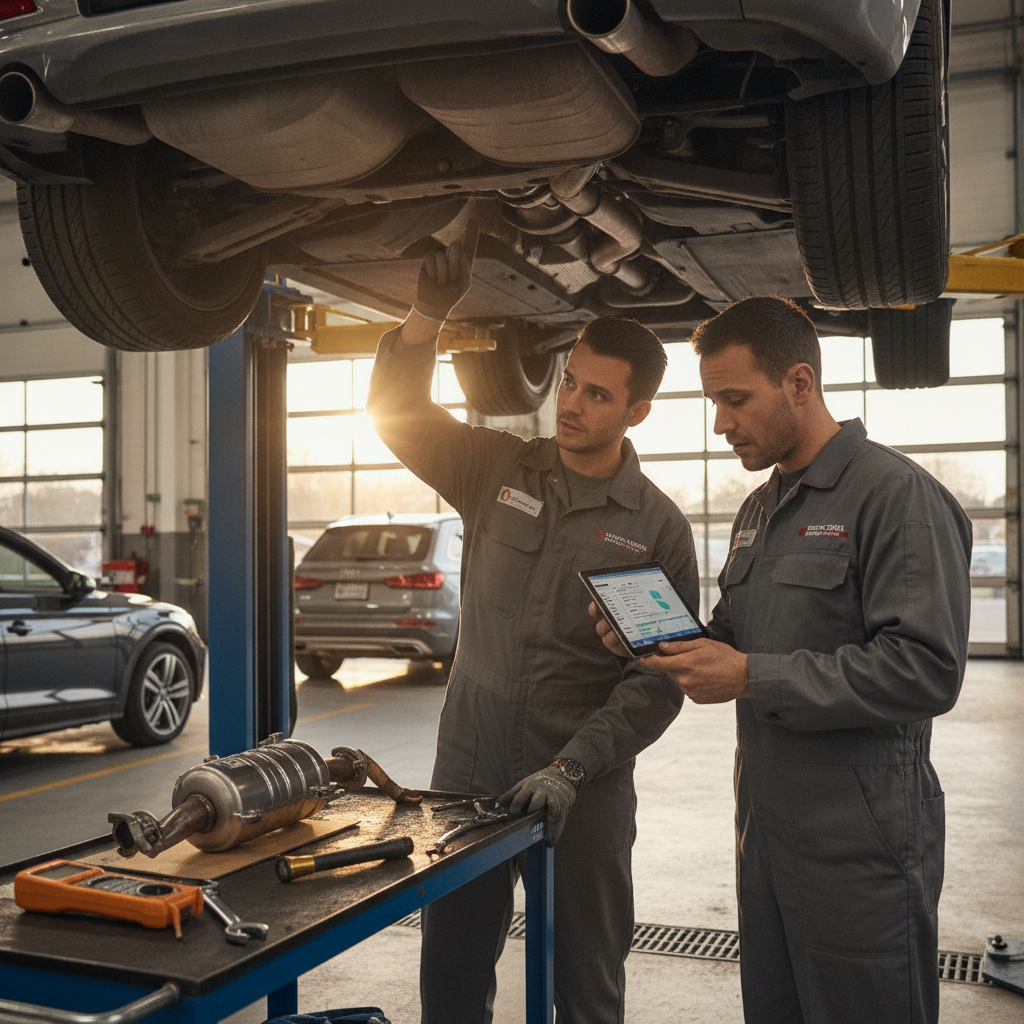
Why Is My BMW or Audi’s Catalytic Converter Failing and What Does It Cost to Replace in Roswell?
If your BMW or Audi has triggered a check engine light with a P0420 or P0430 code, your catalytic converter is likely past its prime — and ignoring it is a mistake that can cost you far more than the converter itself. For drivers in Roswell and across North Fulton County, catalytic converter failure is one of the more misunderstood repairs on European vehicles. It’s not just an emissions issue. A degraded or clogged converter can choke your exhaust flow, rob your engine of power, and in worst-case scenarios, allow unburned fuel to melt the ceramic substrate inside — leading to fragments that get pulled back into the engine. Here’s what’s actually happening, what proper repair looks like, and why the part source and technician you choose matter enormously on a European vehicle.
What a Catalytic Converter Actually Does — and Why European Ones Are Different
Your catalytic converter sits in the exhaust stream and uses a precious-metal-coated ceramic honeycomb — typically platinum, palladium, and rhodium — to chemically convert harmful exhaust gases into carbon dioxide, nitrogen, and water vapor. In a European vehicle like a BMW 5 Series, Audi A6, or Volkswagen Golf GTI, the catalytic converter isn’t a single generic component. Depending on the engine configuration, you may have pre-catalyst units mounted directly on the exhaust manifold (close-coupled cats), downstream main converters, or both — and each plays a distinct role in the emissions and performance system.
BMW’s N52, N54, N55, and S58 engines, Audi’s EA888 turbocharged four-cylinder and their 3.0T V6, and Volkswagen’s TSI engines all have specific catalyst configurations that are calibrated to the vehicle’s engine management system. That calibration matters when it comes time to replace a failed unit, which is why the OEM-versus-aftermarket question is so critical on these vehicles.
The Most Common Warning Signs of Catalytic Converter Failure
Catalytic converter problems don’t always announce themselves with a dramatic symptom. The early stages are often subtle, and the check engine light is frequently the first real signal. Here’s what to watch for:
- Check engine light with P0420 or P0430 codes — these indicate catalyst efficiency below threshold on bank 1 or bank 2
- Sluggish acceleration — a clogged converter restricts exhaust flow, which chokes the engine and kills throttle response
- Rotten egg or sulfur smell from the exhaust — a sign the converter is no longer processing hydrogen sulfide properly
- Rattling noise from underneath the car — especially on cold starts, this can indicate a broken substrate inside the converter housing
- Failed emissions test — Georgia requires emissions testing in metro Atlanta counties, and a failing cat will almost certainly flag the inspection
- Excessive heat under the vehicle — a clogged converter traps heat and can cause underbody components to overheat
The rattling symptom deserves special attention. When the ceramic substrate inside the converter breaks apart — often due to engine misfires sending unburned fuel through the exhaust — you’re past the point of early intervention. Those fragments can be aspirated back into the engine under certain conditions, or they can fully block the exhaust and leave you stranded. At that point you’re dealing with a much more serious repair.
What Causes Catalytic Converters to Fail Prematurely on BMWs and Audis?
Age and mileage are the obvious factors, but premature failure is surprisingly common on European vehicles — and it’s almost always caused by something upstream. The catalytic converter is a casualty, not the root cause. The most frequent culprits include:
- Engine misfires — unburned fuel entering the exhaust stream overheats and destroys the catalyst substrate rapidly
- Oil consumption — BMWs with the N52 or N63 engines are known oil burners; oil in the exhaust coats and poisons the catalyst
- Coolant leaks into combustion — a failing head gasket can send coolant through the exhaust system, contaminating the converter
- Rich-running fuel trims — bad oxygen sensors, failing mass airflow sensors, or fuel injector issues can all cause excess fuel to reach the converter
- Physical damage — road debris, particularly on lowered vehicles or those driven on rough terrain around the Chattahoochee River area back roads, can crack the housing or crack the substrate
This is exactly why diagnostic work must precede any catalytic converter replacement. Installing a new converter without identifying and correcting the root cause will destroy the new part within months. At Solo Motor Sports, every catalytic converter diagnosis starts with a full scan of fuel trims, oxygen sensor data, and combustion health — not just reading the P0420 and ordering a part.
OEM vs. Aftermarket Catalytic Converters: Why It Matters More Than You Think
This is the section that most competitor shops in the Roswell and Alpharetta corridor either skip entirely or gloss over — and it’s the part that costs European vehicle owners the most money in the long run.
Generic aftermarket catalytic converters are widely available and significantly cheaper than OEM units. For a BMW 3 Series or Audi A4, the price difference between an OEM-spec converter and a universal-fit aftermarket unit can be substantial. But here’s what that price difference buys you:
- Precious metal loading — OEM and OEM-equivalent converters use precise ratios of platinum, palladium, and rhodium matched to the engine’s combustion profile. Cheap aftermarket units often use lower concentrations, which means reduced efficiency from day one.
- Substrate cell density — the ceramic honeycomb inside a quality converter has a specific cell-per-square-inch rating engineered for the exhaust flow characteristics of your engine. Generic units often don’t match, leading to performance loss and recurring fault codes.
- Software calibration — many modern BMW and Audi models have oxygen sensor monitoring strategies that are calibrated to expect specific catalyst response times and efficiency curves. A substandard converter may trigger a P0420 code even when brand-new because it doesn’t meet the software’s learned thresholds.
For Johns Creek and Sandy Springs owners driving newer BMW 5 Series, Audi A7, or Porsche Macan vehicles, using an OEM or OEM-equivalent catalytic converter isn’t optional — it’s the difference between a repair that lasts and one that comes back in 18 months with the same fault code.
What Catalytic Converter Replacement Actually Involves on a European Vehicle
On many European vehicles, catalytic converter replacement is not a simple bolt-off, bolt-on job. Depending on the platform, the repair can involve:
- Removing the exhaust manifold or turbocharger heat shield to access pre-catalyst units
- Cutting and re-welding exhaust flanges on older vehicles where hardware has seized
- Replacing oxygen sensors at the same time (sensors that have been monitoring a failed converter are often compromised)
- Clearing adaptive fuel trim data and performing a drive cycle to allow the engine management system to relearn
- Verifying that the root cause — misfire, oil consumption, fuel trim fault — has been fully corrected before sign-off
This is precisely why the labor rate and technician experience matter as much as the part itself. A factory-trained technician working on BMW platforms or Audi vehicles knows the documented failure patterns, the hardware that seizes on high-mileage examples, and the post-repair verification steps that prevent a comeback.
Georgia Emissions Testing and Your Catalytic Converter
Fulton County — including Roswell, Alpharetta, and Sandy Springs — is within Georgia’s enhanced emissions testing area. If your BMW or Audi has a failing catalytic converter, you will not pass the OBD-II portion of the test. Georgia’s emissions program checks for active fault codes and readiness monitors, and a P0420 or P0430 will fail you outright. Beyond the test itself, a vehicle with a clogged or degraded converter that’s been driven for an extended period may need additional time after repair to complete all readiness monitors before re-testing — something worth understanding before you schedule your emissions appointment.
Frequently Asked Questions
How long does catalytic converter replacement take on a BMW or Audi?
For most European vehicles, the labor time ranges from two to five hours depending on the engine configuration and the accessibility of the converter. Pre-catalyst units on turbocharged engines — common on Audi’s 2.0T and BMW’s N55 — typically take longer to access. Same-day turnaround is often achievable when parts are pre-ordered.
Can I drive my BMW or Audi with a failing catalytic converter?
Short distances, yes — but it’s not advisable for any extended period. A partially clogged converter will progressively reduce power and fuel economy. A fully clogged one can cause the engine to overheat internally and leave you stranded. If you’re hearing rattling from the exhaust, stop driving and have it inspected immediately.
Will a cheap aftermarket catalytic converter clear my P0420 code for good?
Possibly not. Many European vehicle owners replace their converter with a universal aftermarket unit and find the P0420 code returns within weeks or months. The oxygen sensor monitoring strategy on modern BMWs and Audis is precise enough to detect substandard converters. OEM-spec parts are strongly recommended to avoid repeat repairs.
Does Solo Motor Sports handle catalytic converter theft repairs?
Yes. Catalytic converter theft has become increasingly common across the Atlanta metro area, including in North Fulton County. If your vehicle’s converter has been stolen, we can source OEM-equivalent replacement units, repair the surrounding exhaust components, and get you back on the road with proper parts and documentation for your insurance claim.
What’s the difference between the pre-catalyst and main catalyst on my BMW?
The pre-catalyst (also called the close-coupled catalyst or manifold catalyst) sits very close to the engine and reaches operating temperature quickly to handle emissions during cold start. The main catalyst handles steady-state operation. Both can fail, and both can trigger a P0420 or P0430 code. Proper diagnosis with live oxygen sensor data tells us which unit — or both — needs replacement.
Get Your Catalytic Converter Diagnosed Right the First Time
If your BMW, Audi, Mercedes, Volkswagen, or any other European vehicle is showing signs of catalytic converter failure, the worst thing you can do is throw a cheap part at it and hope the light stays off. The right repair starts with understanding what failed, why it failed, and what it takes to fix it properly with parts your vehicle’s engine management system will actually accept.
Solo Motor Sports serves Roswell, Alpharetta, Johns Creek, Sandy Springs, and the surrounding North Fulton area with ASE-certified, factory-trained technicians and dealership-level diagnostic equipment — without the dealership markup or the impersonal service experience. Contact us today to schedule your diagnostic appointment and find out exactly what your vehicle needs before committing to any repair.