
Why Is My Porsche or Mercedes Clutch Slipping and Hard to Engage? What Roswell Owners Should Know About European Clutch System Failure
If the clutch in your Porsche or Mercedes feels like it’s slipping under acceleration, engaging too high in the pedal travel, or has suddenly become stiff and unresponsive, you’re dealing with a drivetrain problem that only gets worse the longer you wait. For Roswell owners who drive a manual Porsche 911 or Boxster, a Mercedes with a sport manual, or one of the many performance coupes that run through North Fulton County every day, clutch failure is one of the most disruptive repairs you can face — and also one of the most misunderstood. Here’s what’s actually happening inside your drivetrain, what the warning signs mean, and how to handle it without walking into a dealership and handing over a blank check.
What “Clutch Slipping” Actually Means in a European Performance Vehicle
Clutch slip happens when the friction disc can no longer maintain a solid, locked connection between the engine and transmission. Instead of transferring power cleanly, it starts to slide — and you feel it as the engine revving higher than expected without a matching surge in acceleration. It’s most obvious during hard pulls from a stop or when overtaking on the highway. In a Porsche 911 or Cayman with a high-torque flat-six, that feeling is unmistakable. In a Mercedes C63 AMG or SL with a sport manual, it shows up at exactly the wrong moment.
Clutch slip is almost always caused by one of three things: a worn friction disc that’s simply past its service life, oil contamination on the clutch surfaces (usually from a rear main seal or transmission input shaft seal leak), or a pressure plate that has weakened and is no longer clamping the disc firmly against the flywheel. Each of those has a different repair path, and diagnosing which one is the problem correctly the first time matters — because if you replace a clutch without addressing an oil leak, you’ll be back doing the same job again in short order.
The Dual-Mass Flywheel Factor: What Most General Shops Miss
This is where European clutch service diverges sharply from what you’d find at a generalist shop. Most modern Porsche and Mercedes drivetrains use a dual-mass flywheel (DMF) — a sophisticated component that absorbs drivetrain vibration and smooths torque delivery in a way that a traditional solid flywheel cannot. When the clutch wears out, the dual-mass flywheel often needs to be replaced at the same time. Many shops either don’t know this, don’t check it, or try to skip it to lower the estimate.
The problem is that a dual-mass flywheel that’s past its service life will shudder on engagement, produce a rattling noise at idle, and dramatically shorten the life of a brand-new clutch disc. If a shop installs a clutch without evaluating the flywheel’s condition — testing for rotational play, measuring wear, checking the spring dampener for fatigue — you’re taking a real risk. At Solo Motor Sports, every clutch job includes a thorough evaluation of the flywheel, the throw-out bearing, and the clutch hydraulic system before anything is quoted or ordered.
Clutch Hydraulics: The Component Nobody Talks About
Porsche and Mercedes clutch systems are hydraulically operated, which means a master cylinder and slave cylinder (often a concentric slave cylinder mounted inside the bell housing) are what translate your foot pressure into clutch engagement. When those components wear or develop internal leaks, the clutch can feel spongy, inconsistent, or require significantly more pedal effort than it used to.
A clutch pedal that’s hard to push, slow to return, or feels like it has a “dead zone” at the top or bottom of its travel is often pointing at a hydraulic problem rather than a mechanical one. The good news is that hydraulic components are typically less expensive to replace than the clutch assembly itself. The bad news is that if your hydraulics are failing while your clutch is already worn, they both need to be addressed — ideally at the same time, since the labor involved in accessing the bell housing overlaps significantly.
Learn more about how Solo Motor Sports approaches European transmission and drivetrain repair.
Porsche’s SMG and Sport Clutch Systems: Not the Same as a Standard Manual
Porsche enthusiasts in Alpharetta and Johns Creek who drive older 911s or Boxsters with the optional Sport Chrono or manual transmission setups know their clutch systems are built to handle serious torque. But owners of Porsche models with an SMG-style or automated manual clutch actuator system face a different category of problem entirely. When the clutch actuator fails or the clutch position sensor falls out of calibration, the car can refuse to engage gears, lurch at low speed, or throw a drivetrain fault warning.
These systems require dealership-grade diagnostic equipment to read the clutch actuator data, recalibrate engagement points, and determine whether the issue is electronic, hydraulic, or mechanical. That level of precision is exactly what general repair shops in the area can’t offer — and what Solo Motor Sports is equipped to deliver with factory-level diagnostic tools and technicians who specialize specifically in European drivetrains.
How Atlanta’s Stop-and-Go Traffic Accelerates Clutch Wear
If you commute on GA-400 or navigate Sandy Springs and Roswell surface roads during peak hours, your clutch is working harder than it would in most other cities. Stop-and-go conditions are brutal on clutch friction material — every partial engagement in traffic, every hill start, every slow crawl from a red light adds wear that compounds over time. Porsche and Mercedes clutches are engineered for performance use, not necessarily for the kind of daily urban grinding that North Fulton County commuters put them through.
That doesn’t mean the clutch is poorly designed. It means the service intervals and wear expectations are real, and that ignoring early warning signs — slight slip, a burning smell under hard acceleration, a change in engagement point — will cost you significantly more than catching it early. A clutch that starts slipping in Roswell rush-hour traffic won’t last another six months. It will fail faster, and often at a moment that’s genuinely inconvenient.
What Clutch Replacement Actually Involves on a Porsche or Mercedes
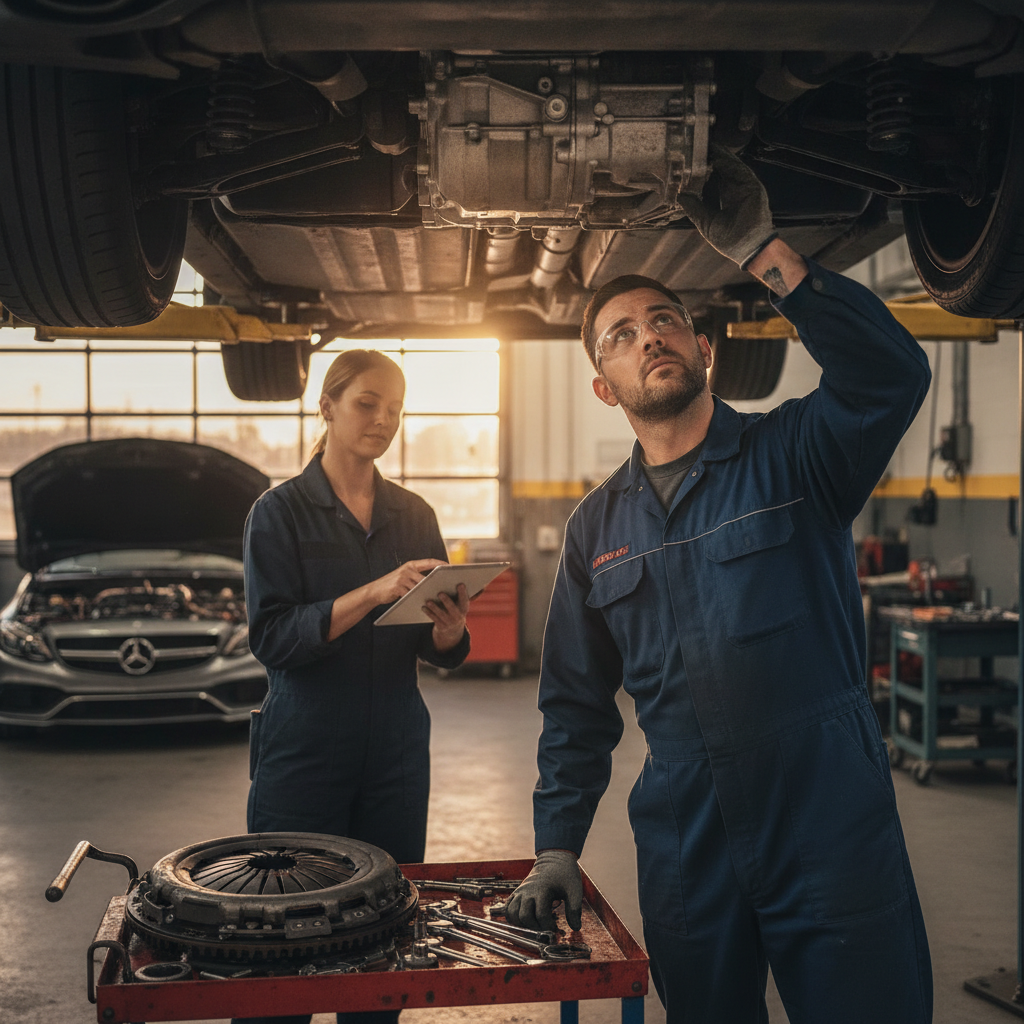
Clutch replacement on a European performance vehicle is not a simple afternoon job. On a mid-engine Porsche Boxster or Cayman, the engine must be dropped out of the car to access the clutch and flywheel. On a rear-engine 911, the transmission comes out from beneath the car. On a Mercedes with a longitudinally mounted drivetrain, the transmission must be dropped. Any of these jobs involves significant disassembly, and the parts cost alone — OEM clutch disc, pressure plate, dual-mass flywheel, throw-out bearing, and potentially a new slave cylinder — reflects the engineering complexity of the vehicle.
What you should expect from a specialist shop is a complete, transparent quote before any work begins, a clear explanation of which components are worn versus which are still serviceable, and confirmation that OEM or OEM-equivalent parts are being used. Aftermarket clutch kits for European performance vehicles vary enormously in quality, and a cheap kit installed on a Porsche flat-six or a high-revving Mercedes AMG engine is a false economy that reveals itself within the first year.
See how Solo Motor Sports services Porsche vehicles across Roswell and the surrounding area.
Frequently Asked Questions
How do I know if my Porsche or Mercedes clutch is slipping versus just worn?
Clutch slip shows up as engine RPMs rising without a matching increase in vehicle speed, especially under hard acceleration. A worn clutch may still engage firmly but have a noticeably higher engagement point and reduced responsiveness. Both conditions warrant an inspection — the difference matters for the repair approach.
Can I keep driving if my clutch is slipping?
Not for long. A slipping clutch will continue to deteriorate, and the heat generated by slip accelerates wear on the pressure plate and flywheel surfaces. In severe cases, you can damage components that would otherwise have been reusable, turning a clutch replacement into a much larger job.
Does the flywheel always need to be replaced when the clutch is replaced?
Not always, but it needs to be evaluated every time. On vehicles with a dual-mass flywheel — which includes most modern Porsche and Mercedes models — the flywheel has its own wear limits and spring dampener fatigue. If it’s borderline, replacing it at the same time as the clutch makes far more economic sense than pulling the transmission again six months later.
How long does a clutch typically last on a Porsche or Mercedes?
It depends heavily on driving style and conditions. Performance driving, frequent stop-and-go commuting, and aggressive launches dramatically shorten clutch life. Under normal conditions, many European clutch assemblies last 60,000 to 100,000 miles — but GA-400 commuters who push hard in traffic often see wear much sooner than that.
Is clutch service something a dealer has to do, or can a specialist shop handle it?
An independent European specialist with factory-trained technicians, the right diagnostic equipment, and access to OEM parts can perform clutch service on a Porsche or Mercedes to the same standard as the dealer — and typically at a meaningfully lower cost. The key is verifying that the shop has genuine experience with your specific make and model, not just European vehicles in general.
Get Your European Clutch Diagnosed by a Specialist Who Knows What to Look For
If your Porsche or Mercedes is slipping, shuddering on engagement, or the pedal no longer feels the way it used to, don’t wait for the problem to strand you on GA-400 or leave you stuck at a light in Roswell. Solo Motor Sports specializes in exactly this kind of European drivetrain work — with factory-level diagnostics, honest assessments, and OEM parts that protect your vehicle the way it was designed to be protected.
Owners from across North Fulton County — Roswell, Alpharetta, Johns Creek, Sandy Springs, and beyond — trust us to give them a straight answer and a repair that holds. Contact Solo Motor Sports today to schedule your clutch inspection and find out exactly what your drivetrain needs.