
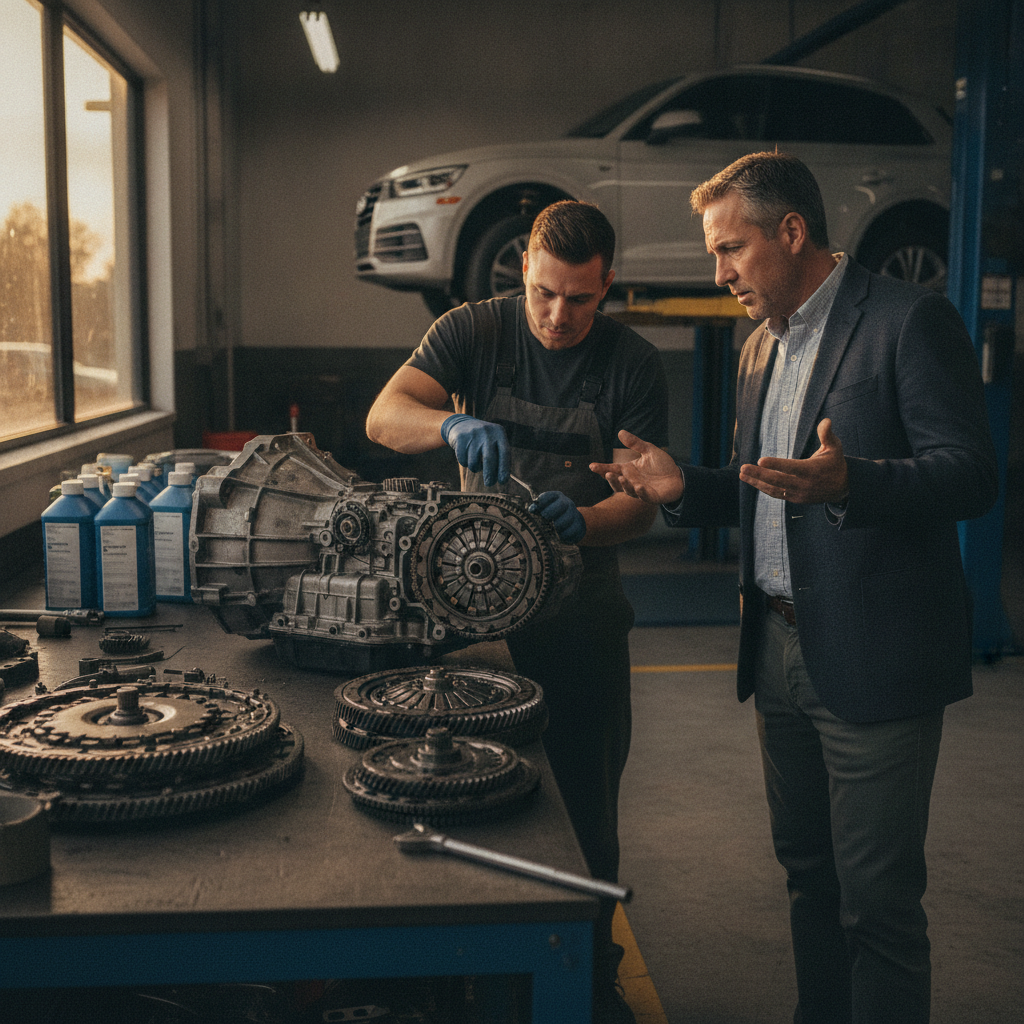
Why Is My Audi or Volkswagen’s DSG Dual-Clutch Transmission Shuddering at Low Speed? What Roswell Owners Should Know About European DCT Service
If your Audi or Volkswagen is shuddering, jerking, or hesitating during slow acceleration — particularly when pulling away from a stop or crawling through traffic — the DSG dual-clutch transmission is very likely the source of that behavior. It’s one of the most misunderstood and under-serviced components on modern Audi and VW vehicles, and in Roswell’s stop-and-go commuting environment, it wears faster than the service interval on the sticker suggests. Understanding what’s happening inside that transmission — and what proper service actually involves — can save you from a repair bill that runs well into four figures.
What Makes the DSG Transmission Different From a Conventional Automatic
Volkswagen’s DSG (Direct Shift Gearbox) — called S-tronic on Audi models — is a dual-clutch automated manual transmission. Unlike a traditional torque-converter automatic, the DSG uses two separate clutch packs: one handling odd gears and one handling even gears. The transmission pre-selects the next gear before you need it, allowing for near-instantaneous shifts and significantly better fuel efficiency than older automatics.
What makes this design brilliant also makes it sensitive. The wet-clutch variant (used in the DQ250 six-speed found in many Golf, GTI, Tiguan, A3, and TT models) runs the clutch packs in a bath of specialized transmission fluid. That fluid is not interchangeable with generic ATF — it’s a precisely engineered lubricant that keeps the clutch packs functioning within tight tolerances. When that fluid degrades, the clutch engagement behavior changes, and shudder is usually the first symptom you’ll feel.
Why Stop-and-Go Driving in Roswell Accelerates DSG Wear
GA-400 through Roswell and into Alpharetta is not a highway in the traditional sense during morning and evening commutes — it’s a slow-moving line of vehicles that crawl, stop, and inch forward repeatedly for miles. For a DSG transmission, this is the worst possible operating condition. The clutch packs are constantly engaging and partially slipping at low speeds to simulate smooth takeoff, and each one of those micro-engagements generates heat and deposits contaminants into the fluid.
Owners commuting from Roswell toward Sandy Springs or Johns Creek along surface roads face similar conditions — traffic lights, school zones, and roundabouts all create the kind of low-speed clutch cycling that breaks down DSG fluid faster than highway driving ever could. If your fluid has never been serviced, or if it was last changed thousands of miles ago using incorrect fluid, shudder is not a question of if — it’s a question of when.
The Root Causes of DSG Shudder at Low Speed
When owners describe DSG shudder, they’re typically experiencing one or more of the following:
- Degraded DSG fluid and filter: Old fluid loses its friction-modifying properties, causing the clutch packs to grab unevenly during engagement instead of slipping smoothly. This produces the shudder or judder you feel at 5–15 mph.
- Incorrect fluid type: Using the wrong ATF — especially if the vehicle visited a quick-lube shop that substituted a generic fluid — will cause the clutch packs to behave incorrectly almost immediately. Some owners notice shudder within days of an improper fluid change.
- Mechatronic unit wear or contamination: The mechatronic unit is the brain of the DSG — a combined hydraulic control module and electronics unit that manages clutch engagement and gear selection. When it’s contaminated or failing, it can send incorrect pressure to the clutch packs, causing jerky or delayed engagement.
- Clutch pack wear: On high-mileage vehicles or those that have been driven hard without proper fluid maintenance, the clutch pack friction material itself can wear to the point where service alone won’t restore normal function. At that point, internal clutch replacement is necessary.
- Transmission control module (TCM) software: VW and Audi have issued software updates for the DSG TCM that improve clutch engagement behavior. If your transmission has never had its software updated, that’s a step that should happen before or alongside any mechanical service.
What Proper DSG Service Actually Involves — and What It Doesn’t
This is where most general repair shops fall short, and it’s a gap that’s genuinely underrepresented in how local competitors describe their transmission services. A proper DSG fluid service is not a drain-and-fill. It is a multi-step procedure that requires the correct OEM-specified fluid, a filter replacement, and in most cases, a mechatronic adaptation reset performed with factory-level diagnostic software.
Here’s what a complete DSG service at a qualified European specialist should include:
- Drain of the internal and external sump (some DSG units have two separate sumps that must both be serviced)
- Filter replacement — not optional, not something to skip to save money
- Refill with the exact OEM-specified DSG fluid (G 052 182 A2 for wet-clutch applications, or the correct variant for your model year and transmission code)
- Mechatronic adaptation reset using VCDS, ODIS, or equivalent factory-level diagnostic software
- Road test to verify clutch engagement behavior and confirm shudder has resolved
- TCM software check and update if applicable
Skipping the adaptation reset is one of the most common mistakes even shops that do the fluid change correctly will make. Without resetting the clutch engagement parameters, the transmission control module continues operating on the old clutch wear data, and shudder may persist or return quickly even with fresh fluid. Proper transmission repair and service at Solo Motor Sports includes every step of this process — not just the fluid swap.
How Often Should You Service a DSG Transmission?
Volkswagen’s official service interval for DSG fluid has historically been labeled as “lifetime fill” on some models — meaning no service interval is specified in the owner’s manual. This is one of the most damaging pieces of misinformation in European vehicle ownership. The fluid degrades, the filter clogs, and the clutch packs suffer. “Lifetime” in VW’s terminology refers to the fluid lasting as long as the vehicle is under warranty, not the life of the vehicle itself.
In practice, most European transmission specialists recommend DSG fluid and filter service every 40,000 miles under normal driving conditions. If you’re commuting daily through Roswell or Alpharetta traffic, that interval should be treated as a maximum rather than a target. High-stress, low-speed driving shortens the effective life of DSG fluid meaningfully.
If you’re not sure when your DSG was last serviced — or if it’s ever been serviced — a multi-point inspection that includes a transmission fluid condition check is a reasonable starting point. Fluid that has gone dark, smells burnt, or shows metal particles in the sump pan is long overdue for service.
When DSG Shudder Is Not Fixed by a Fluid Service
If you’ve had a proper DSG service with the correct fluid, filter, and adaptation reset, and the shudder persists, the diagnosis needs to go deeper. At that point, the likely culprits are mechatronic unit failure, internal clutch pack wear, or in some cases a faulty input shaft speed sensor sending incorrect data to the TCM.
Mechatronic unit replacement is a significant repair — the part alone is expensive, and installation requires the same factory-level software and adaptation procedures described above. Clutch pack replacement is an internal transmission job that requires the unit to come out of the vehicle. Neither of these is a repair you want attempted by a shop using generic scan tools and best-guess procedures.
Owners in Johns Creek and Sandy Springs driving Audi A4, A5, or Q5 models with the DL501 seven-speed S-tronic (which uses a dry-clutch design) should be aware that the service procedure differs from the wet-clutch DQ250. Dry-clutch DSG units do not use a fluid bath for the clutch packs, and their service requirements involve different diagnostic parameters and clutch wear thresholds. Knowing which transmission your vehicle has before authorizing service matters.
Frequently Asked Questions: DSG Transmission Service in Roswell
How do I know if my Audi or VW has a wet-clutch or dry-clutch DSG?
The most common wet-clutch DSG is the six-speed DQ250, found in many Golf, GTI, Tiguan, Passat, A3, and TT models. The seven-speed DQ200 is dry-clutch and commonly found in lighter, lower-torque applications like the Golf TDI and some base Jetta models. The DL501 seven-speed S-tronic in Audi A4, A5, A6, and Q5 models is a wet-clutch unit. Your VIN or transmission code (found on the data tag inside the engine bay or door jamb) will confirm which unit you have. A specialist can identify it immediately from your VIN.
Can a quick-lube shop service a DSG transmission?
No. Quick-lube shops do not carry OEM-spec DSG fluid, do not replace the filter, and do not have the diagnostic software required to perform a mechatronic adaptation reset. An improper DSG service using generic ATF can cause immediate and severe shudder or damage that requires a full mechatronic replacement to correct. This is not a service you want done at a general oil change facility.
Is DSG shudder covered under warranty?
It depends on the age and mileage of your vehicle. Volkswagen has issued technical service bulletins (TSBs) related to DSG shudder on specific model years, and some owners have had fluid services performed under warranty or goodwill at the dealer. If your vehicle is out of warranty, the dealer has no financial incentive to help. A specialist shop can identify whether a TSB applies to your vehicle and service it correctly without dealership pricing.
How much does a DSG fluid and filter service cost?
DSG service is more involved and more expensive than a standard automatic transmission fluid change. Contact Solo Motor Sports directly for current pricing — costs vary depending on your specific transmission type and model. What we can tell you is that the cost of a proper service is a fraction of the cost of a mechatronic unit or clutch pack replacement that results from skipping it.
My VW shudders only when cold — is that still a DSG problem?
Yes. Cold shudder on initial low-speed acceleration that smooths out after the transmission warms up is a classic symptom of degraded DSG fluid that has lost its viscosity range. Fresh OEM fluid with the correct friction modifiers typically resolves cold shudder when no mechanical wear has occurred yet. Don’t ignore it — cold shudder that isn’t addressed tends to progress into shudder at all temperatures as the fluid continues to degrade.
Dealership-Level DSG Service Without Dealership Pricing in Roswell
At Solo Motor Sports, our technicians work on Audi and Volkswagen DSG and S-tronic transmissions with factory-trained expertise, OEM-specified fluids, and the diagnostic software required to do the job correctly from start to finish. We serve owners throughout Roswell, Alpharetta, Johns Creek, Sandy Springs, and the broader North Fulton County area who are tired of paying dealership labor rates for straightforward service work.
If your Audi or Volkswagen is shuddering, jerking, or hesitating at low speed, don’t let a general shop guess at the solution with the wrong fluid and no adaptation reset. Contact Solo Motor Sports today to schedule a diagnostic appointment and get a straight answer about what your transmission actually needs.