
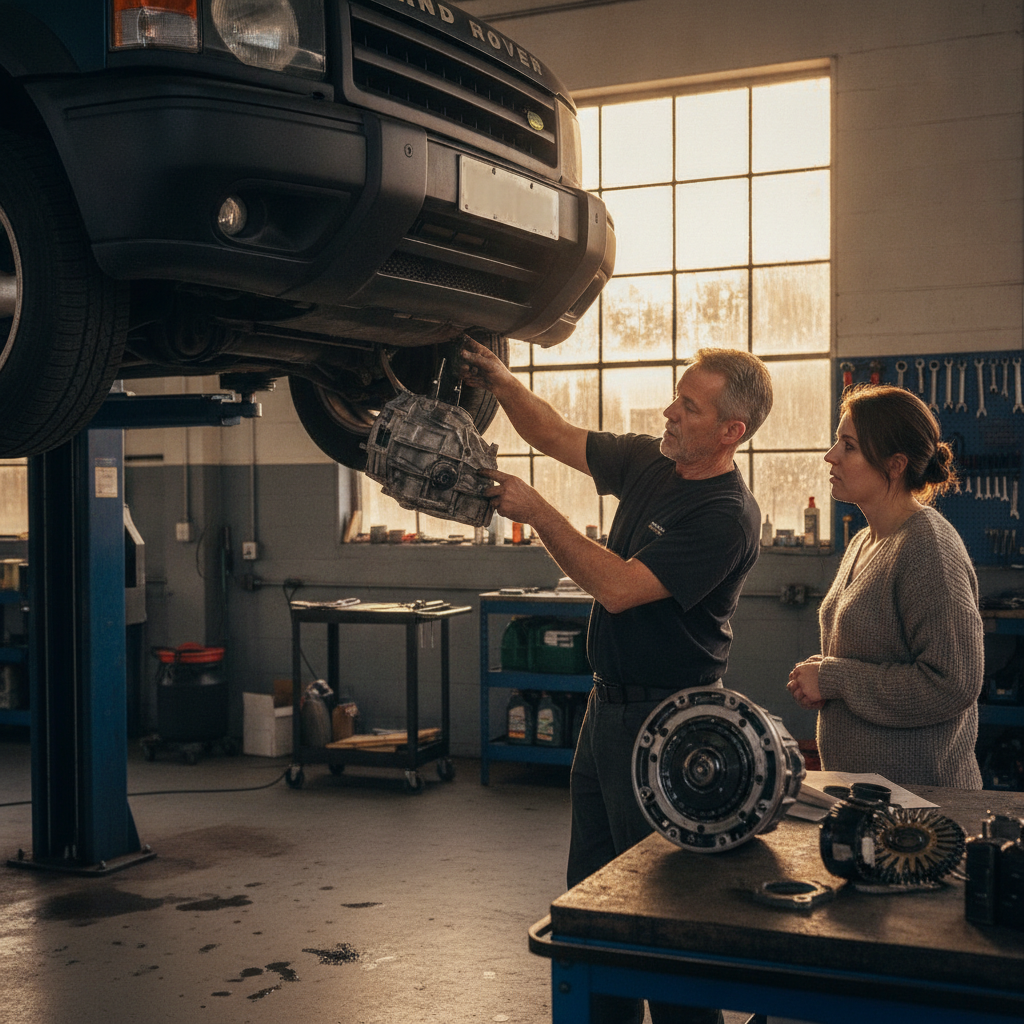
Why Is My Land Rover or Audi’s Transfer Case Shuddering When I Turn? What Roswell Owners Should Know About Center Differential and Viscous Coupling Failure
If your Land Rover Discovery, Range Rover, or Audi Quattro model shudders, jerks, or feels like it’s fighting you through tight parking lot turns, you’re not imagining it — and it’s not a tire problem. What you’re experiencing is almost certainly a failing center differential, viscous coupling, or Haldex clutch pack. These components are the heart of your all-wheel-drive system, and when they degrade, they create exactly this kind of binding, bucking sensation through low-speed turns. For Roswell and North Fulton County owners, this is a repair that needs a specialist — not a general shop guessing at it.
What Is the Center Differential and Why Does It Matter?
Every AWD European vehicle — whether it’s a Land Rover Defender, an Audi Q5, or a Range Rover Sport — relies on some form of torque-splitting mechanism between the front and rear axles. On Land Rovers, this is often a mechanical center differential combined with a viscous coupling unit. On Audi models, it’s either the legendary Torsen center differential found in symmetrical Quattro systems or the electronically controlled Haldex coupling used in transverse-engine Quattro variants like the Q3, TT Quattro, and A3.
These systems are designed to allow a small speed difference between the front and rear axles — which is exactly what happens when you turn a corner. In a turn, your front wheels travel a slightly longer arc than your rear wheels. If your differential can’t accommodate that difference, the drivetrain binds up, and that’s the shudder you feel. When the viscous coupling fluid degrades or the Haldex clutch pack wears out, the system loses that ability to slip and compensate — and the sensation gets worse over time.
The Symptoms Roswell Drivers Usually Notice First
This failure mode has a very specific signature. You’ll typically notice it most in slow, tight maneuvers — parking lots, roundabouts, U-turns, and low-speed lane changes. The vehicle feels like it’s hopping, shuddering, or briefly resisting your steering input before releasing. On a Land Rover, you might also get drivetrain warning lights. On an Audi, the AWD system may quietly deactivate, leaving you in front-wheel drive without any obvious indicator.
Here’s what makes this particularly dangerous: the symptoms are easy to dismiss. Drivers often attribute the sensation to road texture, worn tires, or even a loose sway bar link. Meanwhile, continued driving with a seized or degraded center differential puts enormous stress on the front and rear axle shafts, the transfer case output seals, and even the transmission itself. What starts as a $400–$800 Haldex fluid and filter service can turn into a $3,000–$6,000 repair if the clutch pack burns out completely or if secondary damage accumulates.
Land Rover vs. Audi: Different Systems, Different Failure Patterns
Land Rover Discovery and Range Rover: Viscous Coupling and Transfer Case
Land Rover’s full-time 4WD systems are mechanically robust but demanding to maintain. The viscous coupling — a sealed unit filled with a silicone-based fluid — is the element that allows torque bias between axles. Over time, that fluid breaks down and the coupling either locks up too aggressively or stops engaging at all. Roswell-area Land Rover owners who do a lot of stop-and-go driving on GA-400 or regular highway commutes to Sandy Springs and Atlanta are actually accelerating this wear pattern, because constant speed changes cycle the coupling more aggressively than steady-state highway cruising.
Land Rover’s transfer cases also develop external leaks at the front output seal and the rear output seal — and when fluid drops below the minimum level, internal clutch packs overheat. If your Land Rover is shuddering in turns and you notice a puddle under the center of the vehicle after it sits overnight, those two symptoms together point directly at transfer case seal failure combined with viscous coupling stress. Land Rover owners in Roswell should treat this combination as urgent — it won’t resolve on its own.
Audi Quattro: Torsen vs. Haldex — and Why the Service Interval Is Non-Negotiable
Audi’s Quattro system gets a lot of well-deserved praise, but it is not maintenance-free. Transverse-engine Audi models (A3, Q3, TT Quattro, and earlier Q5 variants) use the Haldex coupling at the rear axle, which requires a fluid and filter change every 30,000–40,000 miles. This is a service that many general shops skip because they don’t know it exists — and that Audi dealers often defer until it becomes a repair rather than a maintenance item.
When the Haldex fluid degrades, the internal pump loses the pressure it needs to engage the rear clutch pack. You lose rear-axle torque delivery under acceleration, and through tight turns at low speed, the system binds rather than smoothly distributing power. Longitudinal-engine Audis (A4, A6, Q5 with longitudinal platform, Q7) use the Torsen center differential, which is mechanical and generally more durable — but it still depends on clean, properly-spec’d gear oil to function correctly. Neither system is plug-and-forget.
What a Proper Diagnosis Actually Looks Like
The single biggest gap in how competitors in the Roswell and Alpharetta area approach this problem is the diagnostic step. Most shops either pull codes and replace parts, or skip the AWD system entirely because they lack the manufacturer-level software to communicate with the transfer case and differential control modules.
A proper diagnosis of center differential and viscous coupling failure involves three things: a factory-compatible scan tool that can read AWD-specific fault codes (not just generic OBD-II codes), a physical inspection of the transfer case for leaks and external wear, and a dynamic road test that isolates the binding sensation to specific turn radii and speeds. At Solo Motor Sports, our technicians use dealership-level diagnostic equipment to evaluate the full drivetrain — not just the codes that light up on a generic scanner.
This matters because the symptom — shuddering in turns — can technically be caused by more than one thing. Severely worn CV axles can produce a similar sensation under load. A collapsed engine mount can mimic drivetrain vibration. Worn subframe bushings on a Land Rover can create a hopping sensation at low speeds. A thorough diagnosis eliminates those possibilities before any parts are ordered, which protects you from paying for repairs that don’t fix the actual problem.
Why Johns Creek and Milton Owners Shouldn’t Default to the Dealership for This
If you’re driving a Range Rover out of Milton or an Audi Q7 from Johns Creek, your dealership will diagnose this — eventually. But center differential and transfer case work at Land Rover and Audi dealerships in the Atlanta metro carries significant labor rate premiums, and the service advisors in those environments are not always incentivized to recommend a flush and service when a full component replacement generates more revenue.
The reality is that most Haldex-related shuddering on Audis under 80,000 miles can be resolved with a proper fluid and filter service using the correct Haldex fluid specification — not a generic substitute. Most Land Rover viscous coupling issues on vehicles under 100,000 miles benefit from a professional fluid flush and seal inspection before condemning the coupling itself. These are precision maintenance procedures, not necessarily major mechanical overhauls. Getting an honest second opinion from a specialist shop that isn’t on a flat-rate clock can save you a significant amount of money.
Frequently Asked Questions
How do I know if my Audi’s Haldex system needs service or full replacement?
If the shuddering started gradually and gets worse in slow turns, a Haldex fluid and filter service is usually the first step. If the AWD warning light is active, the rear clutch pack has already sustained damage and a more thorough inspection is needed before you drive further. A specialist scan tool can read Haldex-specific fault codes that generic readers miss entirely.
Can I drive my Land Rover if the transfer case is shuddering?
Short distances on dry pavement are generally okay, but continuing to drive with a binding transfer case causes accelerating wear on output seals, axle shafts, and the differential itself. If you’re also seeing a fluid puddle under the vehicle, stop driving it and have it towed or inspected immediately.
Does my Audi Quattro center differential need fluid changes if I only drive on pavement?
Yes. The Haldex coupling degrades from normal on-road use, especially stop-and-go driving and spirited acceleration. The service interval exists regardless of terrain. Skipping it is one of the most common — and most expensive — maintenance mistakes Audi owners make.
How much does Haldex service or viscous coupling repair typically cost?
Haldex fluid and filter service is a relatively straightforward maintenance procedure. Viscous coupling replacement on a Land Rover involves more labor. Transfer case seal replacement falls somewhere in between. The range varies significantly by vehicle and condition — contact us directly for an accurate estimate rather than relying on national price guides that don’t account for your specific model year.
Can a general repair shop handle this, or do I need a European specialist?
You need a specialist. General shops typically lack both the correct scan tools to read AWD module data and the model-specific knowledge to interpret what they find. An incorrect diagnosis here — or the wrong fluid specification — can cause immediate damage to a Haldex or Torsen system that was otherwise serviceable.
Get Your AWD System Inspected at Solo Motor Sports in Roswell
If your Land Rover or Audi is shuddering through turns — or if you simply don’t know when the Haldex or transfer case fluid was last serviced — don’t wait for the problem to compound. Solo Motor Sports is Roswell’s European drivetrain specialist, with factory-trained technicians and the diagnostic tools to evaluate your AWD system accurately the first time.
We serve owners throughout Roswell, Alpharetta, Milton, Johns Creek, Sandy Springs, and the wider North Fulton County area. Contact us today to schedule an inspection — before a maintenance item becomes a major repair bill.