
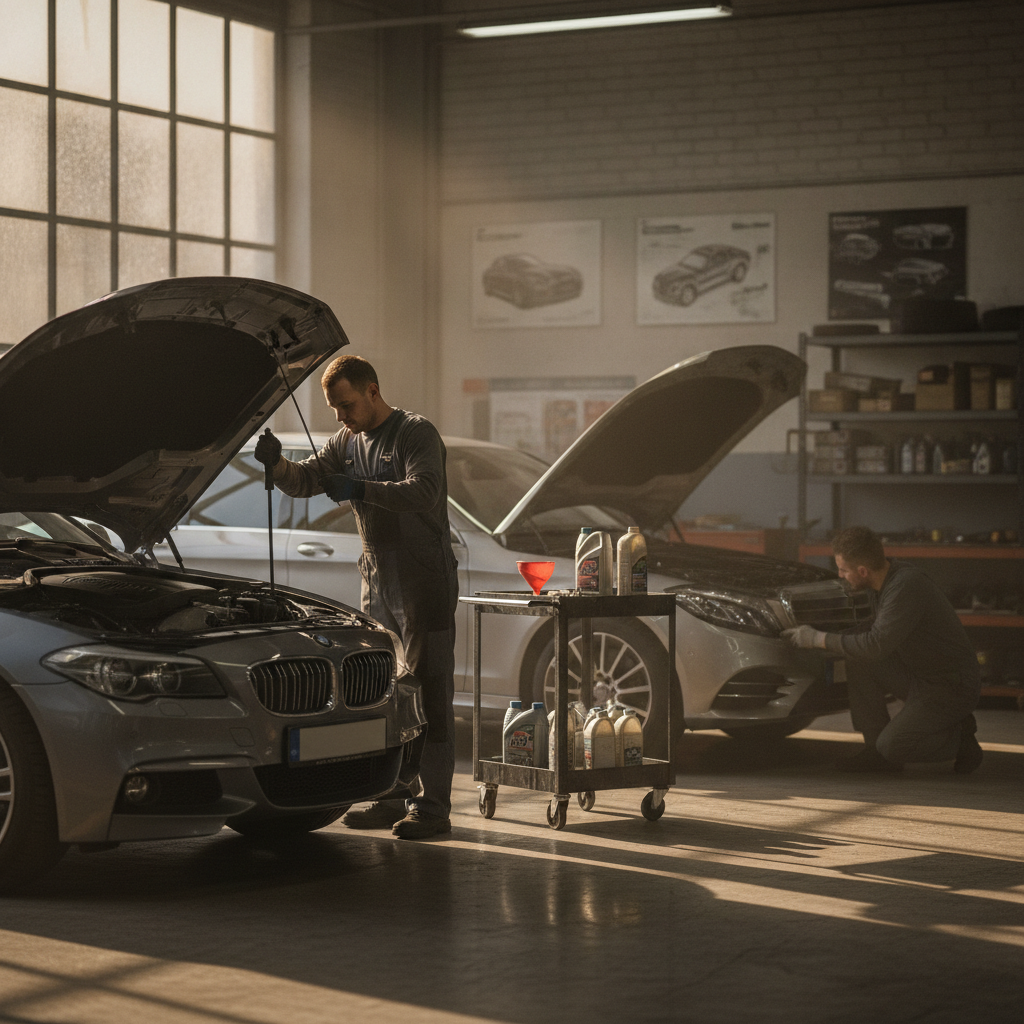
Why Is My BMW or Mercedes Burning Oil Between Services? What Roswell Owners Should Know About European Oil Consumption
If you’re noticing your BMW or Mercedes-Benz oil level dropping between scheduled services, you’re not imagining it — and it’s not always something you should wave away. Some European engines do consume a small amount of oil under normal operation, but there’s a critical difference between minor consumption and a developing problem that’s quietly eating away at your engine. For Roswell drivers who spend real time crawling through GA-400 backups or making short city-loop trips through Alpharetta and Sandy Springs, that distinction matters more than you might think.
What Counts as “Normal” Oil Consumption for a European Engine?
BMW, Mercedes-Benz, and Audi have all issued technical service bulletins acknowledging that their engines can consume up to one quart of oil per 750–1,000 miles and still be considered within specification. That standard was set partly by engineers and partly by legal departments — and it’s a wide enough window to keep dealers off the hook while leaving owners frustrated and confused.
In practice, if your BMW or Mercedes is consuming more than half a quart between oil changes on a normal maintenance interval, that warrants a closer look. And if you’re seeing blue-tinged exhaust smoke at startup, a burning smell after a highway run, or a low-oil warning light appearing sooner than expected, those are signals you shouldn’t ignore.
The vehicles most commonly affected include the BMW N63 V8 engine found in the 550i, 650i, and 750i — a notoriously oil-hungry unit — as well as the BMW N20 and N26 four-cylinders. On the Mercedes side, the M271 and M272 engine families have documented valve seal and piston ring issues that can cause progressive oil consumption if left unaddressed.
The Most Common Causes of Oil Burning in BMWs and Mercedes-Benz Vehicles
Understanding what’s actually happening inside your engine helps you make better decisions about timing and urgency. There are several root causes, and they’re not all equally serious.
Worn or Hardened Valve Stem Seals
Valve stem seals sit at the top of each intake and exhaust valve and prevent oil from being drawn into the combustion chamber. Over time — especially in engines that run hot or that have gone too long between oil changes — these seals harden and crack. When that happens, oil seeps past and burns during combustion. You’ll often see a puff of blue smoke at cold startup that clears within a minute or two. The engine may run fine otherwise, but oil loss is continuous and accelerating.
Degraded Piston Rings
Piston rings seal the combustion chamber from the oil in the crankcase below. When they wear out — either from age, carbon buildup, or oil that wasn’t changed frequently enough — oil gets pulled up into the combustion chamber and burned off with the fuel. This often produces more consistent blue smoke rather than just at startup, and it’s a more involved repair than valve seals.
PCV (Positive Crankcase Ventilation) System Failures
The PCV system routes crankcase vapors back into the intake manifold to be burned rather than venting them into the atmosphere. When the PCV valve or its associated hoses fail — which is common on BMW N52 and N54 engines — oil mist gets pulled into the intake and burned in the combustion chamber. You may also notice rough idle, increased oil consumption, and occasionally misfires. This is one of the most frequently overlooked causes of BMW oil burning, and it’s a relatively straightforward fix when caught early.
External Oil Leaks Being Burned Off
Not all oil consumption is internal. Valve cover gaskets, oil pan gaskets, camshaft position sensor seals, and rear main seals can all leak slowly — and if oil drips onto hot exhaust components, it burns off without ever pooling on your driveway. This is why a visual inspection of your engine bay and undercarriage matters just as much as watching the dipstick.
Why Roswell and North Fulton Driving Conditions Make This Worse
Here’s a factor that rarely gets discussed honestly: your driving environment directly affects how quickly oil-related problems develop and how severe they become.
Stop-and-go commuting on GA-400 keeps your engine at elevated operating temperatures for extended periods without the airflow benefit of highway speeds. Short trips through Roswell, Johns Creek, or Sandy Springs mean your engine never fully reaches and holds operating temperature before you shut it off — which allows moisture and combustion byproducts to accumulate in the oil rather than being burned off. Over time, this degrades the oil faster and accelerates seal wear.
North Fulton County summers don’t help either. When ambient temperatures push past 90 degrees and your car is sitting in traffic on a July afternoon, engine oil temperatures can climb significantly beyond their design range if the cooling system isn’t functioning optimally. Overheated oil loses its viscosity, thins out, and starts getting past seals and rings that would otherwise hold fine.
If your maintenance interval is based on BMW’s or Mercedes’ flexible service indicator rather than a fixed mileage schedule, it’s worth discussing with a European specialist whether that interval is appropriate for your actual driving conditions — not the ideal conditions the algorithm was designed around.
What Most General Shops Miss — and What Competitors Aren’t Telling You
This is where the gap in local service really shows. Many general repair shops and even some import specialists in the Roswell and Alpharetta corridor will diagnose oil consumption with a basic scan, find no fault codes, and tell you the vehicle is “within spec.” They’re not wrong — they’re just not asking the right questions.
Properly diagnosing oil consumption in a European vehicle requires a leak-down test to evaluate piston ring seal, a smoke test to identify external leaks, and in many cases, a careful inspection of the PCV system and valve cover components. On BMW’s N63 engine, it requires familiarity with a technical service bulletin that BMW issued specifically addressing oil consumption remedies — including piston ring and valve stem seal replacement as a campaign repair.
A technician who doesn’t know that bulletin exists, or doesn’t have access to BMW-specific diagnostic software, won’t get you the right answer. That’s the difference between a European specialist and a general shop with a scan tool.
At Solo Motorsports Roswell, our technicians use factory-level diagnostic equipment and have hands-on experience with the specific failure patterns in BMW and Mercedes-Benz engines. We don’t guess — we test. And we explain what we find in plain language before any work begins. You can learn more about our approach on our about page.
When to Act — and What Happens If You Don’t
Oil consumption problems rarely fix themselves. A slow valve seal leak becomes a faster one. A marginal PCV valve that’s causing slight oil mist ingestion eventually fails completely, sending larger volumes of oil into the intake and causing carbon buildup on intake valves — a known and expensive problem on direct-injection engines like the BMW N20 and N54.
The cost of a valve stem seal job on a BMW or Mercedes is real — but it is a fraction of what you’ll pay for engine damage caused by running the engine low on oil for months, or for a walnut blasting and intake cleaning service that becomes necessary after years of PCV-driven carbon accumulation. Our engine repair services are designed to address these problems at the right stage, before they compound.
If you’re checking your oil every few weeks and adding a quart here and there, that’s money leaving your pocket and a problem getting larger. The smart move is to have it properly diagnosed now.
Frequently Asked Questions
Is it normal for a BMW to burn oil?
BMW acknowledges some oil consumption as within specification, but the range they quote is generous. If you’re adding more than a quart every 1,000 miles or seeing blue exhaust smoke, something specific is causing it and it’s worth diagnosing rather than just topping off indefinitely.
Can I use any full-synthetic oil to slow down oil consumption?
Oil grade and specification matter significantly for European engines. BMW engines typically require BMW LL-01 or LL-04 approved oils, and Mercedes engines require MB 229.5 or 229.51 spec fluids. Using the wrong oil — even a quality full synthetic — can accelerate seal degradation and void warranty coverage. Always confirm the correct spec for your vehicle.
Will a low oil level trigger a warning light before damage occurs?
BMW and Mercedes low-oil warning systems are designed to alert you before critical damage, but they are not foolproof. The sensor detects minimum safe level, not the gradual wear caused by consistently running on the low side. Checking your oil manually every 1,000 miles is the safest practice if you know your vehicle consumes oil.
How long does it take to repair valve stem seals on a BMW or Mercedes?
Valve stem seal replacement is typically a one-to-two day job depending on the engine and accessibility. It’s labor-intensive but straightforward for a shop with the right experience. PCV system repairs are usually completed same-day.
Do you service vehicles from Johns Creek and Sandy Springs, or just Roswell?
Solo Motorsports Roswell serves owners throughout North Fulton County, including Johns Creek, Sandy Springs, Alpharetta, and surrounding communities. Most of our customers prefer us specifically because they want specialist-level service without making the drive to a dealership.
Let’s Figure Out What’s Actually Happening to Your Engine
You shouldn’t have to guess whether your BMW or Mercedes has a real problem or just quirky European engineering. A proper diagnosis gives you a clear answer, a realistic repair plan, and the ability to make an informed decision about your vehicle.
Solo Motorsports Roswell specializes in European makes and carries the diagnostic tools, OEM parts, and make-specific expertise to get this right the first time. All repairs come with a warranty, and we’ll walk you through exactly what we find — no vague estimates, no unnecessary upsells.
Contact us today to schedule a diagnostic appointment. Whether you’re in Roswell, Alpharetta, Johns Creek, or anywhere across North Fulton County, we’re the European specialist your vehicle was built for.