
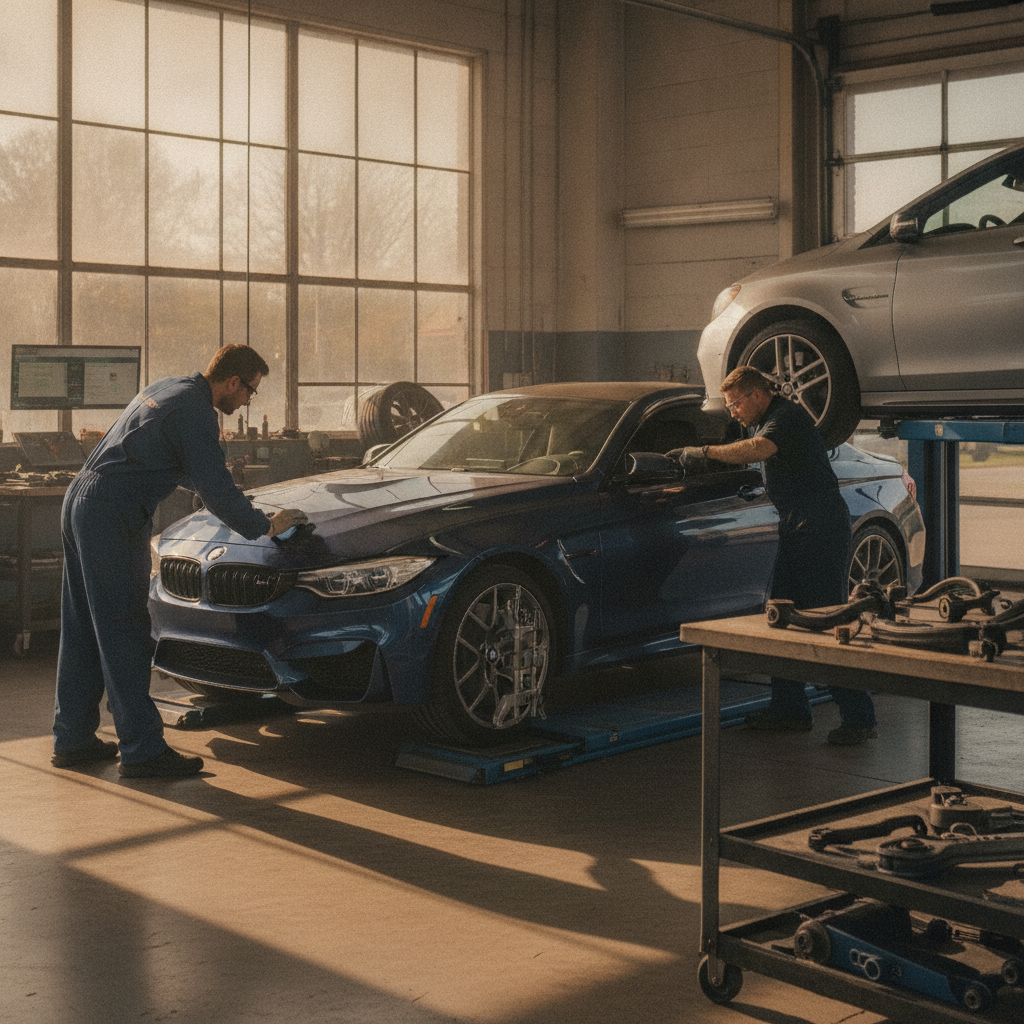
Why Is My BMW or Mercedes Burning Through Tires So Fast? What Roswell Owners Should Know About European Tire Wear
If your BMW or Mercedes seems to chew through a set of tires every 15,000 to 20,000 miles — or you’re noticing uneven wear patterns on the inner or outer edges — you’re not imagining it, and simply buying new tires won’t solve it. Accelerated tire wear on European vehicles almost always points to something deeper: an alignment issue, worn suspension components, or a geometry problem specific to how these cars are engineered. For Roswell owners putting regular miles on the GA-400 corridor between work, school pickups, and weekend drives, this is a real cost problem that compounds quickly when left unaddressed.
European Vehicles Wear Tires Differently Than American Cars — Here’s Why
BMW, Mercedes-Benz, and other European manufacturers engineer their suspension geometry for precise handling and road feedback. That precision comes with a trade-off: tighter tolerances for wheel alignment, camber angles, and toe settings. Even small deviations from factory specification — the kind that might be harmless on a domestic sedan — can cause aggressive tire wear on a 3 Series, C-Class, or E-Class.
Most European performance and luxury vehicles run a slightly negative camber from the factory. This means the tops of the wheels tilt inward slightly, which improves cornering grip and handling stability. It’s intentional. But if that camber drifts further negative due to worn control arms, bushings, or a previous alignment done on generic equipment, the inner edge of your tire takes the brunt of every mile. You’ll typically see it first on the front tires, though rear camber wear is increasingly common on rear-wheel-drive and all-wheel-drive platforms like the BMW xDrive system or Mercedes 4MATIC.
The Run-Flat Tire Problem Nobody Talks About
If your BMW or Mercedes came equipped with run-flat tires from the factory — which is standard on most recent models from both brands — you’re already starting with a tire that has a shorter expected lifespan than a conventional tire. Run-flats use reinforced sidewalls to support the vehicle’s weight without air pressure, which is clever engineering, but those stiff sidewalls transfer more road shock directly through the tire instead of absorbing it. That increases wear rate, and it also means you feel every surface imperfection in North Fulton County’s roads more sharply.
The bigger issue: run-flat tires cannot be repaired after a puncture in most cases, and they cannot be rotated in certain configurations because front and rear sizes differ. If you’re replacing one run-flat at a time rather than in pairs or full sets, your alignment and wear patterns will be thrown off further. A specialist who understands European tire specs will walk you through your options — including whether switching to a high-quality conventional tire with a roadside assistance plan makes more financial sense for your driving habits.
What the Wear Pattern Is Telling You
Tire wear isn’t random. Each pattern is a diagnostic clue, and reading it correctly matters before you spend $800 to $1,400 on a new set of performance tires for your BMW M-series or Mercedes AMG.
- Inner edge wear only: Excessive negative camber — likely a worn control arm bushing, ball joint, or an alignment that has drifted out of spec. This is the most common wear pattern on European sport-tuned vehicles.
- Outer edge wear only: Positive camber or toe-out settings, often caused by bent components after a pothole or curb strike.
- Center wear (both front and rear): Chronic overinflation. Run-flat-equipped vehicles are especially vulnerable here because owners sometimes add pressure thinking it will compensate for the stiff ride.
- Feathering or sawtooth edges: Toe misalignment. Often missed on a basic alignment check because the shop doesn’t have the four-wheel alignment equipment or the experience to correctly set European toe specifications.
- Cupping or scalloping: Shock absorber or strut wear. The wheel is bouncing rather than maintaining consistent contact with the road surface. Common on higher-mileage BMWs and Mercedes vehicles and often mistaken for a simple balance issue.
A multi-point inspection that includes a proper suspension evaluation will catch these issues before you invest in new rubber — and before the wear pattern reveals a more expensive underlying problem.
Why a Generic Alignment at a Chain Shop Won’t Cut It
This is the gap that most shops — including several competitors in the Roswell and Alpharetta corridor — don’t address head-on: a standard alignment on a generic four-wheel rack will not correctly calibrate the suspension geometry of a BMW, Mercedes, Porsche, or Audi to factory specification.
European manufacturers publish specific alignment tolerances for each model year and trim. A BMW M340i xDrive has different front camber, caster, and toe targets than a standard 330i, and both differ from the spec on an E 450 4MATIC. Setting those angles requires equipment capable of reading European-standard alignment data and technicians trained to interpret it. When that expertise is missing, the alignment printout might show all green lights on the screen while your tires are still being eaten alive by a half-degree of camber error that falls outside the acceptable window for your specific chassis.
At Solo Motorsports Roswell, our technicians work specifically with European and import makes. That means your alignment isn’t being done by someone who serviced a pickup truck an hour earlier and is now guessing at your M car’s rear toe adjustment.
Johns Creek and Milton Owners: Road Surfaces Are Accelerating the Problem
If you’re commuting from Johns Creek, Milton, or the outer edges of North Fulton County, you’re dealing with more road variation than owners closer to central Alpharetta or Sandy Springs. Rural routes with uneven pavement edges, pothole-filled intersections after heavy rain, and narrow roads with abrupt camber changes put additional stress on suspension components that were engineered for well-maintained European road surfaces. Combine that with stop-and-go GA-400 traffic, where braking forces load the front suspension repeatedly at low speed, and you have a recipe for premature wear on control arm bushings and tie rod ends — both of which directly affect alignment and tire wear.
If you’ve noticed your steering pulling slightly or your tire wear accelerating after a rough patch of road, don’t wait until your next service interval. A targeted suspension inspection can catch a bent tie rod or collapsed bushing before it becomes a full alignment correction and a new set of tires.
Choosing the Right Replacement Tire for Your European Vehicle
Not all tires are appropriate replacements for European performance vehicles, even if the size matches. BMW and Mercedes specify approved tires from manufacturers like Michelin, Continental, Pirelli, and Bridgestone — often with specific load ratings, speed ratings, and noise specifications that are part of the vehicle’s engineering package. Using an off-brand or incompatible tire can affect ride comfort, handling dynamics, TPMS calibration, and long-term wear patterns.
Our team at Solo Motorsports Roswell sources OEM-approved tires and fits them to manufacturer torque specifications with proper TPMS programming. You can review our tire replacement services to see how we approach this for European makes specifically.
Frequently Asked Questions
How many miles should tires last on a BMW or Mercedes?
Most European performance and luxury tires are rated for 25,000 to 40,000 miles under normal conditions, but run-flat tires often wear faster — sometimes 15,000 to 25,000 miles depending on driving style, alignment, and suspension condition. If you’re replacing tires significantly before those thresholds, something else is wrong.
Can I rotate my BMW’s run-flat tires to extend their life?
It depends on your vehicle. Many BMW models use staggered fitments — wider rear tires and narrower fronts — which are not interchangeable. Even on non-staggered setups, some run-flat tire manufacturers do not recommend rotation. A specialist familiar with your exact model can tell you what’s appropriate.
Is it safe to replace only two tires on my Mercedes 4MATIC?
On an all-wheel-drive system like Mercedes 4MATIC or BMW xDrive, significant diameter differences between front and rear tires can strain the transfer case and rear differential. Replacing in pairs on the same axle is the minimum recommendation, and matching tread depth across all four is strongly preferred.
How do I know if my alignment issue is causing the tire wear, or if it’s a suspension component?
Often it’s both — a worn suspension component causes the alignment to drift, and the alignment drift causes the tire wear. A proper diagnosis starts with a suspension inspection before putting the car on an alignment rack. Aligning a car with worn bushings or ball joints is like painting a wall that hasn’t been repaired. The numbers might look right temporarily, but the underlying issue will push the alignment out of spec again quickly.
Will the dealership fix this correctly, or should I go to a specialist?
Dealerships have access to factory alignment data, but service bay throughput often works against thorough diagnosis. A dealership technician working on flat-rate pay has a financial incentive to complete the alignment quickly rather than investigate underlying wear causes. An independent European specialist with the same equipment and factory training — but without that pressure — is often the better choice for this kind of work.
Stop Replacing Tires. Fix the Real Problem.
Rapid tire wear on your BMW or Mercedes isn’t something to manage with more frequent replacements. It’s a signal that your chassis, suspension, or alignment needs attention from someone who understands how these vehicles are built. At Solo Motorsports Roswell, our ASE-certified technicians work exclusively with European and import vehicles — which means we’re diagnosing these exact patterns every day, not occasionally.
If you’re watching your tires wear out too fast and you want a real answer before you spend another $1,000 on rubber, contact us to schedule an appointment. We’ll inspect the wear pattern, evaluate the suspension geometry, and give you a straight answer about what’s causing it and what it will take to fix it — without dealership pricing or unnecessary upsells.