
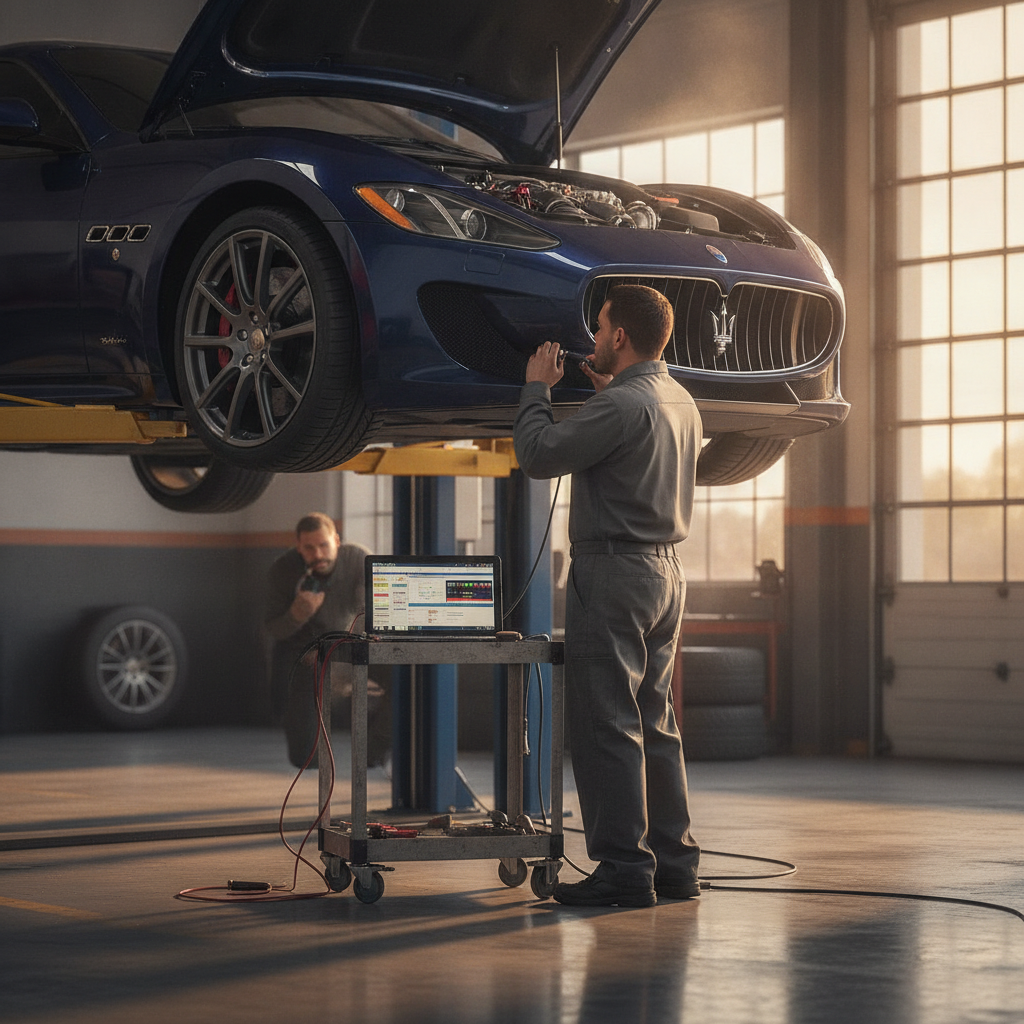
Why Is My Maserati Making a Strange Noise? What Roswell Owners Should Know
If your Maserati has started making an unfamiliar sound — a squeal, a clunk, a rumble, or a drone you can’t quite place — your instinct to take it seriously is the right one. Maseratis are precision-engineered Italian performance machines, and unusual noises are almost always an early signal that something needs attention. For owners in Roswell and the surrounding North Fulton area, the challenge isn’t just identifying the sound — it’s finding a specialist who actually understands these vehicles well enough to diagnose them correctly the first time.
This guide breaks down the most common noises Maserati owners report, what’s likely behind each one, and why getting it diagnosed by a shop with genuine exotic vehicle experience makes a significant difference in both outcome and cost.
The Noises Maserati Owners Most Commonly Report
Maserati builds vehicles like the Ghibli, Quattroporte, Levante, and GranTurismo with performance-focused components that behave differently than what you’d find in a standard European sedan. When something goes wrong, the noises these cars produce tend to be specific — and meaningful.
High-Pitched Squealing When Braking
Brake squeal is the most reported noise from Maserati owners, and it’s one of the most misunderstood. Some light squealing from cold brakes during the first stop of the morning is normal — Maserati’s performance brake pads have a higher metallic content, and morning moisture can briefly amplify that. But if the squeal is consistent, loud, or occurs during normal driving speeds, that’s a different conversation entirely.
Maserati braking systems are engineered for high-torque deceleration, and the rotors and calipers used are specific to each model line. Worn pads, glazed rotors, or — in more serious cases — a sticking caliper can all produce squealing sounds. Attempting to address this with generic aftermarket parts from a non-specialist shop is one of the most common and costly mistakes Maserati owners make. OEM or manufacturer-spec components are not optional on these vehicles — they’re how the braking system was designed to function.
Clunking or Knocking Over Bumps
A clunk from the front or rear suspension when you hit a pothole or road seam on GA-400 is worth diagnosing immediately. Maserati suspension systems — particularly on the Ghibli and Quattroporte — use multi-link setups with a number of wear-prone bushings, control arm components, and shock absorber mounts. These wear at predictable intervals, but they wear faster in stop-and-go Atlanta metro driving than they would in more controlled highway conditions.
The concern with suspension noises is that they tend to compound. A worn bushing leads to increased stress on adjacent components, which accelerates wear across the entire corner of the vehicle. Catching it early with a proper multi-point inspection typically means addressing one or two components rather than rebuilding a suspension corner.
Rumbling or Droning at Highway Speeds
A low-frequency rumble or drone that builds with vehicle speed — and sometimes shifts slightly when you change lanes — usually points to a wheel bearing. Wheel bearing failures are not unique to Maserati, but the cost of ignoring them is higher on exotic vehicles because the labor involved in accessing and replacing them is more involved, and a failed bearing can damage surrounding hub and knuckle components that are expensive to source.
If the drone is more exhaust-like in character — a deeper, throaty sound that’s louder under acceleration — that warrants a look at the exhaust system. Maserati exhausts use specific flex sections and gaskets that can crack or separate, particularly after years of thermal cycling in Georgia’s heat and humidity.
Ticking or Tapping from the Engine Bay
A rhythmic ticking sound from the engine that varies with RPM is almost always valve train related. Maserati’s twin-turbocharged V6 and V8 engines — used across the Ghibli, Quattroporte, and Levante — are sensitive to oil quality and change intervals. If oil maintenance has been stretched, carbon buildup and valve lash issues can produce this kind of noise. It’s not an emergency the moment you hear it, but it does need professional evaluation. Continuing to drive on it without diagnosis risks turning a valve adjustment or oil service into something that involves internal engine work.
Why General Shops and DIY Approaches Fall Short on Maseratis
Maserati diagnostics require factory-level scan tools. The proprietary systems used in Ghibli and Quattroporte models — including active suspension control, adaptive damping, and the multi-mode drive selector — produce fault codes that generic OBD-II readers simply cannot interpret. A general repair shop may clear a code and tell you the car is fine, while an underlying issue continues to develop.
The same principle applies to noise diagnosis. On a Maserati, a clunk that sounds like a sway bar end link might actually be a steering rack mount or a failing transmission mount — components whose behavior overlaps acoustically but requires very different repairs. Getting the diagnosis right on the first visit saves you both time and the compounding cost of unnecessary parts replacement.
This is a gap that most general European auto shops in the Roswell and Alpharetta corridor don’t openly address. Competitor shops in the area tend to list Maserati as one of many makes they service, without detailing the specific diagnostic equipment or model experience they bring to the vehicle. For a Ghibli or Quattroporte, that distinction matters more than it would for a more common European make.
What Local Driving Conditions Do to a Maserati
Owners in Sandy Springs, Johns Creek, and Milton who commute down GA-400 regularly are putting their Maseratis through a specific kind of stress. These are performance vehicles calibrated for spirited driving — not the sustained low-speed thermal loading that comes from sitting in bumper-to-bumper traffic in Georgia’s summer heat. Cooling system components, brake pads, and transmission fluid all degrade faster under these conditions than the factory service intervals assume.
North Fulton County roads also have their share of expansion joints and road irregularities that amplify suspension wear. If you’re noticing new noises after a rough stretch of road, that’s not coincidence — it’s the car telling you a component has finally reached its limit.
Staying ahead of these issues with consistent preventative maintenance — particularly fluid services, brake inspections, and suspension checks — is what keeps a Maserati performing the way it should and prevents minor wear from becoming a major repair bill. You can learn more about what that looks like for your specific vehicle at our Maserati repair page.
What to Expect When You Bring Your Maserati In
At Solo Motor Sports in Roswell, diagnosing a noise on a Maserati starts with a thorough road test and a factory-level scan of all onboard systems — not just the powertrain. From there, the technician performs a physical inspection of the area most likely generating the sound, cross-referencing what the vehicle is communicating electronically with what’s observed mechanically.
You’ll receive a clear explanation of what was found, what it means for the vehicle, and what the repair involves — in plain language, without the upsell pressure that’s unfortunately common at dealership service departments. All repairs use OEM or manufacturer-spec parts, and the work is backed by a warranty.
Frequently Asked Questions: Maserati Noises and Service in Roswell
Is it safe to drive my Maserati if it’s making a noise?
It depends on the noise. Consistent brake squealing, a grinding sound when stopping, or a clunk that affects steering should be addressed before driving further. A drone or light ticking gives you a bit more time, but neither should be left undiagnosed. When in doubt, call a specialist before driving the vehicle further.
How often should I have my Maserati’s brakes inspected?
Maserati recommends brake inspections at every service interval, which is typically every 12 months or 10,000–12,000 miles depending on the model. In stop-and-go North Fulton and Atlanta metro driving, that interval often comes sooner in practice. A visual check during any routine service appointment is good practice.
Can a shop in Roswell actually service a Maserati, or do I need a dealership?
Yes — an independent specialist with factory-level diagnostic tools, OEM parts access, and documented experience with Italian exotics can service your Maserati at least as well as a dealership, and typically with faster turnaround and more transparent pricing. The key is confirming that the shop actually has Maserati-specific equipment and experience, not just a logo on their website.
What’s the most common Maserati repair for Ghibli and Quattroporte owners?
Brake service, suspension bushing replacement, and oil-related maintenance top the list for these models. Both the Ghibli and Quattroporte also have known sensitivities around carbon buildup on intake valves in higher-mileage vehicles — a direct injection characteristic that shows up as rough idle or hesitation rather than always as an audible noise.
Does Solo Motor Sports work on Maserati Levante SUVs as well?
Yes. The Levante shares its platform and drivetrain characteristics with the Ghibli and Quattroporte, and the same diagnostic tools and parts access apply. SUV-specific concerns like transfer case behavior and air suspension diagnostics are also within scope.
Ready to Get Your Maserati Diagnosed?
Strange noises are your Maserati’s way of asking for attention before a minor issue becomes a costly one. If you’re in Roswell, Alpharetta, Sandy Springs, or anywhere across North Fulton County and you’re hearing something that doesn’t belong, don’t wait. The technicians at Solo Motor Sports have the tools, the experience, and the commitment to OEM standards to get it right the first time — without the dealership markup.
Contact Solo Motor Sports today to schedule a diagnostic appointment for your Maserati. We’ll tell you exactly what we find and exactly what it takes to fix it.