
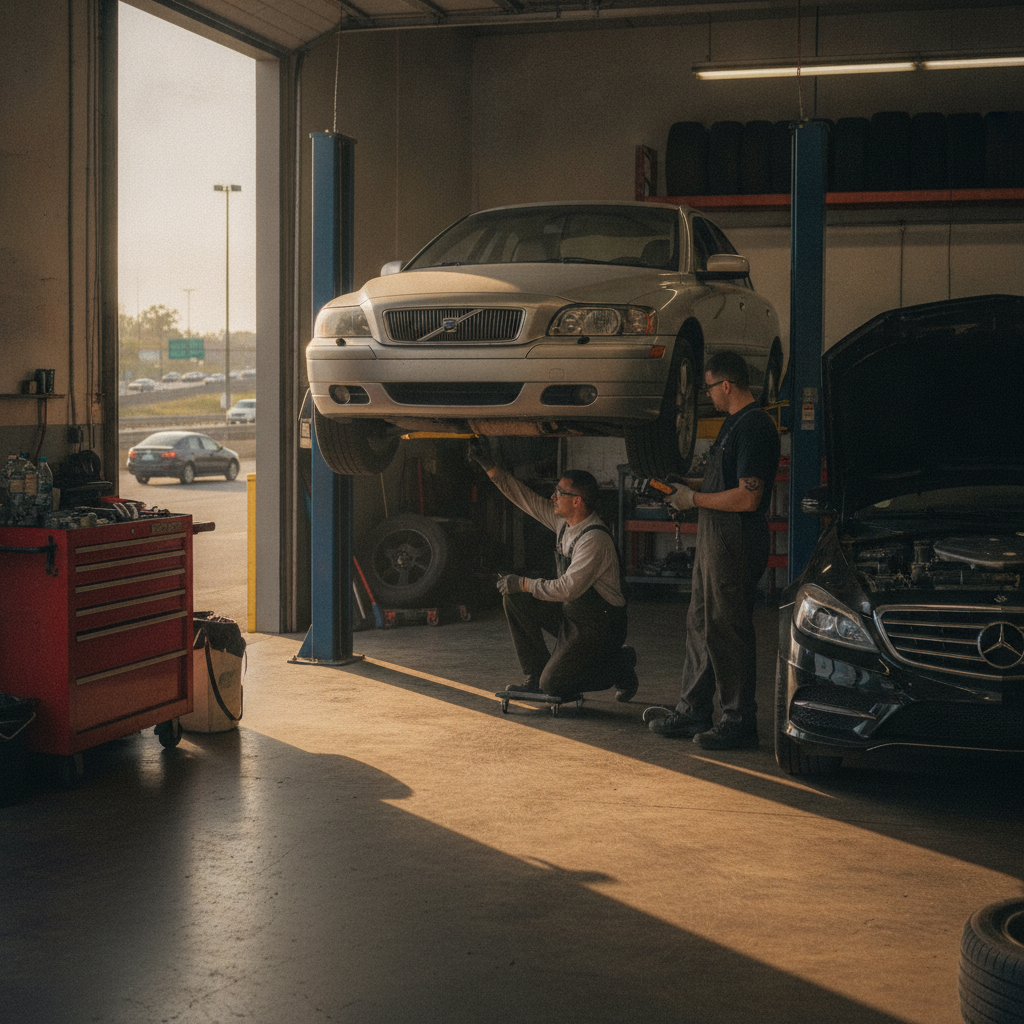
Why Is My Volvo or Mercedes Running Rough and Smelling Like Rotten Eggs? What Roswell Owners Should Know About Catalytic Converter and Oxygen Sensor Failure
If you’ve noticed a faint sulfur smell coming from your Volvo XC90, Mercedes E-Class, or C-Class — especially after a long idle in traffic or during a cold morning startup — your catalytic converter or oxygen sensor is trying to tell you something. In Roswell and along the GA-400 corridor, stop-and-go commuting is a daily reality, and that cycle of heat, partial throttle, and extended idling is one of the fastest ways to degrade these components in European vehicles. The good news: caught early, this is a manageable repair. Left alone, it can turn into a much more serious engine problem that no one wants to deal with.
What’s Actually Causing That Rotten Egg Smell?
The smell most drivers describe as rotten eggs is hydrogen sulfide — a byproduct of sulfur compounds in gasoline that your catalytic converter is supposed to convert into harmless sulfur dioxide during the combustion process. When the catalytic converter is working correctly, you never smell it. When it’s failing, overloaded, or being fed bad data from a failing oxygen sensor, the conversion process breaks down and you get that unmistakable odor.
There are two separate failure modes here, and they’re closely related:
- Oxygen (O2) sensor failure: Your Volvo or Mercedes uses upstream and downstream oxygen sensors to monitor exhaust gas composition and fine-tune the air-fuel mixture in real time. When an O2 sensor fails or sends inaccurate readings, the engine management system can push a rich fuel mixture — too much fuel relative to air — into the combustion chamber. Unburned fuel then passes into the catalytic converter, overheating and damaging it over time.
- Catalytic converter failure: The converter itself contains a substrate coated in precious metals — platinum, palladium, rhodium — that facilitate the chemical reactions that clean your exhaust. Physical damage from road debris, heat cycling, contamination from oil or coolant burning, or sustained operation with a bad O2 sensor can destroy the substrate. Once it’s gone, no amount of sensor replacement will fix the smell or restore proper function.
In many cases, a failing O2 sensor causes the catalytic converter to fail. That’s why the order of diagnosis matters — and why taking your vehicle to a shop with proper European diagnostic equipment is critical before any parts are replaced.
Warning Signs Roswell and Sandy Springs Drivers Shouldn’t Ignore
The sulfur smell is the most obvious symptom, but it’s rarely the only one. By the time the smell is strong enough to notice inside the cabin, the issue has usually been building for a while. Watch for these signals in combination:
- Check engine light illuminated — often with codes P0420, P0430 (catalyst efficiency below threshold), or O2 sensor-related codes like P0136 or P0141
- Rough idle or hesitation on acceleration, especially from a cold start
- Noticeably reduced fuel economy over recent weeks
- Engine running noticeably rich — you may smell raw fuel from the exhaust
- Rattling noise from underneath the car, which can indicate a physically broken catalytic converter substrate
- Failed emissions test — a particular concern if you’re registering a vehicle and live in areas covered by Georgia’s OBD-II emissions testing program
Volvo and Mercedes vehicles both run sophisticated engine management systems, and a single failing sensor can trigger cascading fault codes across multiple modules. A generic OBDII reader from an auto parts store will pull the codes, but it won’t tell you why the code was set or whether the root cause is the sensor, the converter, or something upstream like a fuel system issue. That distinction matters — a lot — when you’re talking about a repair that can range from a relatively inexpensive sensor swap to a full catalytic converter replacement.
Why European Vehicles Are Especially Vulnerable in the Atlanta Metro
European vehicles — particularly modern Volvos and Mercedes — use close-coupled catalytic converters positioned very near the exhaust manifold to reach operating temperature quickly and reduce cold-start emissions. That placement improves emissions performance but also exposes the converter to extreme heat cycles every time the engine starts and stops.
In North Fulton County, where many drivers are making multiple short trips — school runs, errands, quick GA-400 hops between Roswell and Alpharetta or Johns Creek — that heat cycling is relentless. Add in Georgia’s summer heat, which keeps underhood temperatures elevated even after the engine shuts off, and you have conditions that accelerate converter degradation faster than the manufacturer’s design cycle assumes.
Volvo’s turbocharged four-cylinder engines (found in the XC60, XC90 T5/T6, S60, and V60) and Mercedes’s inline-four M270/M274 engines (used in the C300, GLC300, and similar models) are both known to develop oxygen sensor issues in the 60,000–100,000-mile range — often triggered by carbon buildup, heat fatigue, or the combination of short trips and extended idle time that characterizes Atlanta-area driving.
The Diagnostic Step Most Shops Skip — and Why It Matters
Here’s a gap that’s worth addressing directly: many general repair shops in the area — and even some European specialists — will pull the P0420 code, quote a catalytic converter replacement, and call it done. That’s the wrong approach, and it’s expensive when it fails.
A proper diagnosis for catalytic converter and oxygen sensor concerns on a Volvo or Mercedes requires live data analysis — monitoring upstream and downstream O2 sensor voltage waveforms in real time to confirm whether the converter is genuinely inefficient or whether a faulty sensor is making it appear that way. A bad downstream O2 sensor can mimic the exact same code pattern as a failing converter. Replace the converter without confirming the sensor is good, and you’ll be back with the same code within a few thousand miles.
At Solo Motor Sports in Roswell, our technicians use factory-level diagnostic tools to pull the live sensor data, confirm fuel trim values, and rule out upstream causes — oil consumption, coolant leaks into the combustion chamber, or fueling issues — before recommending any parts replacement. That step-by-step process is what separates a real specialist from a shop that just reads codes. You can learn more about our approach to European auto repair services and what that level of precision looks like in practice.
OEM Parts vs. Aftermarket: Why It Matters for Catalytic Converters
Aftermarket catalytic converters vary enormously in quality, and the low end of that spectrum is especially problematic for European vehicles. The precious metal loading in a budget aftermarket converter is typically lower than OEM specification, which means reduced conversion efficiency — and a P0420 code that returns within months even after a proper diagnosis.
For Volvo and Mercedes owners, we strongly recommend OEM or OEM-equivalent converters from manufacturers like Bosch, Delphi, or the vehicle’s original equipment supplier. The price difference is real, but so is the difference in longevity and emissions compliance. Georgia’s emissions testing program uses OBD-II readiness monitors, and a substandard converter that throws a recurring code will cost you more in re-inspections and re-repairs than the premium part would have.
The same principle applies to oxygen sensors. Bosch manufactures the original sensors for most European platforms and offers an exact-fit replacement that’s typically the right call over generic alternatives. Proper oxygen sensor replacement on a Volvo or Mercedes also often requires careful attention to thread condition and anti-seize application — these sensors can fuse to the bung over years of heat cycling, and forcing them out without the right technique can damage the bung or the exhaust manifold. This is one of those repairs where experience with the specific platform matters.
What to Expect From the Repair Process
Timeline and scope depend on what the diagnostic confirms. An oxygen sensor replacement on most Volvo or Mercedes applications is typically a same-day repair. A catalytic converter replacement takes longer — especially if the converter is bolted close to the manifold and the hardware is heat-seized — but is still generally completed within one to two days at a specialist shop. If there’s an underlying cause like an oil consumption issue driving converter contamination, that needs to be addressed in the same service visit, or you’ll be replacing the converter again prematurely.
Our preventative maintenance program includes a thorough review of exhaust system condition, oxygen sensor function, and fuel trim data as part of every major service interval — so issues like this get caught before the rotten egg smell shows up on your morning commute.
Frequently Asked Questions
Can I keep driving my Volvo or Mercedes if it smells like rotten eggs?
For short distances, it’s unlikely to leave you stranded immediately — but continued driving with a failing catalytic converter or oxygen sensor will accelerate engine wear, reduce fuel economy, and risk a failed emissions inspection. If the smell is accompanied by rough running or a check engine light, have it diagnosed as soon as possible.
Will a bad catalytic converter damage my engine?
A converter that physically breaks apart internally can cause fragments to be drawn back into the engine, which is a serious concern. More commonly, the issue is accelerating wear through poor combustion efficiency and elevated exhaust backpressure. Either way, it’s not something to defer indefinitely.
How do I know if it’s the O2 sensor or the catalytic converter?
You generally can’t tell from symptoms alone — both can produce the same code and similar smells. Live data analysis with a factory-compatible diagnostic tool is the only reliable way to distinguish between the two. Don’t let anyone replace the converter without ruling out the sensor first.
Is this repair covered under warranty?
Catalytic converters are covered under federal emissions warranty for 8 years / 80,000 miles from the original sale date on vehicles sold new in the U.S. If your Volvo or Mercedes is within that window, check with us — we can help you understand what your options are before paying out of pocket.
Do you service Volvo and Mercedes vehicles in Sandy Springs and Alpharetta as well?
Absolutely. We serve owners throughout North Fulton County, including Sandy Springs, Alpharetta, and Johns Creek. Our location just off Alpharetta Highway in Roswell puts us within easy reach of the entire GA-400 corridor.
Ready to Get a Real Diagnosis — Not Just a Code Read?
If your Volvo, Mercedes, or any other European vehicle is running rough, smelling like sulfur, or showing a check engine light related to the exhaust system, the team at Solo Motor Sports is ready to help. We use factory-level diagnostic equipment, OEM and OEM-equivalent parts, and the kind of methodical approach that actually fixes the problem — not just clears the code. Contact us today to schedule a diagnostic appointment and find out exactly what your vehicle needs before the repair becomes a bigger expense than it has to be.