
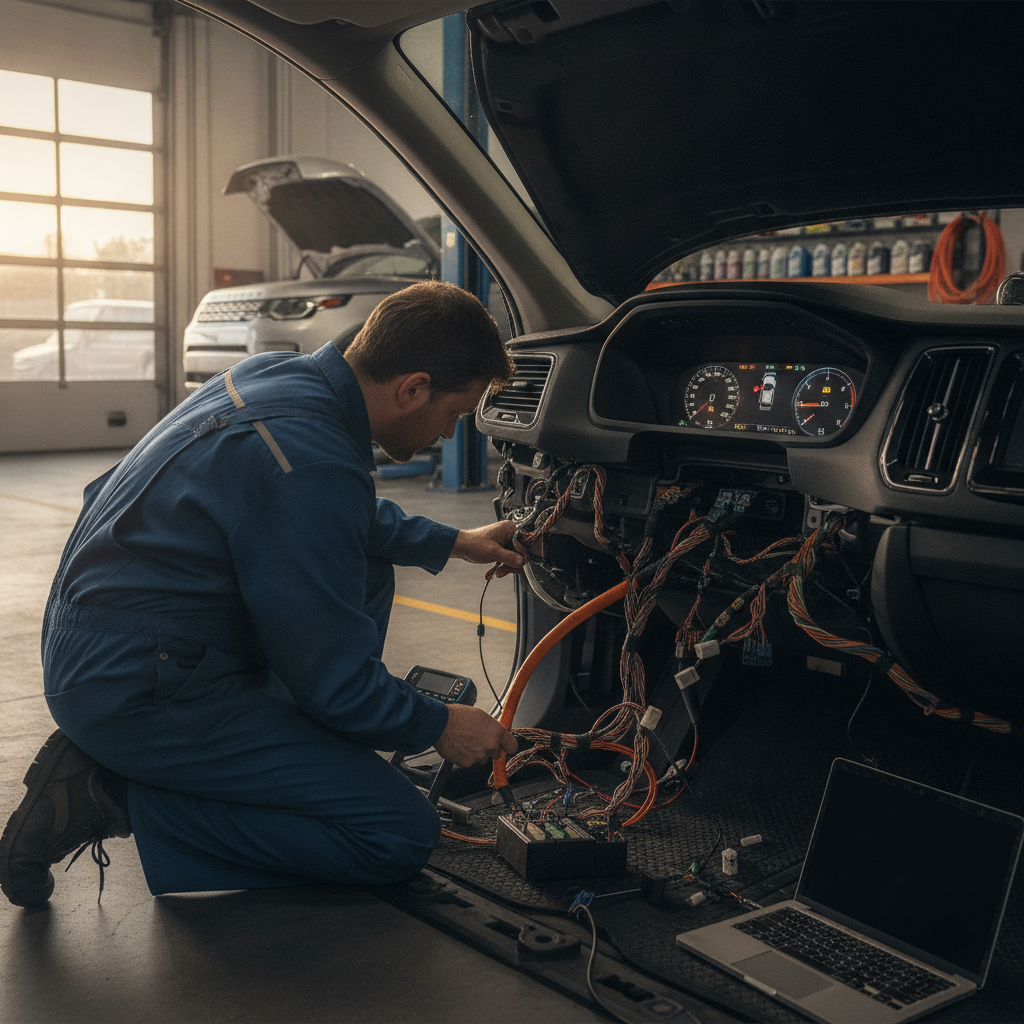
Why Is My Volvo or Land Rover’s Electrical System Throwing Multiple Warning Lights at Once? What Roswell Owners Should Know About CAN Bus Communication Failure
If your Volvo XC90 or Land Rover Discovery suddenly displayed five different warning lights at the same time — stability control, ABS, hill descent, traction, and maybe even a transmission fault — and none of it made sense together, you’re not imagining things. That pattern almost never means five separate systems all failed simultaneously. What it usually means is that the communication network connecting those systems has broken down. In Roswell and across North Fulton County, this is one of the most misdiagnosed and frustrating electrical issues we see in European vehicles — and it’s one that most general repair shops aren’t properly equipped to trace and resolve.
What Is a CAN Bus and Why Does It Matter?
Modern European vehicles — Volvos, Land Rovers, and others — don’t rely on simple point-to-point wiring to connect every module to every other module. Instead, they use a Controller Area Network (CAN bus): a high-speed communication backbone that allows the engine control unit, transmission module, ABS module, body control module, and dozens of other systems to talk to each other in real time. Think of it as the nervous system of your vehicle’s electronics.
When the CAN bus works correctly, all of this happens invisibly. When it doesn’t — due to a failed module, a damaged wire, a corroded connector, or a ground fault — individual control units stop receiving the data they need from the rest of the network. Without that data, they flag errors. Multiple modules flagging errors at the same time produces exactly what you saw on your dashboard: a cascade of seemingly unrelated warning lights that don’t point to one obvious cause.
This is why a standard code reader from an auto parts store won’t solve the problem. It will pull the stored fault codes, but those codes reflect the symptoms of network disruption, not the source. Chasing each code individually — replacing an ABS sensor here, a transmission solenoid there — is how owners end up spending thousands of dollars without fixing anything.
Why Volvos and Land Rovers Are Particularly Vulnerable
Both Volvo and Land Rover build vehicles with deeply integrated electronic architectures. Land Rovers in particular — especially the Discovery, Defender, and Range Rover lines — are known for complex multi-network layouts that include separate CAN buses for different vehicle domains: powertrain, chassis, and body. Volvos share a similar complexity, especially models built on the SPA platform (XC90, XC60, S90, V90). When a single module on one of these networks starts behaving erratically, the ripple effects across adjacent systems can be significant.
Georgia’s climate doesn’t help. The combination of summer heat, humidity, and the temperature swings that come with seasons along the GA-400 corridor accelerates corrosion in connectors and wiring harnesses — particularly in engine bay grounds and underhood junction boxes. A corroded ground connection is one of the most common physical triggers for CAN bus communication faults in both makes.
What a Proper CAN Bus Diagnosis Actually Looks Like
A legitimate CAN bus diagnosis requires more than pulling fault codes. At Solo Motor Sports, our technicians use manufacturer-level diagnostic tooling — VIDA for Volvo, SDD and PATHFINDER for Land Rover — that can communicate natively with each module on the network, map which modules are responding, identify which are offline or showing abnormal communication patterns, and isolate the network segment where the fault originates.
The process typically involves:
- A full network scan across all control modules, not just powertrain
- Identifying which modules are reporting communication loss versus which are genuinely faulted
- Measuring network resistance and signal integrity on each CAN bus line
- Inspecting physical wiring, ground points, and connectors in the affected segments
- Determining whether the fault lies in a module itself, the wiring harness, a ground circuit, or a power supply issue
This process takes time and skill. It’s not something that can be rushed, and it’s not something a generic scan tool can automate. Our Land Rover service and Volvo repair work are built around exactly this kind of methodical, system-level diagnosis — the same approach a Volvo or Land Rover dealer would take, but without the dealer-level wait times and pricing.
The Gap Most Shops Leave Open: Module-Level Network Faults
Here’s what’s missing from nearly every competitor website in the Roswell and Alpharetta area: none of them explain what happens when the fault is in the network itself rather than in a specific component. You’ll find plenty of content about ABS sensors, transmission solenoids, and oxygen sensors — but very little about what to do when the problem is systemic rather than component-specific.
That gap is where owners get hurt financially. A shop without manufacturer-grade tooling will diagnose and replace individual components that are functioning fine, because they can’t see the network clearly enough to identify the actual failure point. If you’ve already had parts replaced at another shop and your warning lights came back within days or weeks, a network communication fault is a likely explanation.
For owners in Johns Creek and Sandy Springs who drive Land Rovers or Volvos daily — often in stop-and-go traffic on GA-400 and surface roads that stress electrical systems through repeated thermal cycles — getting this diagnosed correctly the first time is the only approach that actually saves money.
When to Come In Immediately
Some CAN bus faults are stability-critical. If your warning lights include any of the following, treat it as an urgent repair rather than a “monitor it” situation:
- Electronic Stability Control (ESC or DSC) offline
- ABS unavailable
- Terrain Response or Hill Descent Control inoperative on a Land Rover
- Brake system warning combined with other module faults
- Power steering assist lost or erratic
These systems rely on real-time CAN bus data to function. When the network is disrupted, they can’t do their jobs — and that affects your ability to control the vehicle in an emergency. Don’t wait on those. A thorough inspection will give you a clear picture of where the fault is and what it will take to resolve it.
Frequently Asked Questions
Can I drive my Land Rover or Volvo safely with multiple warning lights on?
It depends on which lights are on. If stability control, ABS, or braking system warnings are present, driving the vehicle — especially in traffic or on the highway — carries real risk. Have it looked at before driving any significant distance.
Will clearing the fault codes make the warning lights go away?
Temporarily, in some cases. But if the underlying network fault is still present, the lights will return — often within a single drive cycle. Clearing codes without diagnosing the root cause doesn’t fix anything.
How long does a CAN bus diagnosis take?
A thorough network diagnosis typically takes two to four hours of technician time, depending on the vehicle and how many modules are affected. Some faults — particularly intermittent ones triggered by heat or vibration — may require additional time or a road test to reproduce. We’ll give you a clear timeline and explanation before any work begins.
Is CAN bus failure covered under my extended warranty?
It depends on your specific policy and what the root cause turns out to be. Wiring harness damage from corrosion is sometimes excluded, while module failures are often covered. Bring any warranty documentation when you come in — we’re happy to document the diagnosis in a way that supports a warranty claim if applicable.
Why did this happen right after I had other work done on my vehicle?
Occasionally, a CAN bus fault emerges after unrelated work if a connector was disturbed, a ground wasn’t properly reinstalled, or a module was inadvertently powered down incorrectly during the repair. This is worth mentioning when you describe your vehicle’s history — it helps us narrow down where to look first.
Get a Straight Answer from a Shop That Actually Knows These Vehicles
Solo Motor Sports is a European and import specialist in Roswell serving owners throughout North Fulton County, including Alpharetta, Johns Creek, and Sandy Springs. Our technicians work with manufacturer-grade diagnostic software for Volvo, Land Rover, and every other European make we service — because there’s no other way to do this work correctly. If your dashboard is telling you something is wrong but nobody has been able to tell you what, that’s exactly the kind of problem we’re built to solve.
Contact us today to schedule a diagnostic appointment. We’ll give you a clear, honest answer about what’s happening with your vehicle’s electrical system — and what it will actually take to fix it.