
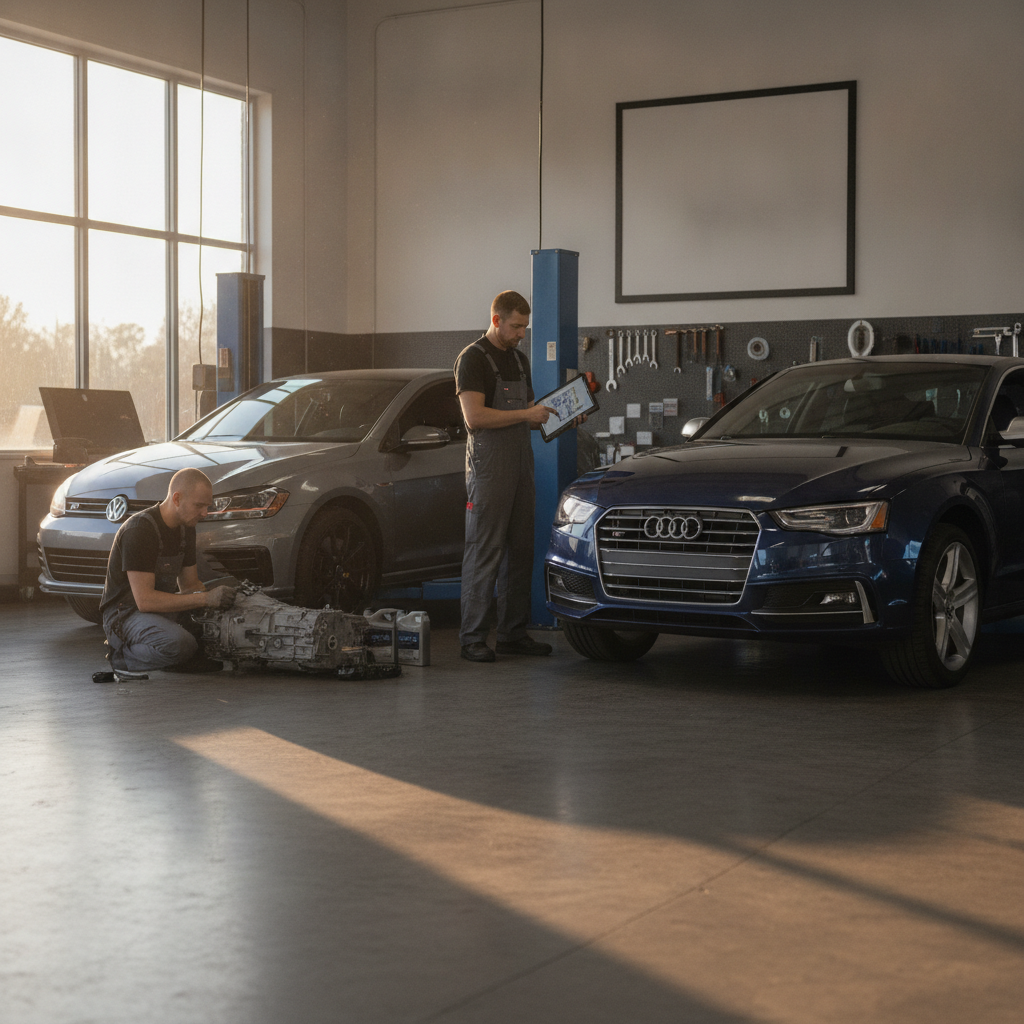
Why Is My Volkswagen or Audi’s DSG Clutch Pack Shuddering at Low Speed? What Roswell Owners Should Know About Dual-Clutch Transmission Service
If your Volkswagen Golf, GTI, Jetta, Passat, or Audi A3, A4, or Q5 shudders and shakes when pulling away from a stop — especially in light traffic or on surface streets around Roswell — the most likely culprit isn’t the engine. It’s the DSG dual-clutch transmission, and specifically the clutch pack inside it that’s either contaminated, worn, or overdue for a fluid and filter service. The good news: when caught early, this is a manageable, relatively affordable fix. When ignored, it becomes a mechatronic unit replacement or a full transmission rebuild — and neither of those conversations is enjoyable.
What Is a DSG Transmission and Why Does It Shudder?
DSG stands for Direct Shift Gearbox — Volkswagen’s proprietary name for its dual-clutch automated manual transmission. Audi uses the same technology under the name S tronic. Unlike a conventional automatic with a torque converter, or a true manual with a clutch pedal, the DSG uses two separate clutch packs — one for odd gears, one for even — allowing near-instantaneous gear changes with no torque interruption. It’s an engineering feat, and in normal operation it’s smooth and fast. But it has a specific vulnerability: the wet clutch variant (used in most four-cylinder applications) bathes its clutch packs in transmission fluid. When that fluid degrades or breaks down, the clutches lose their ability to engage smoothly at low speeds. The result is the characteristic shudder, vibration, or jerking sensation that feels like the car is struggling to find its footing every time you creep away from a light.
Stop-and-go driving makes this worse. If you’re commuting down Alpharetta Highway, sitting in GA-400 traffic, or navigating the lights along Holcomb Bridge Road, your DSG is cycling through low-speed clutch engagement dozens of times per trip. That kind of driving accelerates fluid degradation faster than highway miles ever would.
How to Tell Whether It’s the DSG or Something Else
DSG shudder has a pretty specific signature. Here’s what to look for:
- Shudder or vibration between 5 and 15 mph — typically when the clutch is engaging from a near-stop. Once you’re rolling at normal speed, it disappears.
- Jerky, hesitant takeoff — the car doesn’t pull away smoothly; it feels like it’s stuttering or hunting between states.
- Worse when cold — DSG shudder often shows up more aggressively on a cold morning and smooths out once the transmission reaches operating temperature. That’s a classic sign of degraded transmission fluid losing its friction-modifier properties.
- No warning lights — this is what catches a lot of drivers off guard. DSG shudder doesn’t always trigger a check engine light or transmission warning. You might drive for months thinking it’s normal before the situation worsens.
- Occasional hard shifts — as the problem progresses, shifts that were once smooth may start to feel abrupt or clunky, particularly the 1-2 and 2-3 transitions.
If the shudder is accompanied by a fault code, unusual hesitation at higher speeds, or the transmission entering limp mode, you may be dealing with a mechatronic unit issue rather than a simple fluid service — but a proper diagnostic will separate one from the other quickly.
The Service Most VW and Audi Owners Don’t Know They Need
Here’s where a real content gap exists — and where most general repair shops fail Volkswagen and Audi owners entirely. Volkswagen’s official stance for many years was that the DSG transmission fluid was a “lifetime fill” — meaning no scheduled change was needed. That language has since been walked back, but the damage was done. Millions of owners and many independent shops still treat the DSG like a sealed unit that takes care of itself.
It doesn’t. The DSG fluid — VW’s proprietary G 052 182 formulation — carries very specific friction modifiers that degrade with heat and use. Most specialists who work deeply with these platforms recommend a DSG fluid and filter service every 40,000 miles under normal conditions, and every 20,000 to 30,000 miles if your driving is primarily short trips, heavy traffic, or towing. The service involves draining the old fluid, replacing the internal filter, and refilling with fresh OEM-spec fluid. It takes a couple of hours and is one of the highest-value maintenance procedures you can perform on a VW or Audi with a dual-clutch unit.
Getting this done correctly matters. The DSG requires a specific fluid quantity and a mechatronic adaptation procedure after the service — essentially a software reset that allows the transmission control unit to relearn clutch engagement points with the fresh fluid. Without that adaptation, owners sometimes report that the shudder actually feels different or persists briefly even after a proper fluid change. The adaptation is performed with factory-level diagnostic software, not a generic OBD scanner. This is one of the clearest reasons why specialized shops with the right tools and trained technicians make the difference on European drivetrains. At Solo Motor Sports in Roswell, our technicians use factory-equivalent diagnostic equipment to perform complete DSG services, including the full adaptation cycle, on both Volkswagen and Audi platforms.
When It’s More Than Fluid: Mechatronic Unit Failure
If a proper DSG fluid service doesn’t resolve the shudder — or if you’re experiencing hard fault codes, limp mode, or erratic behavior across the gear range — the mechatronic unit becomes the next area of focus. The mechatronic unit is the integrated valve body and control module that manages all hydraulic and electronic functions of the DSG. It’s a sophisticated and expensive component, and it does fail — often between 80,000 and 120,000 miles in harder-driven examples.
Diagnosis matters here. A proper scope of the issue requires reading fault memory across the transmission control module, checking hydraulic pressure data, and in some cases performing an adaptation test drive with live data running. Owners in Johns Creek, Sandy Springs, and Milton who’ve been quoted transmission replacement prices at a dealership without this level of diagnostic work may simply be looking at a mechatronic replacement rather than a full rebuild — a meaningful cost difference.
If you’re not sure what you’re dealing with, a multi-point inspection combined with a transmission-specific diagnostic is the right starting point. It gives you a clear picture without committing to a repair before you know what you actually need.
What DSG Service Costs and What to Expect
A standard DSG fluid and filter service at an independent European specialist typically runs significantly less than the same service at a VW or Audi dealership. Expect the job to take two to three hours including the adaptation procedure. OEM-spec fluid is non-negotiable here — aftermarket substitutes that don’t carry the correct VW specification can cause the shudder to persist or worsen, because the friction modifiers that prevent clutch slip are formulation-specific.
If your mechatronic unit needs replacement, costs rise considerably depending on whether you’re using a remanufactured or new unit. Your specialist should be able to present you with options and explain the tradeoffs honestly — not default to the highest-cost path. That kind of transparency is something dealerships rarely offer, and it’s what separates a shop that works with you from one that works around you. You can learn more about how Solo Motor Sports approaches transmission repair for European vehicles across our service area.
Frequently Asked Questions
How do I know if my VW or Audi has a wet or dry clutch DSG?
Most four-cylinder engines (1.4T, 1.8T, 2.0T) are paired with the wet clutch 6-speed or 7-speed DSG (DQ250 or DQ200). The DQ200 dry-clutch variant is used in some fuel-economy-focused applications and has somewhat different failure characteristics. Your VIN and transmission code will confirm which unit you have — your technician can identify this at the time of inspection.
Can I drive on a shuddering DSG without making it worse?
For a short time, yes — but the shudder indicates clutch wear or fluid breakdown that will accelerate with continued use. The longer contaminated or depleted fluid circulates, the more wear accumulates on the clutch pack friction material. What starts as a fluid service can become a clutch pack replacement if you wait too long.
Will a DSG software update fix the shudder?
In some cases, Volkswagen or Audi has released updated transmission control unit software that adjusts shift parameters and engagement timing — particularly for early DQ200 dry-clutch units that had known shudder issues from the factory. A scan of your vehicle’s software version will tell you whether an applicable update exists. However, a software update without a fluid service is usually not a complete solution if the fluid is already degraded.
Is a DSG service something I can skip to save money?
It’s one of the maintenance items you really can’t afford to defer on a dual-clutch transmission. The cost of a fluid and filter service is a fraction of a mechatronic unit replacement or clutch pack rebuild. Preventative service on the DSG is one of the best returns on investment in European vehicle ownership.
Does Solo Motor Sports service both Volkswagen and Audi DSG transmissions?
Yes. We work on the full range of Volkswagen and Audi platforms across the DSG and S tronic family, including wet and dry clutch variants. We use factory-spec fluids, OEM filters, and manufacturer-equivalent diagnostic tools to perform the complete service correctly — including the adaptation procedure that many shops skip.
Don’t Let a Shudder Turn Into a Rebuild
If your Volkswagen or Audi is showing the early signs of DSG trouble, the window to resolve it cleanly is right now. Owners across Roswell, Alpharetta, Johns Creek, and Milton often wait until the symptoms are impossible to ignore — and by that point, the repair conversation is a much harder one. The DSG is a sophisticated transmission that rewards proactive care and punishes neglect, usually in that order.
At Solo Motor Sports, we specialize in Volkswagen and European drivetrains, and we have the equipment and experience to diagnose DSG issues accurately, perform factory-correct service, and give you a straight answer about what your car actually needs — without the dealership markup. Contact us today to schedule a transmission inspection or request a consultation. We’re located at 11702 Alpharetta Hwy in Roswell, and you can reach us at (470) 282-1238 or through our contact page to book your appointment.