
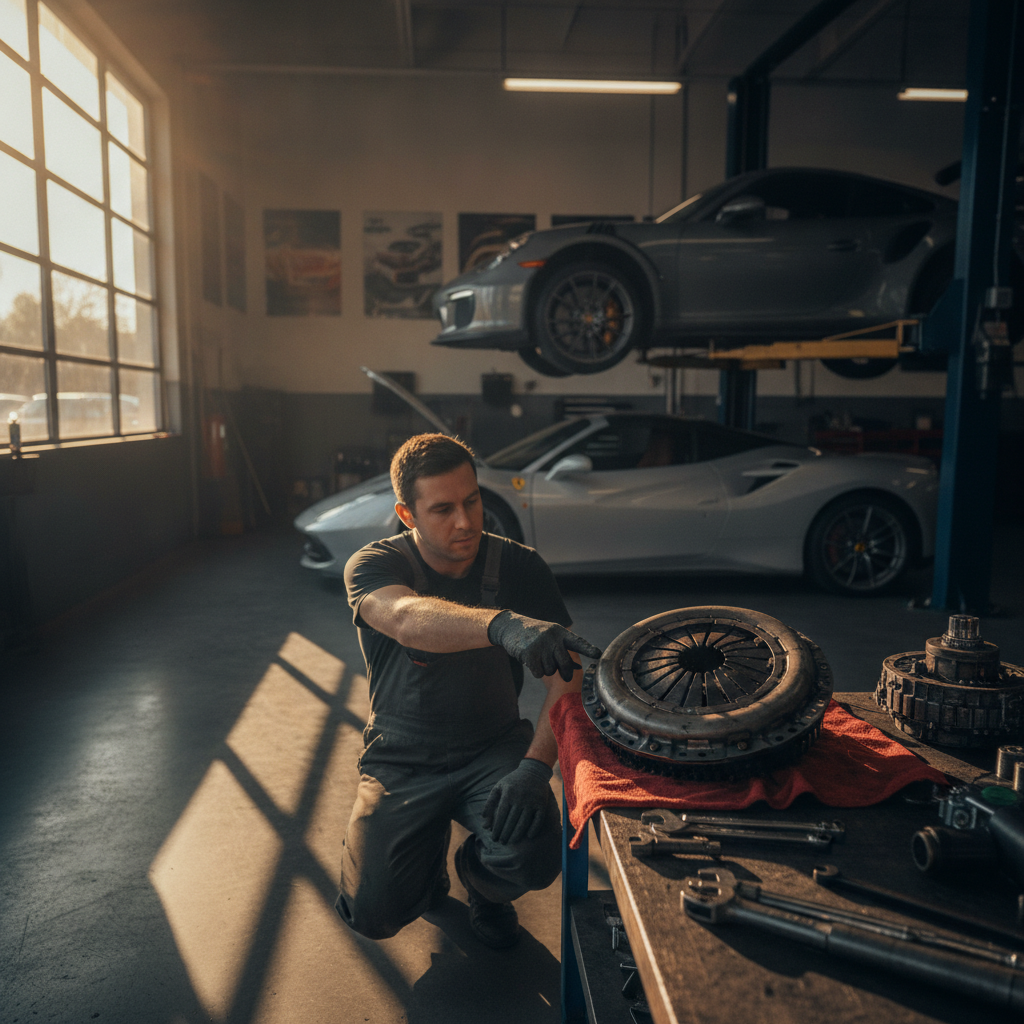
Why Is My Porsche or Ferrari’s Clutch Slipping or Dragging? What Roswell Owners Should Know About European Performance Clutch Failure
If your Porsche 911 is revving high but not accelerating the way it should, or your Ferrari’s clutch pedal feels like it’s fighting you through every gear, you’re not imagining things. A slipping or dragging clutch on a European performance vehicle is one of those problems that starts subtly and gets expensive fast if you wait. For owners in Roswell and across North Fulton County, understanding what’s happening — and getting it diagnosed by someone who actually knows these cars — can be the difference between a manageable repair and a full drivetrain overhaul.
What Does a Slipping Clutch Actually Mean on a Porsche or Ferrari?
Clutch slip happens when the clutch disc can no longer maintain solid contact with the flywheel. Instead of transferring engine power cleanly to the transmission, it partially disengages — and you feel it as the engine revving higher than your speed would justify, especially under hard acceleration. In a Porsche 911 or Carrera, this often shows up first during aggressive on-ramp pulls. In a Ferrari 458, California, or F430, it’s most noticeable during spirited second-to-third gear transitions.
A dragging clutch is the opposite problem: the clutch doesn’t fully disengage when you press the pedal, making gear changes grinding and imprecise. It can also cause the car to creep even with the clutch depressed at a stop. Both conditions stress the transmission, flywheel, and surrounding components with every drive.
Common Causes of Clutch Failure in Porsche and Ferrari Vehicles
These aren’t commuter cars, and their clutch systems reflect that. Here’s what’s typically behind the problem:
- Worn clutch disc friction material. High-performance clutch discs operate under significantly higher heat and torque loads than what you’d find in a standard sedan. On a Porsche GT3 or a Ferrari with a factory sport exhaust, clutch wear accelerates — particularly in stop-and-go traffic like the GA-400 corridor through Roswell and Alpharetta, where slipping the clutch repeatedly in slow traffic causes heat buildup that degrades the friction material much faster than open-road driving would.
- Oil contamination of the clutch disc. Rear main seal leaks and gearbox input shaft seal failures on both Porsche and Ferrari platforms can allow oil to soak the clutch disc, destroying its grip. Once a disc is oil-contaminated, cleaning it isn’t an option — it needs to be replaced.
- Pressure plate fatigue or spring failure. The pressure plate applies clamping force to keep the clutch disc engaged. On high-mileage Porsches and Ferraris, the diaphragm springs in the pressure plate can lose their tension, reducing clamping force and causing slip under load.
- Flywheel hot spots and glazing. Repeated clutch slip generates intense heat at the flywheel surface. Over time, this creates hard spots (often called “hot spots”) that prevent even clutch engagement. A clutch replacement that doesn’t also address a damaged flywheel will fail again prematurely.
- Hydraulic system faults. Ferraris in particular use hydraulic clutch actuation systems that can develop master cylinder or slave cylinder leaks, causing a soft or spongy pedal that doesn’t fully release the clutch. This is often mistaken for a worn clutch disc when the actual problem is in the hydraulic circuit.
Why Clutch Work on These Cars Is Not a Generic Repair
This is where the gap between a European performance specialist and a general shop becomes critical. On a Ferrari, accessing the clutch requires removing the engine or transaxle — a labor-intensive job that can take twelve to twenty hours or more depending on the model. On a mid-engine Porsche like the 718 Cayman or Boxster, the process is similarly complex. Doing it correctly requires factory-level tooling, genuine OEM or approved-specification parts, and a technician who has done this job on these platforms before.
A shop that quotes you a clutch replacement on a Ferrari at half the price of a specialist is almost always cutting corners — on parts quality, on flywheel resurfacing, on hydraulic component inspection, or on the proper torque specifications that prevent future failures. And when something goes wrong at mile 500 after a budget clutch job, you’re back to removing the engine again.
At Solo Motorsports Roswell, clutch service on Porsche and Ferrari vehicles is performed with OEM-grade components and proper factory procedures. That includes flywheel inspection and resurfacing when needed, hydraulic circuit testing, and a road test calibrated to the specific model’s engagement characteristics — not a generic test drive around the block.
How Atlanta Metro Driving Conditions Accelerate Clutch Wear
Owners in Johns Creek, Milton, and Sandy Springs often assume their clutch wear is purely a function of mileage. But driving style and conditions matter just as much. The stop-and-go rhythm of GA-400 during peak commute hours creates a specific pattern of clutch abuse — repeated low-speed engagement and disengagement, often with the clutch partially held to prevent rolling on inclines. That kind of use stresses a performance clutch far more than the same number of miles at highway speed.
If you’re driving a manual Porsche or Ferrari as a daily or semi-daily driver through the Atlanta metro, your clutch is working significantly harder than it would be in the car’s intended performance context. Building in a clutch inspection at higher mileage intervals — or any time you notice changes in pedal feel or engagement point — is just smart ownership.
Warning Signs You Shouldn’t Ignore
Don’t wait for a complete failure. These are the signals that a Porsche or Ferrari clutch inspection is overdue:
- Engine RPM climbs without a corresponding increase in vehicle speed, especially in third gear and above
- A burning smell after spirited driving or stop-and-go traffic
- The engagement point (the moment the clutch grabs) has moved significantly higher or lower on the pedal travel
- Grinding or crunching when shifting, especially into first or reverse
- A spongy or unusually light clutch pedal (hydraulic fault)
- Clutch chatter — a vibrating or shuddering sensation as the clutch engages at low speed
Any one of these symptoms warrants a proper inspection before the next track day — or before another 2,000 miles of GA-400 commuting makes the problem substantially worse. If you’re also noticing broader drivetrain concerns, a multi-point inspection can catch related issues with the transmission, differential, and engine mounts before they compound the repair bill.
What a Proper Clutch Service Includes — and What It Doesn’t
When you bring a Porsche or Ferrari to Solo Motorsports Roswell for clutch diagnosis, the process starts with a thorough inspection of the hydraulic system, pedal feel, and engagement behavior — not just a visual check under the car. If internal access is needed, the flywheel, pressure plate, clutch disc, release bearing, and pilot bearing are all evaluated together. Replacing only the disc and leaving a fatigued pressure plate or a scored flywheel in place is a common shortcut that leads to a repeat failure within a year.
Parts sourcing matters too. Aftermarket clutch kits for high-performance Porsches and Ferraris vary enormously in quality. Genuine OEM components or approved-specification kits from established performance suppliers are the only reliable options for cars producing this level of torque and heat.
Frequently Asked Questions
How many miles should a Porsche or Ferrari clutch last?
It depends heavily on driving style and conditions. A conservatively driven Porsche 911 in non-urban use might see 60,000–80,000 miles from a clutch. A Ferrari driven in Atlanta metro traffic or used occasionally on track days may need clutch attention well before 40,000 miles. There’s no single answer — pedal feel and engagement quality are better indicators than mileage alone.
Can I drive my Porsche or Ferrari with a slipping clutch?
You can, but every mile you drive on a slipping clutch is accelerating damage to the flywheel and potentially the transmission input shaft. A problem that’s a clutch-and-flywheel job today can become a much larger repair if left alone. Get it inspected promptly.
Is clutch replacement on a Ferrari really that expensive?
It’s a significant repair because of the labor involved — not because of price gouging. Mid-engine Ferrari clutch access requires major disassembly. The cost reflects real hours of skilled labor. What you can control is choosing a specialist who does the job right the first time, so you’re not paying to have the engine pulled twice.
Does Solo Motorsports Roswell service both Porsche and Ferrari clutches?
Yes. Solo Motorsports Roswell services both Porsche and Ferrari vehicles, including clutch diagnosis, replacement, flywheel service, and hydraulic system repair. These are make-specific repairs performed by technicians familiar with the engineering of each platform.
Should I upgrade to a performance aftermarket clutch when I replace it?
For a street-driven car, OEM-specification components typically offer the best balance of durability and drivability. Performance aftermarket clutches can increase holding capacity but often sacrifice pedal feel and longevity on the street. If you’re using your car on track regularly, that conversation is worth having with a specialist who knows your specific model and use case.
Talk to a European Performance Specialist in Roswell
Clutch problems on a Porsche or Ferrari aren’t something to hand off to a general shop and hope for the best. If you’re in Roswell, Alpharetta, Johns Creek, Milton, or Sandy Springs and your car isn’t engaging the way it should, Solo Motorsports Roswell has the tools, the parts relationships, and the hands-on experience with these platforms to diagnose it correctly and repair it right. No guesswork, no upsells — just an honest assessment and quality work backed by a warranty.
Contact Solo Motorsports Roswell today to schedule a clutch inspection or discuss what you’re experiencing with your vehicle. We’ll tell you exactly what’s going on and what it will take to fix it properly.