
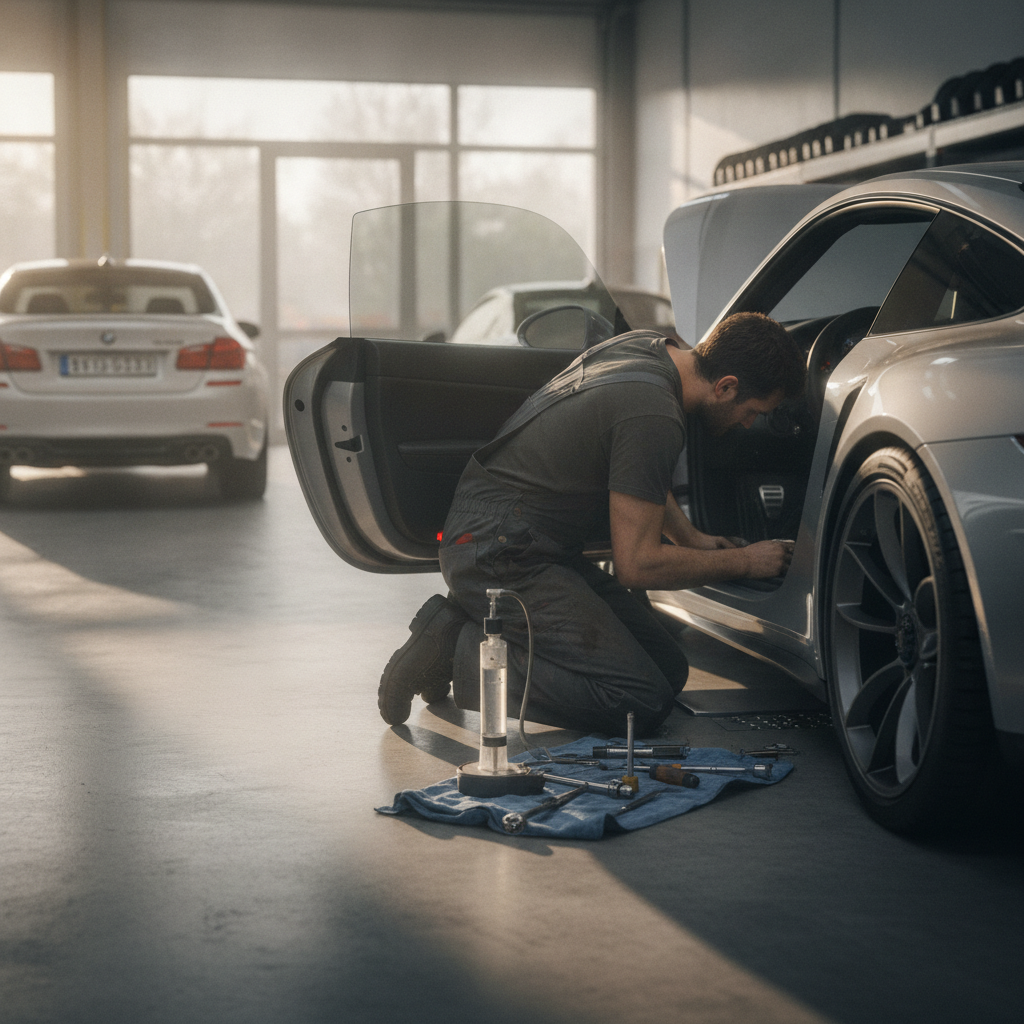
Why Is My Porsche or BMW’s Brake Pedal Spongy or Sinking to the Floor? What Roswell Owners Should Know About Master Cylinder Failure
If you press your brake pedal and it feels soft, spongy, or — worse — slowly sinks toward the floor mat, stop driving and get your vehicle inspected immediately. On a Porsche or BMW, that sensation is almost never a minor issue. It typically points to a failing brake master cylinder, contaminated brake fluid, or a hydraulic leak somewhere in the braking circuit. In Roswell and across North Fulton County, where these vehicles are driven hard on everything from the daily GA-400 commute to weekend canyon runs, a compromised brake system is a genuine safety emergency — not a “keep an eye on it” situation.
What the Brake Master Cylinder Actually Does (And Why It Fails)
The master cylinder is the heart of your hydraulic braking system. When you press the brake pedal, it converts that mechanical force into hydraulic pressure, pushing brake fluid through the lines to clamp your calipers against the rotors. On a BMW or Porsche, this system is engineered to extremely tight tolerances — far tighter than what you’d find on a domestic vehicle. That precision is what gives these cars their characteristic firm, confident brake feel.
Over time, the internal seals inside the master cylinder wear down. When that happens, fluid starts bypassing the piston internally rather than being pushed outward with full force. The result is exactly what you’re feeling: a pedal that sinks under sustained pressure, offers inconsistent resistance, or feels like you’re pressing through a sponge instead of a precision hydraulic component.
Several factors accelerate this wear, and many of them are specific to how European vehicles are driven and maintained in the Atlanta metro area:
- Moisture-saturated brake fluid: Brake fluid is hygroscopic — it absorbs moisture from the air over time. Georgia’s heat and humidity accelerate this process significantly. As water content rises, the fluid’s boiling point drops, its lubricating properties degrade, and internal components corrode faster. Most BMW and Porsche factory maintenance schedules call for a brake fluid flush every two years, a service many owners skip.
- Stop-and-go heat cycles: The relentless start-stop rhythm of GA-400 and Highway 9 traffic generates repeated heat cycles in the braking system that stress seals and accelerate wear on master cylinder internals.
- Age and mileage accumulation: Many Porsches and BMWs in the Roswell and Alpharetta area are driven year-round as daily drivers despite being high-performance machines. Accumulated miles and years on original components eventually take their toll.
- Air in the hydraulic system: A spongy pedal can also result from air entering the brake lines — whether from a caliper bleed gone wrong, a cracked line, or a leaking bleeder screw. Air is compressible; brake fluid is not. Even a small air pocket destroys pedal feel.
Spongy Pedal vs. Sinking Pedal: These Are Different Problems
Most shops treat these symptoms interchangeably, but they actually point to different failure modes — and confusing them leads to misdiagnosis and wasted money.
A spongy pedal — one that feels soft or mushy from the moment you apply pressure — most commonly indicates air in the hydraulic system or severely degraded brake fluid. It may also suggest a swelling or deteriorating brake hose that expands under pressure instead of transmitting force efficiently.
A sinking pedal — one that starts firm but slowly travels toward the floor under sustained pressure — is the hallmark of internal master cylinder failure. The piston seals are bypassing fluid rather than holding pressure. This is a more serious condition and one that won’t resolve itself with a simple fluid flush.
Getting this distinction right matters. Brake repair on European vehicles requires technicians who understand the difference and have the diagnostic equipment to confirm it — not someone who replaces parts by trial and error.
Why This Is One of the Most Underdiagnosed Brake Issues at General Shops
Here’s the gap that most shops in the area don’t address clearly: master cylinder failure in European vehicles is frequently misdiagnosed as air in the system. A technician bleeds the brakes, the pedal briefly firms up, and two weeks later you’re back with the same sinking sensation. Why? Because the bleeding addressed the symptom, not the source. If the master cylinder’s internal seals are failing, no amount of bleeding will give you a consistently firm pedal — because pressure is bleeding off internally every time you hold the brake.
On a Porsche — particularly Boxster, Cayman, 911, and Cayenne models — the master cylinder is integrated with the brake booster in ways that make DIY diagnosis unreliable. On BMW 3 Series, 5 Series, X5, and M models, the Dynamic Stability Control module interacts with the hydraulic system in ways that can create confusing overlapping symptoms. Accurate diagnosis requires OEM-compatible scan tools that can read brake pressure sensor data and hydraulic control unit feedback — not just a basic code reader.
What You Should Expect From a Proper Diagnosis and Repair
When you bring a Porsche or BMW to Solo Motorsports Roswell with a spongy or sinking pedal, the diagnostic process goes beyond a visual check. Our ASE-certified technicians use factory-level diagnostic tools to evaluate brake pressure distribution, inspect for external leaks at the master cylinder, booster, calipers, and lines, and assess brake fluid condition with a moisture content test.
If the master cylinder has failed, it’s replaced with a genuine OEM or OEM-equivalent part — not a low-cost aftermarket unit that may not meet the pressure tolerances your vehicle’s ABS and stability control systems require. The system is then bled precisely, and brake pedal feel is verified before the vehicle leaves the shop. All repairs are warranty-backed, and we’ll walk you through exactly what was found and why it needed to be fixed.
Timeline for this repair is typically same-day for most BMW and Porsche applications, assuming parts are available — which they usually are given our parts sourcing relationships for European makes. If your vehicle also needs a multi-point inspection to check whether related components like brake lines, calipers, or rotors have been affected, we’ll fold that into the same visit so you’re not scheduling a second appointment.
Serving Porsche and BMW Owners Across the North Fulton Area
Solo Motorsports Roswell is located in Roswell and serves owners across Alpharetta, Johns Creek, Sandy Springs, and the broader North Fulton County corridor. If you’re driving a Porsche 911 in Alpharetta or a BMW M5 in Johns Creek and your pedal doesn’t feel right, you don’t need to drive to a dealership in Buckhead or Perimeter to get a proper diagnosis. You need a specialist who knows your vehicle’s hydraulic architecture and won’t charge you a dealer markup to fix it.
The GA-400 and surface street traffic in this area puts real demands on braking systems. A compromised master cylinder that might hold up on light suburban driving can fail dangerously in heavy stop-and-go conditions. Don’t wait to find out which category yours falls into.
Frequently Asked Questions
Can I drive my BMW or Porsche with a spongy brake pedal?
No. A spongy or sinking pedal means your brake system cannot generate consistent stopping force. This is a safety-critical failure. Drive the vehicle only if absolutely necessary, and have it inspected as soon as possible — ideally without driving on highways or in heavy traffic.
How much does master cylinder replacement cost on a BMW or Porsche?
Parts and labor costs vary by model and year. A BMW 5 Series or Porsche Cayenne will be priced differently than a Porsche Boxster or BMW 3 Series. We provide transparent, itemized quotes before any work begins — contact us for a specific estimate based on your vehicle.
Can contaminated brake fluid cause a spongy pedal?
Yes. Moisture-saturated fluid can contribute to a soft pedal feel, particularly in humid climates like ours in North Fulton County. A brake fluid flush is often part of the repair process, and it’s a good practice regardless of whether the master cylinder has failed. BMW and Porsche both recommend fluid changes on a fixed interval — don’t wait for symptoms.
Will replacing the master cylinder fix my ABS warning light?
Sometimes, but not always. If the hydraulic pressure sensor detected an anomaly due to master cylinder failure, the light may clear once the system is repaired and bled. If the ABS module itself has a fault, that’s a separate issue that requires its own diagnosis. Our technicians will tell you exactly what the scan data shows — no guesswork, no unnecessary parts.
Is this a repair I should take to the dealership?
Not necessarily. Solo Motorsports Roswell offers the same factory-level diagnostic capability and OEM parts sourcing as a BMW or Porsche dealership — at significantly lower labor rates and with faster turnaround. You get the expertise without the overhead.
Don’t Ignore What Your Pedal Is Telling You
A spongy or sinking brake pedal on a Porsche or BMW is your hydraulic system signaling that something has broken down. In a vehicle engineered for precision, that signal deserves a precise response — not a guess and a bleeder screw. If you’re in Roswell, Alpharetta, Johns Creek, or anywhere in North Fulton County, Solo Motorsports Roswell is ready to diagnose it correctly the first time.
Contact Solo Motorsports Roswell today to schedule an inspection or speak with one of our European vehicle specialists. Your safety — and your braking system — shouldn’t wait.