
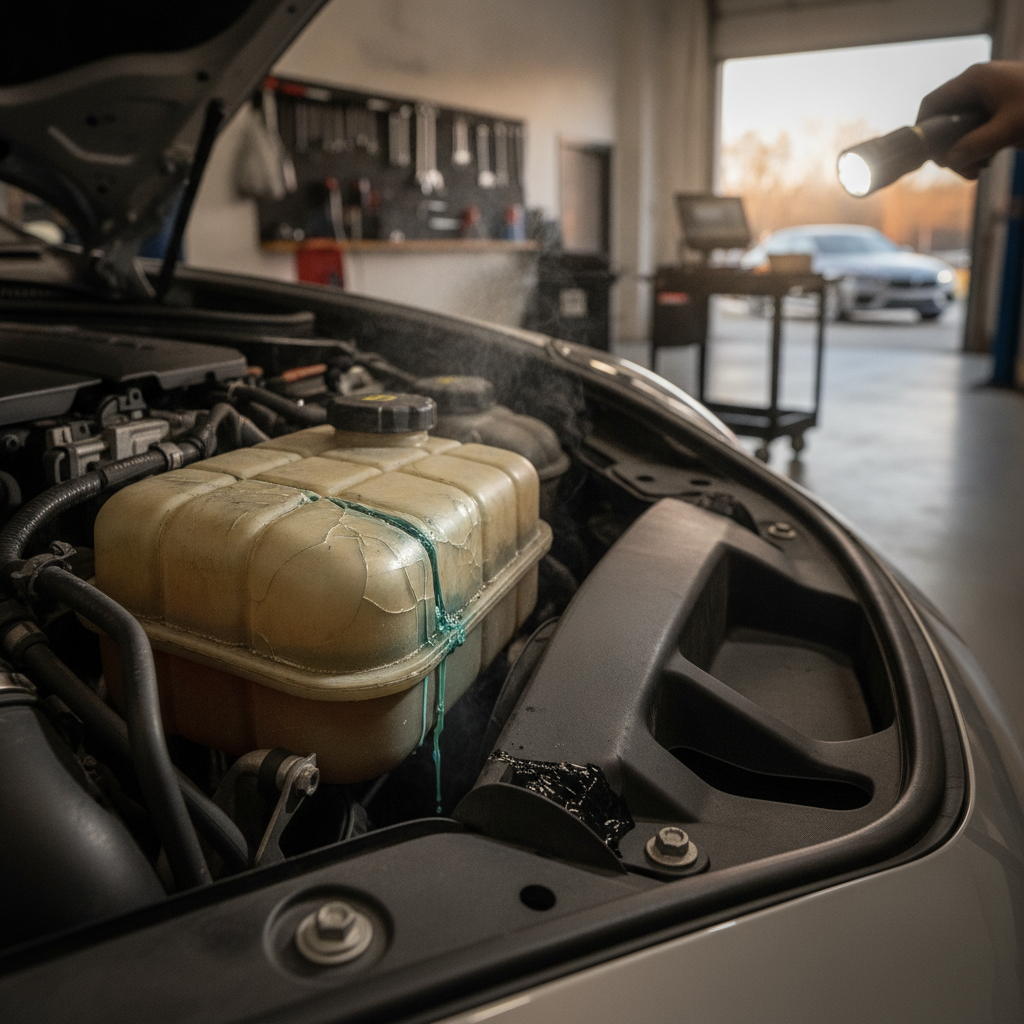
Why Is My Porsche or BMW’s Coolant Reservoir Cracking or Leaking? What Alpharetta Owners Should Know About Expansion Tank Failure
If you’ve noticed a sweet smell near your engine bay, a low coolant warning on your instrument cluster, or a puddle of greenish or pinkish fluid under your car after parking overnight, your coolant expansion tank may be cracking or leaking. For Porsche and BMW owners in Alpharetta and across North Fulton County, this is not a minor inconvenience — it’s a failure mode that can escalate to a complete engine overheat within miles if it goes unaddressed. The good news is that expansion tank failure is predictable, diagnosable, and far less expensive to fix proactively than the engine damage that follows if you ignore it.
What Is a Coolant Expansion Tank — and Why Does It Fail?
Unlike older vehicles that used simple overflow bottles, modern BMWs and Porsches use a pressurized expansion tank — also called a coolant reservoir — as an active part of the cooling circuit. The system is sealed and pressurized, meaning the tank handles significant thermal stress every time your engine heats up and cools down. On a vehicle that commutes daily through GA-400 stop-and-go traffic, that’s repeated heating and cooling cycles, day after day, year after year.
The tanks themselves are made from plastic — a cost and weight decision from the factory — and that plastic becomes brittle over time. Heat cycling weakens the material at the seams, around the cap fitting, and at the hose connection points. On BMWs, the failure often shows up first as a hairline crack along the side of the tank or a weep around the cap seat. On Porsches, particularly the Cayenne, Panamera, and 911 variants, the expansion tank cap and neck are common weak points, and a failing tank can dump coolant suddenly rather than slowly. Both scenarios can result in rapid coolant loss and an engine that hits dangerous temperatures before you even see the temperature gauge climb.
Warning Signs Alpharetta and North Fulton Owners Should Not Ignore
Expansion tank failure rarely announces itself with a dramatic bang. More often, it develops gradually — which is why so many owners miss it until the problem becomes serious. Here’s what to watch for:
- Low coolant warning light — If your BMW or Porsche is telling you coolant is low but you’re not sure where it’s going, the expansion tank is the first place to inspect.
- Sweet smell from the engine bay — Ethylene glycol has a distinct, almost syrupy odor. If you smell it after parking, you have a leak somewhere in the system.
- Visible staining or residue on the tank — White or tan mineral deposits on the outside of the reservoir are a tell-tale sign of a slow seep around a seam or fitting.
- Coolant puddle under the front of the car — Not all leaks are dramatic. Even a slow drip warrants immediate inspection.
- Temperature gauge climbing higher than usual — Once you’re losing coolant volume, your system can no longer regulate engine temperature effectively. This is the stage you do not want to reach.
- Visible cracks on the reservoir body — On many BMW models, you can inspect the tank visually with the hood open. Hairline cracks are sometimes visible, especially under bright light.
If you’re seeing any combination of these symptoms, don’t top off the reservoir and hope for the best. Have the system inspected by a specialist who understands the specific failure patterns of your make and model.
Why This Matters More in Georgia Than You Might Think
Georgia’s climate is genuinely hard on cooling systems. Summers in Alpharetta and the broader North Fulton area bring sustained heat — daytime temperatures that regularly exceed 90°F — combined with high humidity and the kind of stop-and-go driving conditions that push cooling systems to work harder and longer. A vehicle sitting in traffic on GA-400 with a compromised expansion tank is already running its cooling system near capacity. Add a slow coolant leak, and the margin for error disappears quickly.
It’s also worth noting that temperature cycling in Georgia is more severe than in many northern climates. Winters are mild but do drop below freezing, meaning your coolant mixture is handling both extremes. That repeated contraction and expansion is exactly what fatigues the plastic tank material over time. Most factory coolant tanks on BMWs and Porsches have a realistic service life of roughly six to ten years depending on the model, coolant chemistry, and how hard the vehicle has been driven — not indefinitely.
What Makes Porsche and BMW Expansion Tank Failure Different From Other Vehicles
This is the section that most general repair shops — and even a few European specialists — don’t get quite right. Because the expansion tank on a BMW or Porsche is a pressurized, active component rather than a passive overflow bottle, replacing it is not simply a matter of swapping in a new container. The cap must hold system pressure correctly, the hose connections must seal to spec, and the system must be properly bled of air after the repair. Trapped air pockets in a European cooling system can cause localized hot spots, erratic temperature readings, and in some cases, head gasket stress over time.
At Solo Motor Sports in Roswell, our technicians use factory-level procedures for cooling system repairs — including proper pressure testing, OEM or OEM-equivalent replacement parts, and a full system bleed to ensure the repair is complete. A new expansion tank installed without a proper bleed is a repair that’s only half-finished. Preventative maintenance that includes periodic coolant system inspections is the most reliable way to catch tank degradation before it becomes a roadside emergency.
BMW-Specific Expansion Tank Notes
BMW’s inline-six and V8 engines — found across the 3 Series, 5 Series, 7 Series, X5, and X7 — are well-engineered powerplants, but their plastic cooling components are a known long-term liability. The expansion tank, coolant hoses, thermostat housing, and water pump are all components that benefit from proactive replacement rather than reactive repair. Many experienced BMW owners in Johns Creek and Milton replace these components together as a set during higher-mileage services rather than waiting for individual failures, because the labor overlap makes bundled repairs significantly more cost-effective. If your BMW has over 80,000 miles and has never had cooling system work, it’s worth having the entire system evaluated.
Porsche-Specific Expansion Tank Notes
Porsche owners — particularly those driving Cayenne, Macan, or Panamera models — should be aware that expansion tank failure can be abrupt rather than gradual on some configurations. The pressurized cap and tank neck assembly on several Porsche models has a documented tendency to fail at the connection point rather than developing a slow seep first. Owners in Sandy Springs and the broader North Fulton area who use their Porsches as daily drivers should have the coolant system inspected annually, particularly once the vehicle passes the five-year mark. For performance-oriented 911 owners, the stakes are even higher — a mid-drive coolant failure on a vehicle with a flat-six is not an experience you want. Our Porsche repair and service specialists at Solo Motor Sports understand the specific failure patterns across the model range and can give you an honest assessment of where your vehicle stands.
What the Repair Looks Like — and What It Costs to Ignore It
Expansion tank replacement on a BMW or Porsche is a straightforward repair when handled proactively. The tank itself, an OEM or OEM-equivalent cap, and any degraded hoses at the connection points are replaced, the system is refilled with the correct coolant specification for your vehicle, and the circuit is properly bled. Depending on the model, additional components like the thermostat or coolant temperature sensor may be recommended if they’re showing wear during the same service window.
The cost of ignoring the failure is a different conversation entirely. A blown head gasket on a BMW inline-six or a warped cylinder head on a Porsche flat-six can run into the thousands of dollars — repairs that could have been avoided with a fraction of that investment in proactive cooling system maintenance. The diagnostic work alone to assess the extent of overheating damage on a European engine is time-consuming and expensive. If you want a broader look at the overall condition of your vehicle, a multi-point inspection is a practical starting point that covers the cooling system alongside brakes, suspension, fluids, and other key components.
Frequently Asked Questions
How do I know if my BMW or Porsche’s coolant reservoir needs replacement versus just a new cap?
A failing cap will cause the system to lose pressure, which can result in coolant boiling over at lower temperatures than normal. A cracked tank body is a separate failure. A pressure test can distinguish between the two — and often both are replaced together since the parts are inexpensive relative to the labor.
Can I keep driving if my coolant level is slightly low?
Only if you top it off immediately with the correct coolant type and have the source of the loss diagnosed right away. Continuing to drive with a dropping coolant level is a significant risk of engine overheating. Don’t treat a recurring low coolant reading as normal.
What coolant type does my BMW or Porsche require?
BMW specifies its own blue-formula coolant (BMW Coolant/Antifreeze), while Porsche requires a specific pink or violet-formula coolant. Using a generic green or orange universal coolant can damage seals and cause corrosion in European aluminum cooling systems. Always use the OEM-specified fluid.
How long does a coolant expansion tank replacement take?
Most expansion tank replacements can be completed within one to three hours depending on the model. If additional cooling system components are being replaced at the same time, plan for more time. We aim to provide same-day turnaround for most cooling system services.
Does Solo Motor Sports service other European makes with cooling system issues?
Yes. We service BMW, Porsche, Mercedes-Benz, Audi, Volkswagen, Land Rover, Volvo, Maserati, Mini Cooper, Aston Martin, Ferrari, Lamborghini, and more. Cooling system failures are common across European and luxury makes, and each has its own failure patterns and fluid specifications that require make-specific expertise.
Don’t Wait for the Temperature Gauge to Climb
If you’re in Alpharetta, Roswell, Milton, Johns Creek, Sandy Springs, or anywhere in North Fulton County and you’re seeing any signs of a coolant leak on your BMW or Porsche, the right move is to get it diagnosed before it becomes a bigger problem. At Solo Motor Sports, we use dealership-level diagnostic equipment, genuine and OEM-equivalent parts, and factory-trained repair procedures — without dealership pricing or dealership upsells. Our technicians know European cooling systems specifically, not just generally, and we’ll give you a straight answer about what your vehicle needs and why.
Contact us today to schedule an inspection or request an appointment. Reach out to Solo Motor Sports here — we’re easy to get to from the GA-400 corridor and serve owners throughout the Roswell and North Fulton area.