
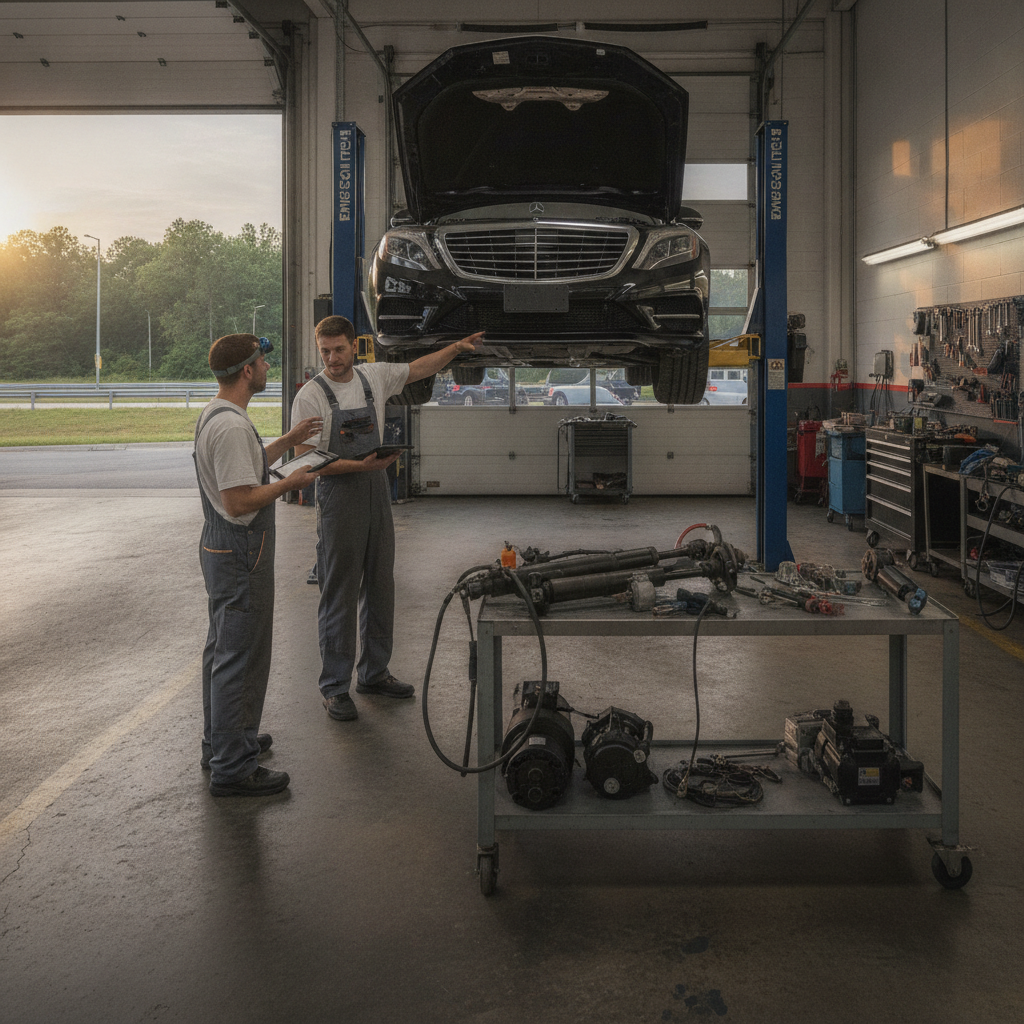
Why Is My Mercedes-Benz Suspension Riding Rough? What Roswell and Alpharetta Owners Should Know
If your Mercedes-Benz has started riding rough, sitting unevenly, bottoming out over speed bumps, or swaying through turns the way it never used to, the suspension system is almost certainly at fault. This isn’t the kind of problem that resolves itself — and for Mercedes owners in Roswell and Alpharetta, it tends to get more expensive the longer it goes unaddressed. The good news is that a proper diagnosis from a European specialist will tell you exactly what’s failing, what it will cost, and whether a repair or a component replacement makes the most sense for your specific model and mileage.
Mercedes-Benz Suspension Is Not One-Size-Fits-All
This is where a lot of general repair shops get into trouble. Mercedes-Benz has used several fundamentally different suspension architectures across its model lineup, and treating them interchangeably leads to misdiagnosis, wasted money, and parts that don’t fix the actual problem.
The three systems you’re most likely to encounter in North Fulton County driveways are:
- AIRMATIC: The air suspension system used on models like the E-Class, S-Class, GLE, and GLS. AIRMATIC uses air struts and an onboard compressor to maintain ride height and adjust damping electronically. When the compressor fails or an air strut develops a leak, the vehicle will visibly sag — sometimes on just one corner — and the ride becomes harsh or wallowing depending on which component has failed.
- ABC (Active Body Control): A hydraulic suspension system found primarily in older S-Class and CL-Class models. ABC is sophisticated, effective, and notoriously expensive to repair when ignored. Warning signs include a harsh, stiff ride, visible body roll, and an ABC warning light on the dash.
- Conventional coil-over or multilink suspension: Used across many C-Class, E-Class, and GLC models. These systems rely on struts, control arms, bushings, and ball joints — all of which wear out predictably but need to be inspected and replaced on schedule.
A shop that doesn’t know which system your vehicle uses — or that treats all three the same way — is going to cost you time and money before you ever get an accurate repair estimate.
The Warning Signs You Shouldn’t Ignore in Stop-and-Go Traffic
If you’re commuting along GA-400 or navigating surface streets through Alpharetta or Sandy Springs every day, you already know how much stop-and-go traffic stresses a vehicle’s suspension. The repeated compression and rebound of daily driving accelerates wear on strut mounts, bushings, and air components — especially in Georgia’s heat, which shortens the life of rubber and compressed-air fittings alike.
Watch for these warning signs:
- The vehicle sits noticeably lower on one side or all four corners at startup
- You hear a clunking, knocking, or creaking noise over bumps or during turns
- The car takes longer than it used to to level itself after starting
- You notice excessive nose-dive under braking or body roll in corners
- A suspension or ABC warning light has appeared on your instrument cluster
- The ride quality has shifted from smooth and controlled to harsh and jittery — or the opposite, to vague and floaty
None of these symptoms are cosmetic. They affect handling, tire wear, braking performance, and — in the case of ABC or AIRMATIC failures — can leave you stranded if the compressor or pump fails completely.
What Competitors in the Area Aren’t Telling You About AIRMATIC and ABC Repairs
Most European auto repair shops in the Roswell and Alpharetta corridor advertise Mercedes service, but very few go into detail about how they handle AIRMATIC and ABC systems specifically. That matters because the diagnostic process for these systems is not the same as for a conventional strut replacement. You need factory-level scan tools to read the air suspension control module, interpret fault codes, and distinguish between a failed compressor, a leaking strut, a faulty valve block, or a bad sensor — all of which produce similar symptoms on the surface.
At Solo Motor Sports, the diagnostic process starts with reading the suspension control module directly, not guessing based on symptoms alone. That distinction is what separates an accurate repair estimate from a costly trial-and-error approach where you’re replacing components one at a time and hoping the problem goes away.
It’s also worth knowing that converted AIRMATIC systems — where air struts are replaced with conventional coil-over conversion kits — may lower your upfront cost but will change your vehicle’s ride character permanently and can affect resale value. That’s a trade-off worth discussing openly before any work begins, not something that should be decided for you.
How Milton and Johns Creek Mercedes Owners Are Getting Overcharged at Dealerships
Dealership pricing for Mercedes suspension work in this part of North Fulton County tends to run significantly higher than what a qualified independent specialist charges for the same OEM parts and labor. This is partly overhead, partly markup on parts, and partly the assumption that Mercedes owners will simply pay whatever the service advisor quotes. Many do — until they realize there’s a better option available a few miles away.
A legitimate European specialist uses genuine or OEM-equivalent parts, employs factory-trained technicians who specialize in Mercedes-specific systems, and provides a warranty on parts and labor. The repair itself is identical in quality. The difference is in the pricing and the transparency of the process.
If you’ve been quoted a number at a dealership that made your stomach drop, it’s worth getting a second opinion from a specialist who can show you exactly what’s worn, explain why it needs replacement, and give you an honest cost comparison before you commit.
A multi-point inspection is often the right starting point — it gives you a complete picture of your vehicle’s suspension, brakes, tires, and fluids so you can prioritize what needs immediate attention and what can wait.
What to Expect From a Suspension Diagnosis and Repair
A thorough suspension diagnosis on a Mercedes-Benz typically involves a visual inspection of all suspension components, a road test to confirm symptoms, and a full scan of the suspension control modules with Mercedes-compatible diagnostic equipment. From there, a technician should be able to identify the specific failed component — or components — and provide a clear repair estimate with parts and labor broken out.
Common repairs and their typical scope include:
- AIRMATIC strut replacement: One or both front or rear air struts, often paired with a compressor inspection or replacement depending on age and condition
- Compressor replacement: The AIRMATIC compressor has a finite service life and often fails on higher-mileage S-Class and GLE models
- ABC hydraulic pump or valve block: The most involved repair in the Mercedes suspension catalog — requires a specialist and the right tooling
- Control arm and bushing replacement: Common on C-Class and E-Class models with conventional suspension; usually paired with a wheel alignment
- Strut mount replacement: Often the source of clunking noises; frequently overlooked when only struts are replaced
Any suspension repair should be followed by a proper four-wheel alignment. Skipping alignment after suspension work is one of the most common mistakes owners make — and it leads to accelerated tire wear and handling problems that bring them right back in.
Frequently Asked Questions
How long does a Mercedes AIRMATIC compressor last?
Most AIRMATIC compressors last between 80,000 and 120,000 miles, though Georgia’s heat and heavy stop-and-go driving can shorten that range. If your vehicle is slow to level after startup or is running the compressor constantly, have it inspected before it fails completely.
Can I drive my Mercedes if the suspension warning light is on?
It depends on the fault. Some suspension faults are minor sensor issues; others indicate a component that is actively failing and affecting vehicle stability. Don’t assume it’s safe to ignore — get a diagnostic scan as soon as possible.
Is converting from AIRMATIC to coil-overs a good idea?
Conversion kits lower the upfront cost of repair, but they permanently change the ride quality of a vehicle engineered for air suspension. They can also affect resale value and may not be covered under any remaining warranty. It’s a legitimate option in some cases, but it should be a fully informed decision — not the default recommendation.
How much does Mercedes suspension repair cost in Roswell compared to a dealership?
Independent European specialists in the Roswell area typically charge meaningfully less than Mercedes-Benz dealerships for the same repair using OEM or genuine parts. The exact difference depends on the specific repair and parts involved. Contact Solo Motor Sports for a transparent estimate before committing to dealership pricing.
Do you service Mercedes-Benz models from all years and generations?
Yes. Solo Motor Sports services Mercedes-Benz vehicles across all model lines and generations, from older W211 and W220 chassis to current GLE, GLS, S-Class, and C-Class models. Suspension systems vary significantly by generation, which is why make-specific expertise matters.
Get a Straight Answer on Your Mercedes Suspension — Without Dealership Prices
If your Mercedes-Benz is riding rough, sitting low, or showing a suspension warning light, you don’t need to hand it over to a dealership and accept whatever estimate comes back. Solo Motor Sports in Roswell has the diagnostic tools, factory-trained technicians, and make-specific experience to give you an honest assessment and a repair that’s done right the first time.
Owners from Alpharetta, Johns Creek, Milton, Sandy Springs, and across North Fulton County bring their Mercedes here because they want dealership-level expertise without the dealership markup. Contact us today to schedule a suspension inspection or request a second opinion on a dealer quote — we’ll give you the information you need to make the right decision for your vehicle.