
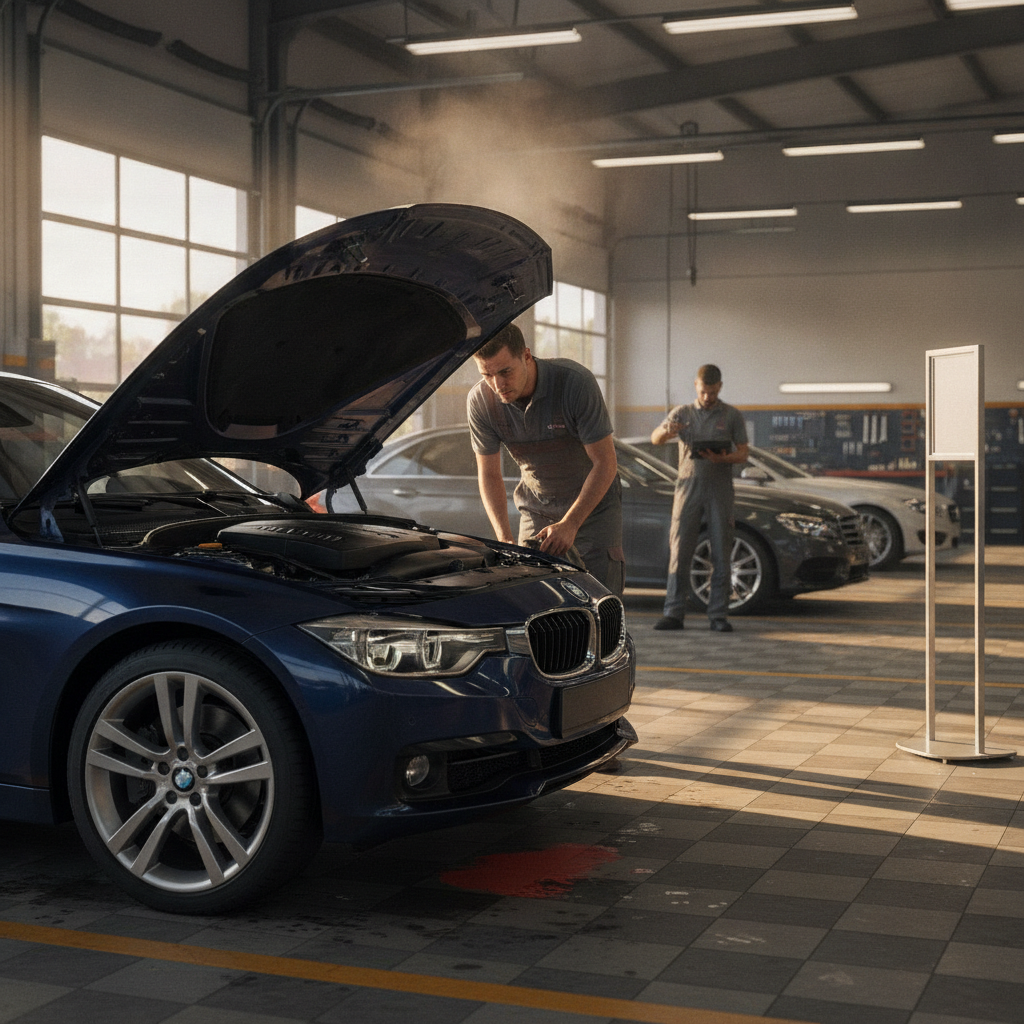
Why Is My BMW or Audi Overheating? What Sandy Springs Drivers Should Do First
If your temperature gauge is climbing, steam is rising from under the hood, or your dashboard is flashing a coolant warning, pull over — carefully, and immediately. An overheating European vehicle is not a “drive it and see” situation. For BMW, Audi, Volkswagen, and Mercedes drivers in Sandy Springs and throughout the North Fulton area, overheating is one of the most common causes of severe engine damage, and it almost always starts with a cooling system component that could have been caught early. Here’s what’s likely happening, what you should do in the moment, and why a European specialist matters more than ever when it comes to diagnosing the root cause.
Why European Vehicles Are Particularly Vulnerable to Cooling System Failures
European manufacturers engineer their vehicles for performance and efficiency, which often means tighter tolerances throughout the drivetrain — including the cooling system. That precision works beautifully under normal conditions. Under the stop-and-go traffic of GA-400 during a Georgia summer, it becomes a liability if maintenance has slipped even slightly.
Unlike domestic vehicles, many European platforms use plastic-and-aluminum coolant systems. Plastic expansion tanks, thermostat housings, and coolant flanges crack over time — especially when they’re subjected to repeated heat cycles in Atlanta metro traffic. BMW’s inline-six and V8 engines are notorious for plastic water pump impeller failures. Audi’s 2.0T and 3.0T engines have well-documented thermostat housing issues. Volkswagen’s timing-driven water pumps are on a service interval most owners don’t know exists until something goes wrong.
Add Georgia’s July and August heat to a highway-speed commute, and a cooling system that’s 80% functional can tip into failure faster than you’d expect.
The Most Common Cooling System Failures by Make
BMW
BMW’s N52, N54, N55, and S55 engines all share a common weakness: the electric water pump. Unlike traditional belt-driven pumps, BMW uses an electronically controlled pump that can fail without obvious warning. When it does, coolant stops circulating — and temperatures climb fast. The plastic expansion tank is another frequent failure point, often developing hairline cracks that leak slowly until the system loses pressure entirely. If your BMW is showing an intermittent temperature spike, especially after extended idling or city driving, a failing water pump or expansion tank should be the first thing a technician checks.
Audi and Volkswagen
Audi and Volkswagen vehicles share many platforms, and their cooling vulnerabilities often overlap. The thermostat housing on the 2.0T TSI engine is a known weak point — it’s made of plastic, sits directly on the engine block, and cracks under thermal stress. A failing thermostat can cause the engine to run either too hot or inconsistently, which damages components over time even if it doesn’t trigger an immediate overheat. On older VW models with timing belt-driven water pumps, the pump is typically replaced at the timing belt service interval — but only if your technician knows to spec it. A shop that doesn’t specialize in European vehicles may miss this entirely.
Mercedes-Benz
Mercedes cooling systems are generally robust, but the M272 and M273 V6 and V8 engines have a history of balance shaft and oil pump sprocket failures that can mimic overheating symptoms while causing deeper mechanical damage. On many Mercedes models, coolant lines and the radiator itself require OEM-spec coolant — mixing incompatible fluids causes silicate buildup and accelerates corrosion. This is a common mistake made at shops that aren’t Mercedes-fluent.
What to Do If Your Car Starts Overheating Right Now
This matters, because the decisions you make in the next five minutes can be the difference between a $400 repair and a $6,000 engine rebuild.
- Turn off the A/C immediately and, if safe to do so, turn the heat on full blast. This redirects heat away from the engine through the cabin heater core.
- Pull over as soon as it’s safe. Do not try to make it home or to a shop — every additional minute at elevated temperature risks warping cylinder heads or cracking the block.
- Do not open the hood immediately. Wait at least 15–20 minutes for pressure to drop before approaching the coolant reservoir.
- Never add cold water to a hot engine. Thermal shock can crack the block or the head. If you need to add fluid, let the engine cool completely first.
- Call for a tow if the temperature gauge is in the red. This is not the time to drive it in.
Once the vehicle is cooled, a full diagnostic inspection is essential before you drive it again. Overheating symptoms without an obvious external leak almost always point to a failed component — not just low coolant.
Why This Is a Gap Most Local Shops Don’t Address Properly
Most European auto repair shops in the Roswell and Sandy Springs area list cooling system service as something they offer — but few go into what that actually means for specific platforms. Replacing a radiator on a BMW is not the same job as replacing one on a VW Tiguan, and the diagnostic process for each is completely different. Without factory-level scan tools and make-specific knowledge, a technician may clear a coolant warning code without identifying the underlying component failure. You’ll drive home thinking the problem is solved, and two weeks later you’re back — with more damage.
At Solo Motor Sports, cooling system work starts with a proper diagnosis using dealership-level diagnostic equipment. That means reading live coolant temperature data, checking water pump performance electronically (on BMWs with electric pumps), pressure-testing the system, and inspecting every plastic component in the coolant circuit — not just the obvious ones. For vehicles like the BMW models we service regularly, we know exactly which components fail first and at what mileage to expect them.
The North Fulton Heat Factor
Sandy Springs, Alpharetta, Johns Creek — the entire GA-400 corridor sits in one of the most thermally demanding environments a vehicle can face. Georgia summers routinely push ambient temperatures above 90°F, and asphalt temperatures on I-285 or Highway 9 can exceed 140°F. When you add stop-and-go commuting to those conditions, your European vehicle’s cooling system is working significantly harder than the manufacturer designed for in a more temperate climate.
This is why preventative cooling system maintenance — not just reactive repair — matters so much in North Fulton. Coolant flushes on the correct interval with the right fluid specification, thermostat inspections, and water pump checks at high mileage aren’t optional service upsells. They’re the difference between a vehicle that lasts 200,000 miles and one that needs a head gasket at 90,000.
Frequently Asked Questions
How do I know if my BMW’s water pump is failing before it causes overheating?
Common early signs include a slightly elevated temperature gauge during city driving or idling, intermittent coolant warning lights, and in some cases a soft whirring or grinding noise near the front of the engine. On BMWs with electric water pumps, a fault code will often appear before complete failure — which is exactly why regular diagnostics catch this before it becomes an emergency.
Can I drive my Audi if it’s running slightly hot but not in the red?
Not recommended. A temperature reading above normal — even if it hasn’t reached the red zone — means your cooling system is already struggling. Continued driving accelerates damage to gaskets, seals, and in some cases the cylinder head. Get it inspected the same day if possible.
Does the type of coolant really matter for European cars?
Absolutely. BMW, Audi, Mercedes, and Volkswagen all specify particular coolant chemistries — often phosphate-free or OAT-based formulas. Using the wrong coolant causes corrosion inside the cooling system, particularly to aluminum components, and will void cooling system warranty coverage. Your technician should always use the OEM-specified fluid for your make.
How much does a cooling system repair typically cost on a European vehicle?
It varies significantly by make, model, and what component has failed. A water pump replacement on a BMW with an electric pump will differ substantially in cost from a thermostat housing replacement on an Audi 2.0T. The best approach is a proper diagnostic first — that tells you exactly what needs to be replaced and prevents unnecessary parts from being swapped in. Solo Motor Sports provides honest, upfront estimates before any work begins.
Is Solo Motor Sports able to handle cooling system repairs for less common European makes like Maserati or Land Rover?
Yes. In addition to BMW, Audi, Mercedes, and VW, Solo Motor Sports services the full range of European and luxury imports — including Land Rover, Maserati, Volvo, Porsche, and more. Each make requires specific knowledge and parts sourcing, and our technicians are trained across all of them.
Don’t Wait Until You’re on the Side of GA-400
Cooling system failures rarely announce themselves with much warning. By the time your gauge is in the red, damage may already be underway. If you’ve noticed your temperature creeping higher than normal, a coolant warning light appearing and disappearing, or any sweet smell coming from under the hood, that’s your vehicle telling you it needs attention now — not next month.
Solo Motor Sports serves Sandy Springs, Roswell, Alpharetta, Johns Creek, and the surrounding North Fulton area with dealership-level diagnostics and European-specialist knowledge — without dealership pricing or the upsell culture that comes with it. Contact us today to schedule a cooling system inspection or describe what you’re seeing and we’ll point you in the right direction.