
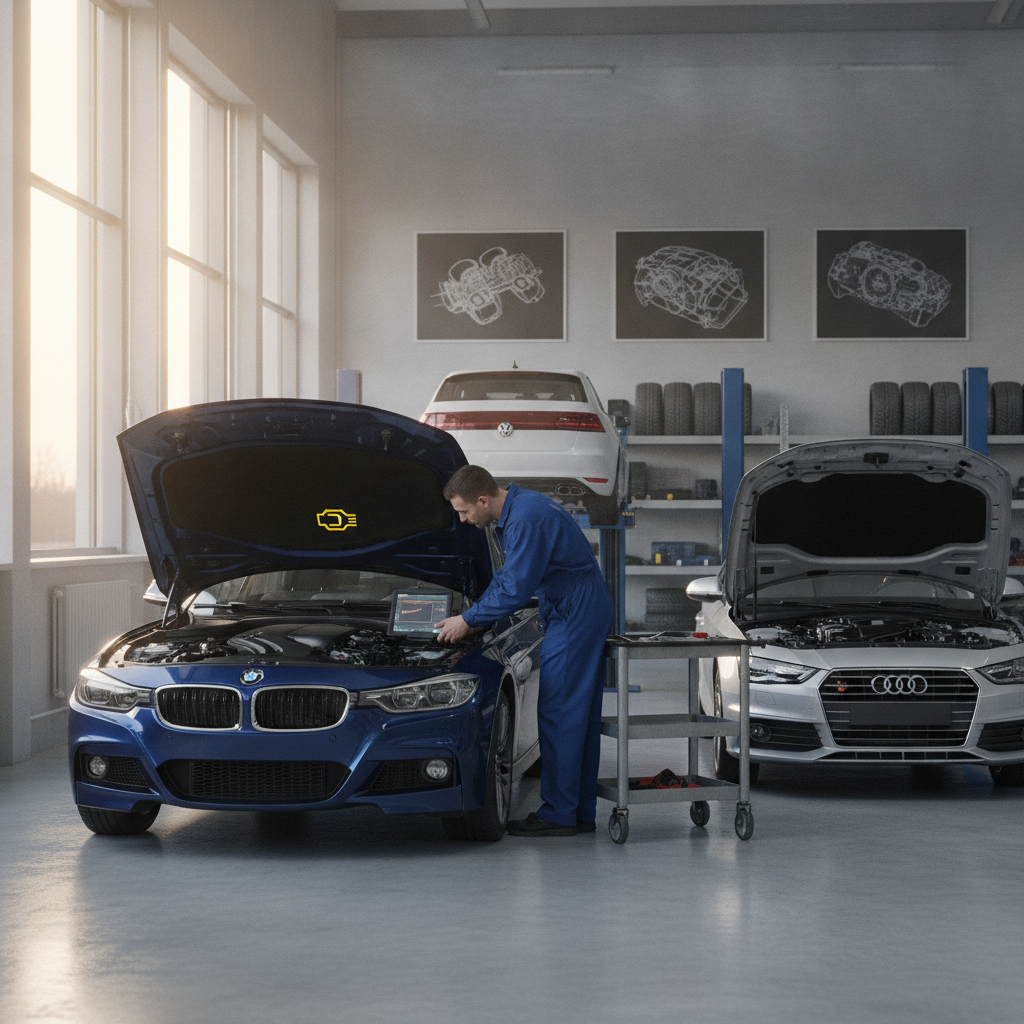
Why Is My Check Engine Light On? A European Car Owner’s Guide to Diagnostics in Alpharetta
That amber glow on your dashboard is one of the most misunderstood signals in modern motoring — and if you drive a European vehicle in Alpharetta or anywhere along the GA-400 corridor, the stakes are higher than they are for the average commuter car. A check engine light on a BMW, Audi, Volkswagen, or Mercedes-Benz is rarely a simple fix, and a generic code reader from an auto parts store won’t tell you the full story. Here’s what’s actually happening, why European vehicles demand a more precise diagnostic approach, and how to get a real answer without paying dealership prices to find out.
What a Check Engine Light Actually Means on a European Vehicle
The check engine light — technically the malfunction indicator lamp (MIL) — illuminates when your car’s onboard computer detects a fault it can’t resolve on its own. On any modern vehicle, this is triggered by a stored fault code. But on European makes like BMW, Audi, Volkswagen, and Mercedes-Benz, the story doesn’t end there.
These vehicles use proprietary manufacturer-specific diagnostic protocols layered on top of the standard OBD-II system. A generic scan tool reads OBD-II codes — the universal language all cars have spoken since 1996. But BMW’s ISTA platform, Audi’s ODIS system, and Volkswagen’s VAG-COM suite go several layers deeper, reading sub-system faults, live sensor data, adaptations, and module-to-module communication that a $50 reader simply cannot access.
What this means practically: a generic scan might tell you there’s an oxygen sensor fault. The manufacturer-level scan tells you which sensor, whether it’s a wiring issue or the sensor itself, what the downstream impact on your fuel trim and catalytic converter looks like, and whether a software update is part of the fix. That’s the difference between a correct repair and a parts-replacement guessing game.
Common Reasons European Cars Trigger the Check Engine Light
Across the BMW, Audi, Volkswagen, and Mercedes vehicles we service at Solo Motor Sports, these are the most frequent culprits behind a check engine warning in the North Fulton area:
- Ignition coil or spark plug failure — BMW N54 and N55 engines, as well as many Audi and VW four-cylinders, are known for coil pack issues. You may also notice a rough idle or misfire under acceleration.
- Carbon buildup on intake valves — Direct-injection engines, including a wide range of modern European motors, don’t benefit from fuel washing the intake valves. Carbon deposits accumulate over time, triggering misfires and fault codes.
- Oxygen or NOx sensor faults — Particularly common on high-mileage diesel models and late-model BMWs. Atlanta’s stop-and-go GA-400 traffic accelerates wear on these sensors.
- EVAP system leaks — A loose or degraded gas cap is often the culprit, but failing purge valves and charcoal canisters are common on European platforms and require proper leak-down testing to diagnose accurately.
- Coolant temperature sensor or thermostat faults — Georgia’s heat and humidity put real stress on cooling systems. A failing thermostat or temperature sensor frequently triggers a check engine light before any visible overheating occurs.
- Transmission control module faults — European dual-clutch and ZF automatic transmissions monitor dozens of parameters. A fault code here warrants immediate attention rather than a wait-and-see approach.
Why a Generic Code Reader Isn’t Enough for Your German Car
This is the gap that most local shops — and frankly, most of the competitor sites serving the Alpharetta and Roswell corridor — don’t address clearly enough. They’ll mention diagnostics, but rarely explain why the tool matters as much as the technician using it.
Here’s the issue: many general repair shops invest in one or two mid-grade scan tools and call it a day. Those tools handle domestic vehicles well. For a BMW with iDrive, an Audi with MMI integration, or a Volkswagen with a complex DSG transmission, you need access to the same software the factory uses — or as close to it as possible. At Solo Motor Sports, our technicians use professional-grade, manufacturer-compatible diagnostic platforms that give us the same depth of system access you’d get at a dealership, without the service department markup.
That matters because accurate diagnostics protect you from unnecessary repairs. If a shop can’t read beyond the surface-level code, they may replace a part that wasn’t the root cause — and your check engine light comes back on within weeks. We see this regularly from customers in Johns Creek and Sandy Springs who visited a general shop first and are now paying twice.
What to Expect at a Proper European Diagnostic Appointment
When you bring your vehicle to Solo Motor Sports for a check engine light concern, here’s what a thorough diagnostic process actually looks like:
- A full system scan — not just the powertrain, but transmission, ABS, SRS, and any other modules throwing stored or pending codes
- Live data review — monitoring real-time sensor values to catch intermittent faults that don’t always store a code
- Component-level testing where appropriate — verifying that the suspected part is actually the failure point before recommending a replacement
- A clear, written explanation of findings — what the fault is, what caused it, what happens if it’s left unaddressed, and what the repair involves
You shouldn’t leave a diagnostic appointment with a vague answer. You should leave knowing exactly what’s wrong, why it matters, and what it costs to fix it. That’s what transparent service looks like. Learn more about the full range of services we provide at Solo Motor Sports.
Alpharetta and North Fulton Drivers: Why Your Driving Conditions Matter
The driving environment here isn’t kind to European vehicles — even well-maintained ones. The GA-400 corridor through Alpharetta, Milton, and into Roswell is one of the most congested stretches of roadway in the metro Atlanta area. Constant stop-and-go cycles push cooling systems, transmission fluid temperatures, and brake components harder than highway driving does. Add Georgia’s summer heat and humidity, and you have conditions that accelerate wear on the precise mechanical systems that European engineers calibrated for different climates.
If your check engine light comes on during or after a long commute — especially if it’s paired with rough idle, sluggish acceleration, or unusual smells — that’s not a coincidence. It’s the car telling you that something accumulated stress has crossed a threshold. The right response is a prompt, accurate diagnosis — not a reset and a wait-and-see.
Can You Drive With the Check Engine Light On?
This is one of the most common questions we hear, and the honest answer is: it depends. A steady check engine light with no other symptoms — no overheating, no rough running, no loss of power — is typically lower urgency. A flashing or blinking check engine light is a different situation entirely. On European vehicles, a flashing MIL almost always indicates an active misfire severe enough to damage the catalytic converter. Pull over safely and call for assistance.
Either way, you should have the fault diagnosed within a few days of the light appearing. Waiting longer risks turning a relatively minor repair into a cascading failure. Staying current with preventative maintenance is the single most effective way to keep warning lights from appearing in the first place.
Frequently Asked Questions
Will the check engine light go off on its own?
Sometimes. If the fault was intermittent — say, a brief sensor glitch or a loose gas cap — the light may clear after a few drive cycles once the computer confirms the issue isn’t recurring. But the fault code remains stored in the system. It’s still worth having it scanned to understand what triggered it.
Can I just reset the code without fixing anything?
You can, but it’s not a repair. The code will return if the underlying problem isn’t resolved. In some cases, a reset can also clear important diagnostic data that helps identify the root cause — making the technician’s job harder and your repair more expensive.
Does a check engine light affect my vehicle’s performance?
Yes, often. Many European vehicles enter a reduced-performance or “limp mode” when certain faults are detected — limiting boost, throttle response, or transmission shift points to protect the engine. You may not realize this is happening until you compare how the car feels after the repair.
How much does a diagnostic scan cost at Solo Motor Sports?
We encourage you to contact us directly for current pricing and any specials. What we can tell you is that our diagnostic fee is applied toward the repair cost when you choose to proceed with us — so it’s not an additional charge on top of the repair bill.
Do you service all European makes, or just German cars?
We work on the full range of European and import vehicles — BMW, Audi, Volkswagen, Mercedes-Benz, Porsche, Land Rover, Mini Cooper, Volvo, Maserati, Jaguar, Ferrari, Lamborghini, Aston Martin, Bentley, and Rolls Royce. If it came from Europe, we have the tools and training to work on it properly.
Get a Real Answer — Not Just a Reset
A check engine light on a European vehicle deserves a European specialist’s response. Owners in Alpharetta, Johns Creek, Sandy Springs, Milton, and throughout North Fulton County trust Solo Motor Sports because we use the right tools, explain what we find in plain language, and never recommend a repair we can’t justify. Our ASE-certified, factory-trained technicians treat your car the way you expect it to be treated — with precision and respect for what it is.
Don’t guess. Don’t wait. Schedule your diagnostic appointment with Solo Motor Sports today and get the accurate answer your vehicle deserves.