
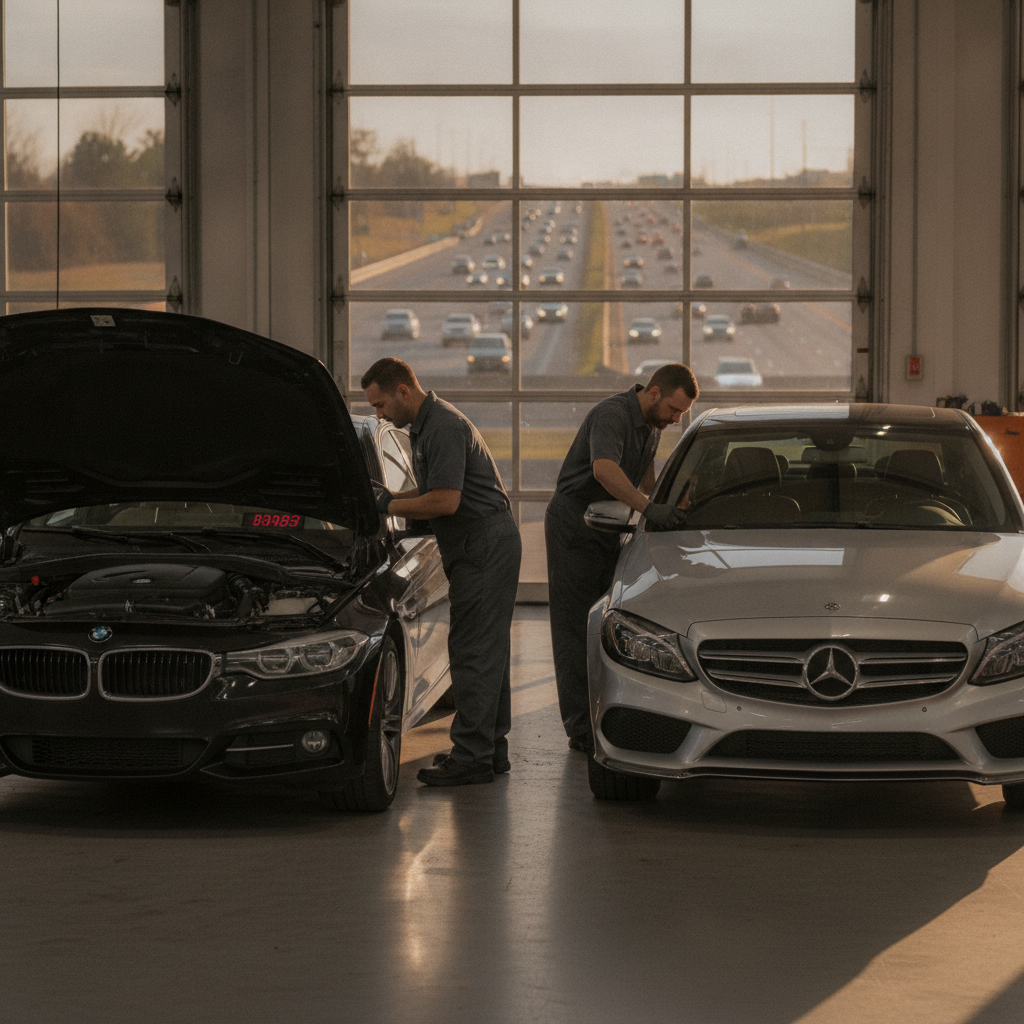
Why Is My BMW or Mercedes Overheating in Stop-and-Go Traffic? What Roswell Owners Should Know About Cooling System Failures
If your temperature gauge starts creeping toward the red every time you’re crawling along GA-400 in Roswell rush-hour traffic, your BMW or Mercedes is telling you something urgent. Overheating in slow or stopped traffic is one of the clearest warning signs of a cooling system under stress — and in European vehicles, it’s a problem that can escalate from a minor repair to a destroyed engine faster than most owners realize. The good news is that most cooling system failures follow a predictable pattern, and catching them early makes all the difference.
Why Stop-and-Go Traffic Is Especially Hard on European Cooling Systems
When you’re moving at highway speed, airflow through your grille does a significant share of the work keeping your engine cool. The moment traffic grinds to a halt — whether you’re on GA-400 near the Holcomb Bridge exit, sitting at a red light on Alpharetta Highway, or idling in construction near Sandy Springs — your cooling system has to carry that entire load on its own. The electric cooling fan, water pump, and radiator are suddenly working overtime with no help from forward motion.
European engines from BMW and Mercedes-Benz are precision-engineered to run within very specific temperature tolerances. The electronics, valve timing, and fuel mapping all assume a stable thermal environment. When temperatures start climbing past that threshold, your engine management system begins making compensations — and if the cooling system can’t recover, you’re looking at warped cylinder heads, blown head gaskets, or worse. Georgia’s summer heat only amplifies the problem. When ambient temperatures are sitting in the upper 90s, your cooling system’s margin for error shrinks considerably.
The Most Common Causes of Overheating in BMW and Mercedes Vehicles
These are the failure points our technicians see most frequently on European vehicles brought in from Roswell, Johns Creek, and surrounding North Fulton communities:
- Water pump failure: BMW’s plastic impeller water pumps are notorious for degrading over time. The plastic blades become brittle and can crack or spin freely on the shaft, meaning coolant stops circulating effectively even though the pump appears to be running. Mercedes-Benz models have their own water pump vulnerabilities, particularly on the M276 and M278 engines found in C-Class and E-Class models.
- Thermostat stuck closed: European engines use electronically controlled thermostats that fail differently than the mechanical thermostats most older car owners are familiar with. When these stick in the closed position, coolant can’t flow to the radiator to dissipate heat. The temperature gauge climbs quickly — often with very little warning.
- Coolant leaks: Slow leaks from plastic expansion tanks, hose connections, or the radiator itself reduce the volume of coolant in the system. Low coolant means less thermal capacity, and overheating under load — especially in traffic — becomes nearly inevitable.
- Radiator blockage or damage: Road debris, deteriorating fins, and internal scaling can all reduce your radiator’s cooling efficiency. On older BMWs and Mercedes models, internal corrosion and mineral buildup are common causes of reduced flow.
- Cooling fan failure: At low speeds and idle, your electric cooling fan is your primary defense. If the fan motor, relay, or control module fails, you’ll overheat in traffic while the engine runs perfectly fine on the highway — a specific symptom pattern that points directly to this component.
- Head gasket failure: In some cases, overheating isn’t the cause — it’s the symptom of an existing head gasket issue. Combustion gases entering the cooling system create pressure that pushes coolant out and allows the system to overheat unpredictably.
What the Temperature Gauge Is Really Telling You — and When to Pull Over Immediately
One detail that surprises many owners: on modern BMWs and Mercedes-Benz vehicles, the temperature gauge is designed to stay in a narrow band in the center of the dial under normal conditions. If you notice the needle sitting slightly higher than usual, or creeping noticeably toward the red zone, that’s not normal variation — that’s your car asking for attention.
If the gauge reaches the red zone or you see a high-temperature warning light, pull over safely as soon as possible. Do not continue driving. Running a European engine in an overheated state for even a few minutes can warp the aluminum cylinder heads — a repair that runs into thousands of dollars and often isn’t worth the cost on older vehicles. Turning on your cabin heater at full blast can buy you a few minutes of additional cooling capacity by routing heat through the heater core, but it’s a short-term measure, not a fix.
The moment you’re safely stopped, turn the engine off and let it cool before opening the hood. Never open a pressurized coolant reservoir on a hot engine. Let a specialist handle the diagnosis from there.
What Makes Cooling System Diagnosis Different for European Vehicles
This is where general repair shops often fall short — and it’s a gap worth addressing directly. European cooling systems are considerably more integrated with the vehicle’s electronic architecture than domestic or Japanese cars. A BMW’s coolant temperature sensor communicates with the DME (Digital Motor Electronics) unit to manage everything from fan speed to fuel trim. A Mercedes-Benz uses multiple temperature sensors feeding data to the ECU simultaneously.
Diagnosing an overheating issue properly requires factory-level scan tools, not generic OBD readers. A basic code reader might flag a coolant temperature sensor fault, but it won’t tell you whether the thermostat is mechanically failing, whether the water pump impeller has shed its blades, or whether a head gasket is introducing combustion gases into the cooling circuit. That requires a technician with the right equipment and hands-on experience with these specific platforms.
At Solo Motorsports Roswell, our technicians use the same diagnostic tools as the dealer network — without the dealer markup. When your BMW or Mercedes comes in with an overheating concern, we perform a complete multi-point inspection of the cooling system, including pressure testing, fan operation checks, coolant condition analysis, and electronic fault code review. Every repair uses OEM or equivalent-quality parts, and our work is warranty-backed.
How to Prevent Cooling System Failures Before They Happen
Regular preventative maintenance is your best defense. European manufacturers specify coolant flush intervals for a reason — degraded coolant becomes acidic and corrodes internal cooling system components from the inside out. Expansion tanks and hoses made from plastic and rubber have finite service lives that many owners overlook until they fail.
If your BMW or Mercedes has more than 60,000 miles on the original water pump or thermostat, it’s worth having them inspected. On certain BMW inline-six and V8 platforms, proactive water pump replacement before failure is one of the smartest maintenance decisions you can make. The cost of the part and labor is a fraction of what you’ll spend if the pump fails and you end up overheating an engine on the way home from work.
Owners in the Roswell and Alpharetta area deal with some of the most demanding traffic conditions in metro Atlanta. The combination of summer heat, stop-and-go commuting, and a concentration of high-performance European vehicles puts cooling systems under above-average stress. A structured preventative maintenance schedule tailored to your specific make and model is the most reliable way to stay ahead of these failures.
Frequently Asked Questions
My BMW temperature gauge spikes in traffic but goes back to normal on the highway. What does that mean?
That pattern almost always points to the electric cooling fan. When you’re moving, airflow cools the radiator passively. When you’re stopped, the fan has to do that work — and if it’s failing, temperatures climb. Get it diagnosed promptly before the next traffic jam pushes your engine past a safe threshold.
Can I top off my coolant and keep driving if I’m running low?
You can top it off in an emergency, but you should not treat low coolant as a solved problem. Coolant doesn’t disappear without a reason. There’s a leak somewhere — external or internal — and continuing to drive without finding the source risks overheating, further damage, or masking a more serious underlying issue like a leaking head gasket.
How much does it typically cost to repair a BMW or Mercedes cooling system?
Costs vary widely depending on the specific failure. Thermostat replacement is typically a moderate, straightforward repair. Water pump replacement on a BMW inline-six is more involved due to access requirements. A head gasket repair is a major job. The most important thing is accurate diagnosis first — which prevents throwing parts at a problem and missing the actual cause. Contact us for a proper assessment before committing to any repair estimate.
Is it safe to drive my car to the shop if it’s running hot?
If your temperature gauge is in the normal range but you’ve noticed it running higher than usual, driving carefully to a nearby specialist is generally acceptable. If the gauge is approaching the red zone or you’ve seen a warning light, you should not drive it. Call for assistance or have it towed. The risk of engine damage from continued driving is not worth the savings on a tow.
Do Sandy Springs and Johns Creek owners need to worry about overheating more than others?
Any owner in the Atlanta metro area who faces regular stop-and-go commuting is at elevated risk compared to rural drivers. The combination of Georgia summer temperatures and heavy traffic on corridors like GA-400 and GA-141 creates conditions that stress European cooling systems more than their design environment assumes. Staying current on cooling system maintenance is especially important here.
Get Your BMW or Mercedes Cooling System Inspected by a Specialist
A temperature gauge that’s climbing in traffic isn’t something to watch and wait on. Cooling system failures in European vehicles move fast, and the repair costs scale dramatically the longer the problem goes unaddressed. If your BMW, Mercedes-Benz, or any other European vehicle is showing signs of overheating — or if you just want a professional eye on the cooling system before summer really takes its toll — Solo Motorsports Roswell is ready to help.
We serve owners throughout Roswell, Alpharetta, Sandy Springs, Johns Creek, and the broader North Fulton County area with dealership-level expertise and honest, transparent pricing. Contact us today to schedule an appointment and let our ASE-certified technicians diagnose the issue correctly the first time.