
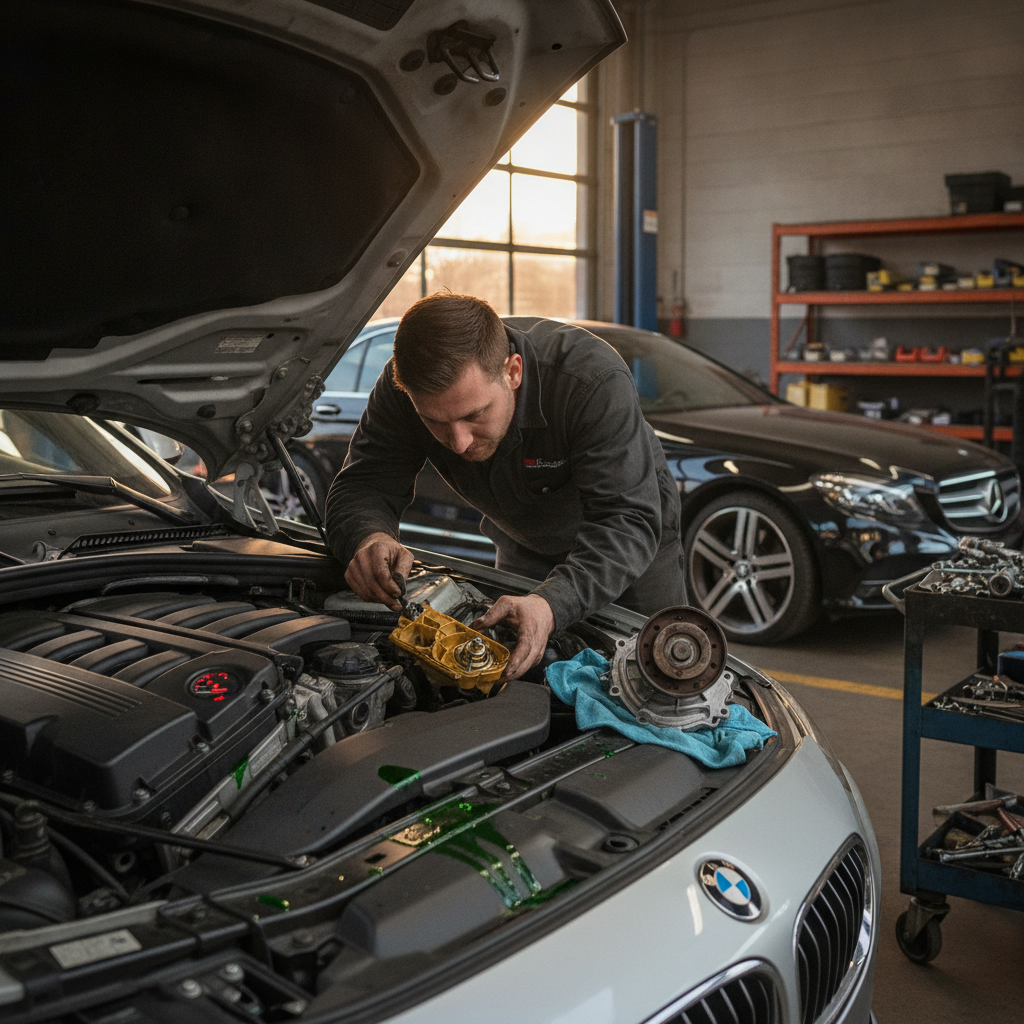
Why Is My BMW or Mercedes Engine Overheating on the Highway? What Roswell Owners Should Know About Water Pump and Thermostat Housing Failure
If your BMW or Mercedes temperature gauge is climbing toward the red while you are cruising up GA-400 — or sitting in the stop-and-go that backs up through Roswell and Alpharetta on a hot Georgia afternoon — you are probably not dealing with a minor inconvenience. You are likely looking at a failing water pump or a cracked thermostat housing, and on a European vehicle, ignoring either one for even a short distance can turn a few-hundred-dollar repair into an engine rebuild. Here is exactly what is happening inside your cooling system, why these parts fail on BMWs and Mercedes-Benz vehicles specifically, and what to do about it before the damage becomes irreversible.
How European Cooling Systems Actually Work — and Why They Fail Differently
BMW and Mercedes-Benz engines run tight tolerances and high compression. To keep everything within operating temperature, they rely on an integrated cooling circuit that moves coolant from the engine through the radiator and back — continuously, precisely, and under pressure. Two components sit at the center of that circuit: the water pump, which circulates coolant mechanically or electrically, and the thermostat housing, which regulates when and how quickly coolant flows based on engine temperature.
On most domestic vehicles, these are heavy cast-iron or metal components that last the life of the car. On many BMWs and Mercedes models, particularly those built from the mid-2000s through the mid-2010s, they are made of plastic and composite materials to reduce weight and improve thermal response. That is smart engineering — until Georgia heat, age, and coolant chemistry work against the material over time. The plastic impeller blades inside a BMW N52 or N54 water pump can shear off completely with no warning. The thermostat housing on a Mercedes M272 or M273 V6 or V8 engine can develop hairline cracks that weep coolant slowly — until they do not.
What Roswell and Alpharetta Drivers Experience First
The early symptoms are easy to miss, especially if you are used to driving a German car that almost never complains. Watch for these:
- The temperature gauge climbs higher than usual during normal highway driving or after sitting in traffic
- A sweet, faintly chemical smell coming from under the hood — that is burning coolant, not a good sign
- A small puddle of pink, green, or orange fluid under the front of the vehicle after parking
- The heater blowing cool air even when the engine is fully warmed up (a classic sign coolant is not circulating)
- A low coolant warning light or temperature alert on the instrument cluster
- In electric water pump applications, a fault code stored in the DME or ECU with no obvious external leak
The challenge in North Fulton County’s driving environment is that both highway and city driving stress the cooling system differently. Long pulls up GA-400 generate sustained heat load. The stop-and-go between Roswell and Sandy Springs keeps the engine idling with limited airflow across the radiator. Summer temperatures in the Atlanta metro — regularly above 90°F — shrink your margin for error significantly. A water pump that is losing efficiency may perform adequately in October and fail catastrophically in July.
The Real Cost of Waiting
This is where many owners make a costly mistake. A water pump replacement on a BMW 3 Series or Mercedes E-Class is a legitimate repair — not trivial, but absolutely manageable. The same repair delayed until the engine overheats and warps a cylinder head, blows a head gasket, or seizes a bearing becomes an entirely different conversation, potentially involving engine removal and partial or full rebuild work.
On some BMW six-cylinder and eight-cylinder engines, the water pump and thermostat are best replaced together because the labor to access one nearly covers the labor for both. A good European specialist will walk you through that logic and let you decide — not just replace one and send you on your way to come back in three months for the other.
At Solo Motor Sports, our technicians use factory-level diagnostic tools to assess coolant system pressure, pump output, and thermostat response before recommending parts. That means you are not guessing — and neither are we.
Why This Is a Topic Most Local Shops Handle Poorly
Most general repair shops — and even some shops that advertise European service in the Roswell and Alpharetta corridor — treat cooling system failures as simple part-swap jobs. They pull the code or observe the symptom, order a replacement part from a general aftermarket supplier, and install it. The problem is that European cooling systems are interconnected. A BMW with a failed water pump may have also stressed the expansion tank, the upper radiator hose, or the coolant temperature sensor. A Mercedes with a cracked thermostat housing often has compromised coolant chemistry from slow, long-term leakage that has introduced air into the system.
Replacing the obvious failed part without flushing the system, pressure-testing the circuit, and inspecting the related components means the repair may fail sooner than it should — or that a second failure appears shortly after. Factory-trained technicians approach European cooling systems as a system, not a single part number.
BMW and Mercedes Water Pump Specifics Worth Knowing
BMW Electric Water Pump Failure (N20, N52, N54, N55, S55 Engines)
Many BMW models from the mid-2000s onward use an electrically driven water pump rather than a belt-driven unit. This gives the engine management system precise control over coolant flow based on load and temperature — but it also means the pump is an electronics-dependent component that can fail with a fault code rather than a visible leak. The pump motor itself can overheat, the impeller can fail internally, or the control circuit can lose communication with the DME. Owners sometimes drive for weeks with a partially functioning electric pump before the engine temperature finally signals a problem.
Mercedes Thermostat Housing Failure (M272, M273, OM642 Engines)
On Mercedes V6 and V8 gasoline engines common in the E-Class, C-Class, and ML-Class, the thermostat housing is integrated into a composite assembly that sits directly on the engine block. When it cracks — and it frequently does between 80,000 and 120,000 miles — coolant can leak internally or externally. Internal leaks are particularly dangerous because there is no visible puddle to alert you. Owners in Johns Creek and Milton driving higher-mileage ML350s and E350s should treat this as a high-priority inspection item if it has not already been addressed. You can review more about what our Mercedes-specific service covers at our Mercedes repair page.
What to Expect at a Proper European Specialist
When you bring a BMW or Mercedes in for a suspected cooling system issue, a qualified shop should do the following:
- Perform a cooling system pressure test to identify any leaks in the circuit, including slow weeps that are not yet visible
- Scan the DME or ECU for stored fault codes related to coolant temperature, thermostat performance, or pump operation
- Physically inspect the water pump, thermostat housing, expansion tank, radiator hoses, and coolant reservoir cap
- Check coolant pH and condition — degraded coolant accelerates corrosion and contributes to housing failures
- Use OEM or OEM-equivalent parts, not economy-tier aftermarket components that may not meet the thermal specifications of the original design
- Bleed the cooling system correctly after the repair — European systems trap air easily, and improper bleeding causes overheating even after a successful repair
A reliable preventative maintenance schedule that includes periodic cooling system inspection can catch these failures before they leave you stranded. For owners in Sandy Springs and Milton commuting through the GA-400 corridor daily, that kind of proactive check is worth scheduling every time you come in for an oil service.
Frequently Asked Questions
How long does a BMW or Mercedes water pump typically last?
On most BMW and Mercedes models, the water pump is designed to last between 60,000 and 100,000 miles, though plastic-impeller units on certain BMW engines are known to fail earlier — sometimes by 70,000 miles. Driving conditions matter: high-heat environments like the Atlanta metro and extended idling in traffic both shorten pump life.
Can I drive my BMW or Mercedes if it is running a little hot?
No. Even a slightly elevated temperature reading on a European vehicle should be treated as an immediate stop-and-diagnose situation. These engines have very tight aluminum tolerances, and a single overheat event can warp a cylinder head or damage head gaskets in ways that are not immediately obvious but compound over time. Pull over safely and have the vehicle transported to a specialist rather than driving it further.
Is it worth replacing the thermostat at the same time as the water pump?
On most BMW and Mercedes models, yes — especially if both components are original. The labor to access the cooling system covers much of the work for both, and a failed thermostat shortly after a water pump replacement is an avoidable second repair visit. A good specialist will advise you on whether the thermostat shows signs of wear and let you decide with full information.
Why does my BMW heater blow cold air when the engine is warm?
Cold air from the heater with a fully warmed engine is a classic symptom of low coolant circulation — which points to a failing water pump, a stuck-open thermostat, or a significant coolant loss that has introduced air into the system. It warrants immediate diagnosis, not a wait-and-see approach.
Does Solo Motor Sports use OEM parts for cooling system repairs?
Yes. We use genuine OEM or OEM-specification parts for cooling system work on BMW, Mercedes, and all European makes we service. Aftermarket cooling components for these vehicles vary widely in quality, and a failed replacement pump can cause the same damage as the original failure — or worse. We do not cut corners on parts that protect your engine.
Get Your Cooling System Diagnosed Before the Next Hot Commute
If your BMW or Mercedes temperature gauge is climbing, you are smelling coolant, or you have simply not had the cooling system inspected in the last 50,000 miles, do not wait for a warning light to force the decision. Catching a failing water pump or a cracked thermostat housing now costs a fraction of what a warped head or blown gasket will run you — and it keeps you moving through Roswell, Alpharetta, and beyond without an unexpected breakdown on the side of GA-400.
Solo Motor Sports serves BMW, Mercedes-Benz, and European vehicle owners throughout Roswell, Alpharetta, Johns Creek, Sandy Springs, Milton, and the surrounding North Fulton area. Our ASE-certified, factory-trained technicians bring dealership-level diagnostic capability and genuine parts knowledge — without dealership pricing or the pressure to upsell services you do not need.
Schedule your cooling system inspection today. Call us at (470) 282-1238 or use our online appointment form. We will tell you exactly what we find and exactly what it will take to fix it.