
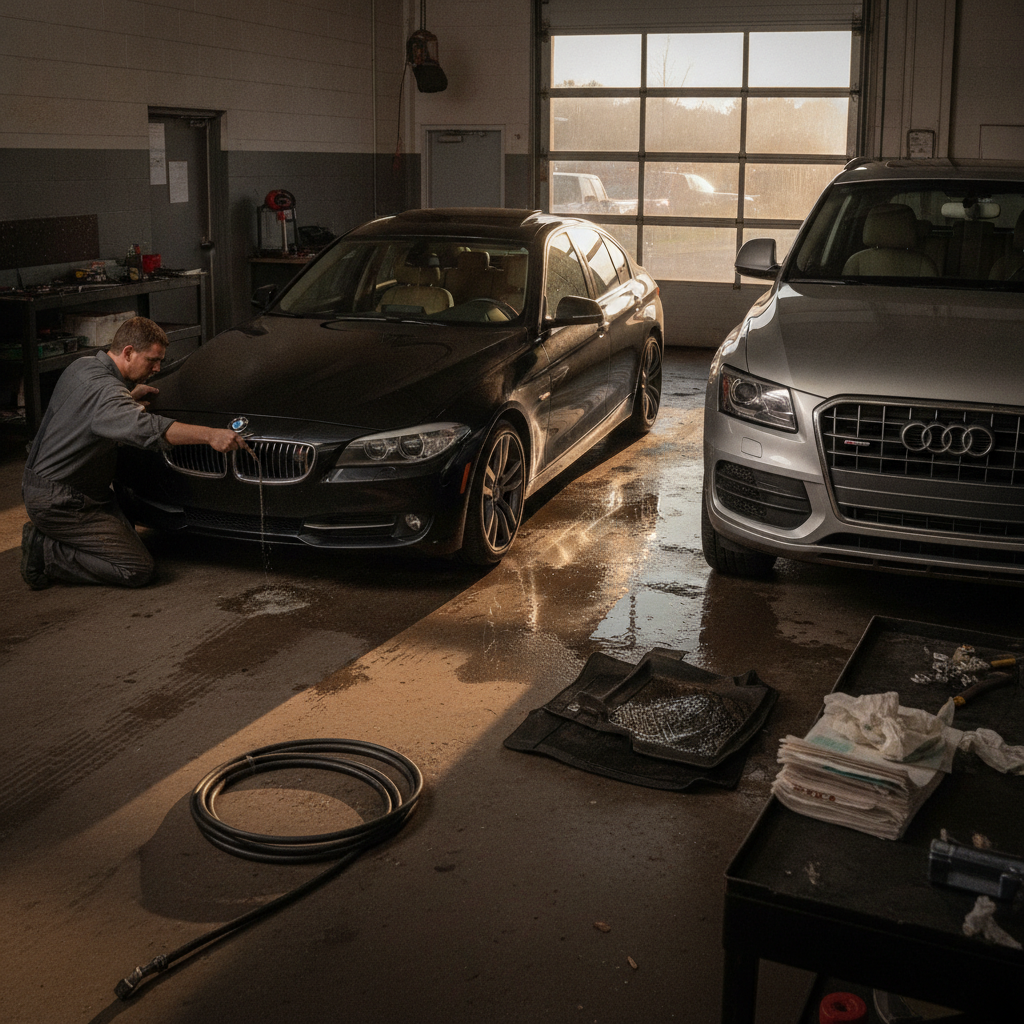
Why Is My BMW or Audi’s Sunroof Drain Clogged and Leaking Into the Cabin? What Alpharetta Owners Should Know
If you’ve noticed a wet front floorboard, a soggy rear carpet, or a persistent musty odor inside your BMW or Audi, there’s a good chance you’re not dealing with a failed roof seal — you’re dealing with a clogged sunroof drain. This is one of the most misdiagnosed and underestimated water intrusion problems in European vehicles, and it’s especially common in the Alpharetta and North Fulton County area, where Georgia’s heat and humidity accelerate the buildup of debris inside those narrow drain channels. Left alone, a blocked sunroof drain doesn’t just make your interior smell like a wet towel — it can silently destroy your vehicle’s electrical system, ECU, and structural components over time.
How Sunroof Drains Work — and Why They Clog
Every BMW, Audi, Mercedes, and most other European vehicles with a sunroof or panoramic glass roof have a drainage system built into the four corners of the sunroof tray. When rainwater or condensation collects in that tray, it flows into thin rubber or plastic drain tubes routed through the A and C pillars — down through the doors or rocker panels — and exits underneath the vehicle. It’s a clever system when it works. When it doesn’t, that rainwater has nowhere to go except into your cabin.
The most common causes of clogging are organic debris — pine needles, leaves, pollen, and grime — that collect in the sunroof tray and slowly work their way into the drain openings. Georgia’s tree canopy and the heavy pollen seasons in spring and fall make this worse than in drier climates. The drain tubes themselves can also kink, crack, or become disconnected at their lower exit points after years of vibration and heat cycling. When you’re driving GA-400 daily through stop-and-go traffic, those small plastic fittings take a beating over time.
The Real Damage a Clogged Sunroof Drain Can Cause
This is where the story gets expensive if you wait too long. Water doesn’t stay put. Once it breaches the sunroof tray, it follows the path of least resistance — and that path often runs directly past your vehicle’s most critical and costly electrical components.
- Saturated front floor carpets: The passenger or driver footwell fills with standing water, soaking the insulation padding underneath the carpet. Moisture locked under the carpet creates a perfect environment for mold growth and persistent odor that’s nearly impossible to eliminate without a full interior extraction.
- ECU and control module damage: In many BMW and Audi models, the engine control module or body control module is located under the front seat or behind the glove box. Water flowing from a clogged front drain tube can reach these modules directly. A water-damaged ECU is a four-figure repair at minimum.
- Damaged amplifier and audio components: Audi and BMW both route amplifiers under rear seats or in the trunk. A rear drain clog channels water directly toward these components.
- Corrosion on wiring harnesses: European vehicles use complex, tightly bundled wiring harnesses. Prolonged moisture exposure causes pin corrosion that produces intermittent electrical faults — the kind that are notoriously difficult and time-consuming to trace.
- Mold and air quality issues: Wet insulation behind interior panels and beneath carpet supports aggressive mold growth. Beyond the smell, this is a genuine air quality concern for anyone spending time in the vehicle.
Which BMW and Audi Models Are Most Affected
Sunroof drain issues are not exclusive to one generation or trim level — if your vehicle has a sunroof or panoramic roof, it has drain tubes that can clog. That said, some models come up repeatedly in our service bay at Solo Motor Sports. BMW 3 Series and 5 Series sedans from the E90 and F30 generations are frequent visitors for front footwell flooding. The BMW X5 and X3 see rear drain issues that saturate the cargo area. On the Audi side, the A4, A6, and Q5 are common, as are older Audi A8 models where drain tubes can fully disconnect from their lower exit points. The Volkswagen Tiguan and Golf SportWagen, which share Audi’s platform architecture in many ways, show the same pattern.
If you drive one of these vehicles and you have a sunroof, it’s worth having the drain system inspected during your next multi-point inspection — before Georgia’s fall rain season turns a minor debris blockage into a cabin flood.
What the Fix Actually Looks Like — and What to Expect
Clearing a sunroof drain is not something a coin car wash and a can of compressed air will solve reliably. The drain tubes in most European vehicles require a technician to access the drain openings in the sunroof tray, carefully feed a thin flexible line or low-pressure air into the channel, and flush it clear without dislodging the tube from its lower fitting. Forcing too much pressure through a brittle or aged drain tube — which is a common DIY mistake — can disconnect the tube entirely inside the pillar, which turns a simple flush into a full interior panel removal job.
When the drain tube has cracked, kinked, or fully separated at the lower exit point, the repair involves removing interior trim panels — A-pillar covers, sill plates, or door jamb trim — to access and reseat or replace the tube. The labor time varies by model and which drain corner is affected. Front drains are generally more accessible than rear drains on panoramic roof models, which may require significant interior disassembly to reach the C-pillar routing.
If water has already reached the carpet and insulation, the repair scope expands. The carpet must be pulled back and the foam underpad inspected and often replaced. Depending on how long the moisture has been sitting, you may also need professional interior drying or mold remediation. This is why catching it early — when you first notice a faint musty smell or a slightly damp floor after rain — is so much less costly than waiting until you’re pulling an inch of standing water from the footwell.
Why This Issue Is Overlooked at General Shops and Even Some European Specialists
Here’s the gap that rarely gets discussed: many general repair shops and even some European independents in the Roswell and Alpharetta corridor will find the wet carpet and assume the roof seal has failed. They’ll replace the seal, clear the obvious drain opening at the tray, and call it done. Two rainstorms later, the floor is wet again because the actual blockage was further down the tube — or the tube had disconnected at the lower end inside the pillar.
Proper diagnosis requires knowing the specific drain routing for the model on the lift, having the right flexible drain clearing tools, and understanding how the interior panels on that vehicle come apart without breaking clips or trim pieces. At Solo Motor Sports, our technicians work specifically on European makes — BMW, Audi, Mercedes, Volkswagen, Porsche, and others — and they know the drain architecture for these vehicles because they service them every day. That model-specific knowledge is the difference between a repair that holds and one that sends you back two weeks later.
Preventing Sunroof Drain Clogs Before They Start
Prevention is straightforward, and it costs almost nothing compared to the repairs that follow neglect. A few habits that protect your sunroof drain system:
- Clear the sunroof tray regularly. Every time you wash your car or park under trees, take thirty seconds to wipe out the sunroof tray with a cloth. Don’t let debris sit in the corners near the drain openings.
- Park strategically when possible. Parking under pine trees, particularly during spring pollen season in North Fulton County, dramatically accelerates debris accumulation in the tray.
- Don’t ignore the smell. A faint musty smell after rain is your early warning sign. Address it before it becomes a saturated floor and potential ECU damage.
- Ask about drain flushing during routine service. A quick preventative flush of the drain channels every few years — during an oil service or inspection — costs very little and eliminates the risk entirely.
Owners in Johns Creek, Milton, and Sandy Springs who park in garages most of the time sometimes assume they’re safe from this issue. They’re not. Even infrequent exposure to rain is enough to accumulate debris over several years, and garage-kept vehicles often go longer between inspections that would catch a slow blockage early.
Frequently Asked Questions
How do I know if my sunroof drain is clogged or if the roof seal has failed?
If water is entering during or right after rain and pooling at the front or rear footwells rather than dripping directly from the headliner at the seal line, a clogged drain is the more likely cause. A technician can confirm by flushing the drain channels with water and watching where it exits — or doesn’t.
Can a clogged sunroof drain damage my BMW’s electronics?
Yes, and this is the most serious consequence of ignoring the problem. Depending on your model, water that reaches the footwell can contact the engine control module, body control unit, or fuse box. Water-damaged modules often require replacement — not repair — and can run well into four figures.
How long does it take to fix a clogged sunroof drain?
A simple flush of all four drain channels takes less than an hour in most cases. If a tube has disconnected inside the pillar and requires interior panel removal, the job takes significantly longer. If the carpet and underpad need to be dried or replaced, that adds additional time depending on the extent of saturation.
Will my car insurance cover sunroof drain water damage?
It depends on your policy and how the damage is classified. Comprehensive coverage sometimes covers water intrusion, but many insurers treat it as a maintenance issue if the cause is a clogged drain rather than a storm event. It’s worth checking with your carrier, but don’t delay the repair waiting for a coverage determination — the damage progresses quickly.
Do Audis and BMWs have the same sunroof drain layout?
Both brands use a four-corner tray drain system with pillar-routed tubes, but the specific routing, tube diameter, and exit points vary by model and generation. That’s why model-specific knowledge matters — the approach for a BMW 5 Series is different from an Audi Q7, and what clears one may damage the other if done incorrectly.
Get Your Sunroof Drain Inspected at Solo Motor Sports
If your BMW, Audi, or any other European vehicle has a sunroof and you’ve noticed a damp smell, wet carpet, or pooling water after rain, don’t wait. The repair is straightforward when caught early and expensive when it isn’t. Solo Motor Sports in Roswell serves owners throughout Alpharetta, Johns Creek, Milton, Sandy Springs, and the surrounding North Fulton area with factory-trained, make-specific expertise — no guesswork, no unnecessary upsells, and no dealership markups.
Contact us today to schedule an inspection and let’s get ahead of the problem before Georgia’s next rain event turns a clogged drain tube into a four-figure repair.