
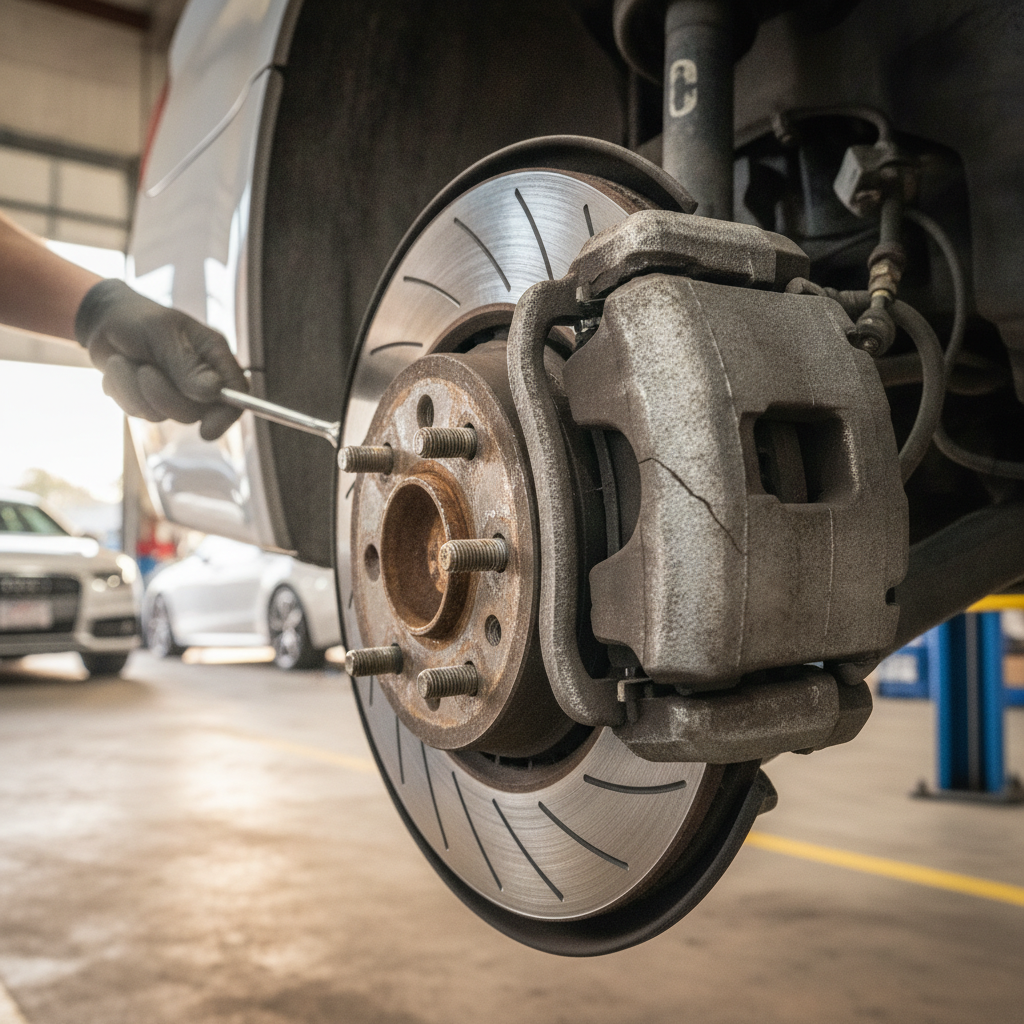
Why Is My BMW or Audi’s Brake Caliper Seized and Dragging? What Alpharetta Owners Should Know About European Brake Caliper Failure
If your BMW or Audi is pulling to one side, the brake pedal feels stiffer than usual, or you’re noticing an acrid burning smell after a short drive — especially during the stop-and-go crawl on GA-400 through Alpharetta — there’s a real chance one of your brake calipers has seized or is dragging. This isn’t a “keep an eye on it” situation. A caliper that fails to fully release keeps constant friction on your rotor, overheats your brake system, accelerates pad and rotor wear dramatically, and in serious cases can cause brake fade exactly when you need stopping power the most. Here’s what’s happening, why European vehicles are particularly vulnerable, and what it actually takes to fix it correctly.
What Does a Seized Brake Caliper Actually Mean?
The brake caliper is the hydraulic clamp that squeezes your brake pads against the rotor when you press the pedal. When everything works as designed, the caliper releases that pressure completely the moment you lift your foot. A seized caliper doesn’t fully retract — the piston or slide pins stay partially engaged, keeping the pad in contact with the rotor even when you’re not braking at all.
On European vehicles like BMWs and Audis, this is especially problematic because the braking systems are engineered to tight tolerances. Multi-piston front calipers on performance trims, electronic parking brake actuators integrated into rear calipers, and complex slide pin geometry that differs significantly from domestic vehicles — all of these features mean that when something goes wrong, it tends to go wrong in ways that a general repair shop might misdiagnose or underestimate.
Two Failure Modes You Need to Know
Brake caliper seizures on BMWs and Audis typically happen one of two ways:
- Piston seizure: The caliper piston corrodes inside its bore — often from old, moisture-saturated brake fluid — and can no longer retract after the pedal is released. The pad stays pressed against the rotor continuously.
- Slide pin seizure: The caliper floats on slide pins that allow it to self-center over the rotor. When those pins corrode or dry out — which happens readily in Georgia’s heat and humidity — the caliper cocks at an angle and applies uneven, constant pressure on one side of the pad. This is the subtler failure mode and the one most likely to be overlooked until the rotor is already damaged.
Why Georgia’s Climate Makes This Worse
North Fulton County gets the worst of Atlanta’s summer humidity combined with real winter temperature swings — not cold enough for extended road salt use, but damp and variable enough to accelerate brake hardware corrosion faster than most owners expect. The slide pins on Audi B8 and B9 platforms and the rear integrated caliper-actuators on late-model BMWs are particularly susceptible to corrosion and binding when they don’t see regular service intervals.
Add in the daily stop-and-go traffic on GA-400 between Alpharetta and Sandy Springs, and you have a recipe for calipers that cycle through heat and cool-down repeatedly without ever getting a proper inspection. Brake fluid absorbs moisture over time regardless of mileage, which accelerates internal corrosion in the piston bores. Most European manufacturers recommend brake fluid replacement every two years — a service interval that’s easy to skip and rarely flagged at oil changes.
Warning Signs You Shouldn’t Ignore
The tricky part about a dragging caliper is that the symptoms can start subtly and worsen gradually. By the time most drivers in Johns Creek or Alpharetta notice something is clearly wrong, the rotor and pad are already significantly degraded. Watch for:
- The vehicle pulling to one side during normal driving — not just when braking
- One wheel noticeably hotter than the others after a drive (you can feel this carefully near the wheel without touching the rotor)
- A burning smell, particularly from one corner of the vehicle
- Reduced fuel economy without explanation — a dragging caliper adds rolling resistance your engine has to overcome constantly
- Uneven pad wear when inspected — one pad worn to the metal while the other side still has material
- A groaning or grinding sound at low speeds that wasn’t there before
On BMWs with the integrated electronic parking brake, you may also see a warning light that doesn’t match any obvious problem — the EPB actuator inside the rear caliper can partially seize and trigger fault codes that look unrelated to a mechanical seizure.
What the Repair Actually Involves — and Why It Matters for European Vehicles
This is the section most competitor shops in the Roswell area skip over entirely, and it’s the gap worth addressing directly. Rebuilding or replacing a seized caliper on a BMW or Audi is not the same job as replacing a caliper on a domestic pickup. Here’s what a proper repair looks like:
- Diagnosis first: A road test and thermal inspection identify which corner is dragging. Pulling the wheel and measuring pad wear on both sides of a caliper confirms whether it’s a piston or slide pin failure.
- Caliper replacement vs. rebuild: On high-mileage European vehicles, replacement with a remanufactured or OEM-spec caliper is usually more reliable than rebuilding a corroded unit. For performance-spec BMWs or Audis with multi-piston calipers, OEM or OEM-equivalent parts are non-negotiable — aftermarket calipers often don’t meet the same bore tolerances or seal specifications.
- Slide pin and hardware service: Even if the caliper itself is replaced, the slide pins, carrier brackets, and hardware must be cleaned, inspected, and correctly lubricated with the right high-temp brake grease. Using the wrong lubricant — or skipping this step — recreates the problem within a year.
- Brake fluid flush: If a piston has corroded from moisture-contaminated fluid, replacing the caliper without flushing the system leaves the same contaminated fluid circulating through the new hardware.
- Rotor and pad evaluation: A caliper that’s been dragging for any length of time has likely scored or heat-warped the rotor and glazed the pad. Both need to be inspected and replaced if compromised — which, given that the rotor damage is often the first visible sign, is frequently the answer.
At Solo Motor Sports, our ASE-certified technicians use factory-level diagnostic tools to confirm exactly which corner is failing and why before any parts are ordered. Every brake caliper repair uses OEM or OEM-equivalent components, and all brake work is backed by a warranty — not a handshake promise. Learn more about our European brake repair services in Roswell.
Dealership Pricing vs. What You Actually Need to Spend
BMW and Audi dealers in the North Fulton area will often recommend full axle brake replacements — both sides, pads, rotors, and calipers — regardless of whether the opposite caliper is actually failing. It’s a defensible recommendation but not always a necessary one, and it adds hundreds of dollars to a job that may only require one side addressed.
An honest inspection tells you what’s actually worn and what still has service life. If you’re in Sandy Springs or Johns Creek and you’ve been quoted a brake job that seems unusually expensive, get a second opinion from a European specialist who will show you the measurements rather than just the estimate. That transparency is the standard at Solo Motor Sports, not an exception to it. Meet our team and learn what sets us apart from the dealership experience.
Frequently Asked Questions
How long can I drive with a seized brake caliper?
Not long, and not safely. A dragging caliper generates continuous heat that can warp rotors, degrade brake fluid, and — in serious cases — ignite surrounding components. If you’re experiencing symptoms, have it inspected immediately rather than waiting for your next scheduled service.
Can I just lubricate the slide pins and call it fixed?
If the pins are lightly seized from dryness but not corroded, cleaning and re-greasing may restore function temporarily. But if the pin or bore is corroded or the caliper piston is internally stuck, lubrication won’t fix it — the hardware needs to be replaced.
Will a seized caliper trigger a warning light on my BMW or Audi?
Sometimes, but not always. The brake pad wear sensors on BMWs trigger a light when pad thickness drops below the sensor threshold — and a dragging caliper accelerates that wear dramatically. On models with integrated electronic parking brakes, an EPB fault code may also appear. Many drivers go weeks without a warning light even with a partially dragging caliper.
Does replacing one caliper mean I need to replace both sides?
Not necessarily. Unlike shock absorbers, brake calipers don’t always need to be replaced in axle pairs. If the opposite caliper is functioning correctly and has been properly serviced, replacing the failed unit alone is often the right call. Your technician should show you why they’re recommending what they’re recommending.
How often should brake calipers be serviced on a European vehicle?
Most European manufacturers recommend inspecting brake hardware — including slide pins and caliper condition — at every brake pad replacement. In Georgia’s humid climate, annual slide pin cleaning and lubrication is a reasonable preventive step, particularly for vehicles that spend a lot of time in stop-and-go traffic.
Schedule Your Brake Inspection at Solo Motor Sports
If your BMW, Audi, or any other European vehicle is showing signs of a seized or dragging caliper, don’t wait for a rotor or a warning light to force the issue. Solo Motor Sports serves owners across Alpharetta, Roswell, Johns Creek, Sandy Springs, and throughout North Fulton County with the factory-trained expertise and diagnostic equipment your vehicle was engineered for — without the dealership markup.
Contact us today to schedule a brake inspection or request a free consultation. We’ll give you an honest assessment, clear pricing, and work backed by a warranty you can count on.