
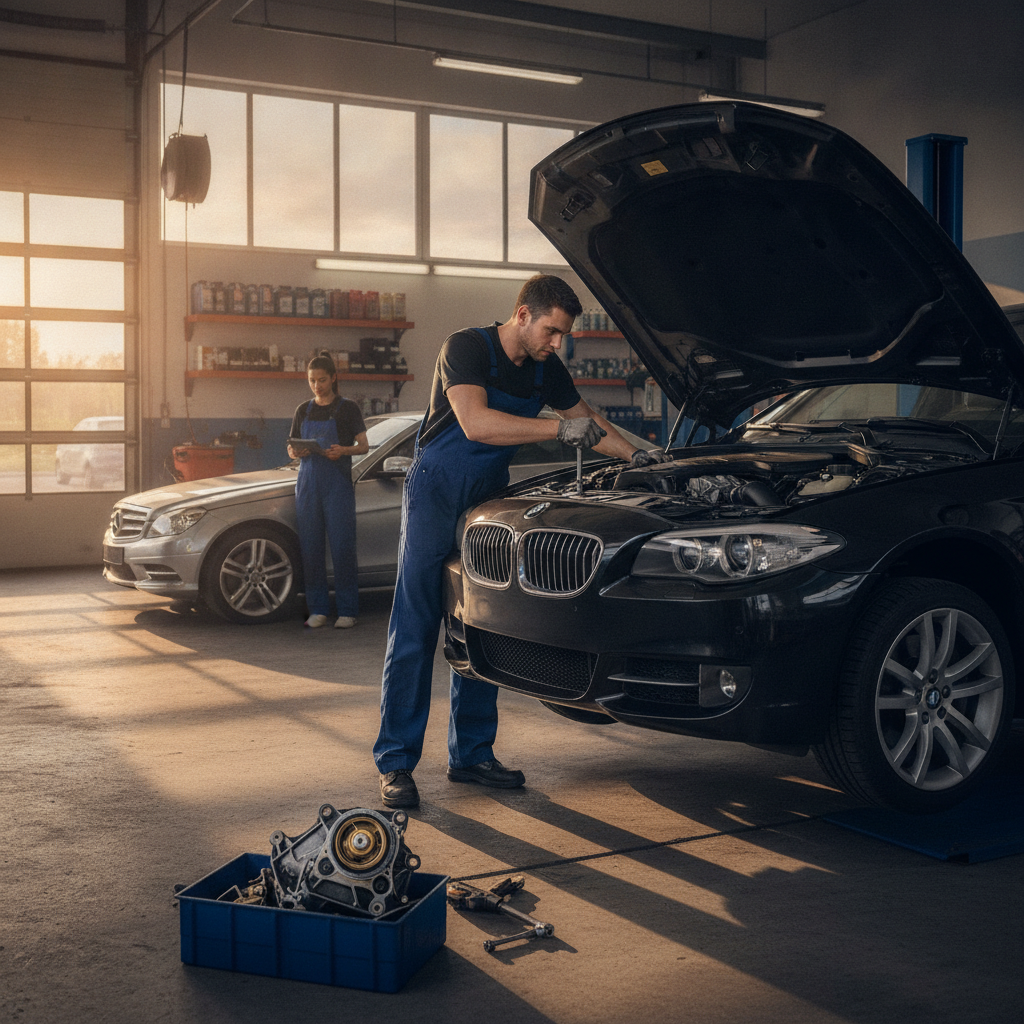
Why Is My BMW or Mercedes Cooling System Overheating in Stop-and-Go Traffic? What Roswell Owners Should Know About European Thermostat and Water Pump Failure
If your BMW or Mercedes temperature gauge has been creeping toward the red during your morning commute on GA-400 or while idling in Roswell traffic, your cooling system is telling you something important — and it’s not a message you want to ignore. In most cases, the culprit is either a failing thermostat, a weakening water pump, or both working against your engine at the same time. These aren’t dramatic, sudden failures. They’re slow, progressive breakdowns that your car’s computer will try to compensate for until it simply can’t anymore. By the time you see the temperature warning light, the damage to your engine may already be underway.
Why European Cooling Systems Are Different — And More Demanding
BMW and Mercedes-Benz don’t build their cooling systems the way domestic manufacturers do. Both brands engineer their engines to run at very precise temperatures — typically between 195°F and 230°F depending on load and driving conditions. To achieve this, they use electronically controlled thermostats and, in the case of BMW’s N-series engines, fully electric water pumps instead of the traditional belt-driven pumps most mechanics are familiar with.
That precision is what makes these cars exceptional performers. It’s also what makes their cooling systems uniquely vulnerable to failure — and uniquely easy to misdiagnose. A general repair shop that isn’t factory-trained on BMW or Mercedes engineering may replace the most obvious component, clear the code, and send you on your way — only for the real problem to resurface two weeks later. That’s not a knock on general mechanics. It’s simply a reflection of how specialized these systems are.
The Specific Ways BMW and Mercedes Cooling Systems Fail
BMW Electric Water Pump Failure
Starting with BMW’s N52, N54, and N55 engines, the water pump is driven electrically rather than mechanically. This was a deliberate engineering choice — it allows the engine management system to control coolant flow independently of engine speed, improving efficiency and temperature regulation. The trade-off is that these pumps run on a motor with brushes and bearings that wear out over time, typically between 60,000 and 80,000 miles.
When the electric water pump begins to fail, it often does so intermittently. You might notice the temperature gauge rising slightly at idle, then dropping back to normal once you’re moving. The fan compensates, coolant circulates, and the problem seems to resolve itself. Until it doesn’t. In North Fulton County’s stop-and-go traffic — especially during Georgia’s long, humid summers — an underperforming water pump gets exposed quickly. The heat load on these engines during low-speed driving is significant, and a marginal pump simply can’t keep up.
Plastic Thermostat Housing and Map-Controlled Thermostats
Mercedes-Benz uses what’s known as a map-controlled thermostat on many of its M272, M273, and later engine families. Unlike a traditional wax thermostat that opens at a fixed temperature, the map-controlled thermostat receives signals from the engine control module to open earlier or later depending on driving conditions. It’s an elegant system — until the thermostat fails in the closed position, trapping hot coolant in the engine and sending temperatures skyward within minutes.
Both BMW and Mercedes also encase thermostats and related components in plastic housings. Georgia heat cycles — swinging from cold mornings to 95°F afternoons — stress these housings over time. Cracking and warping are common. And when a plastic housing cracks, it doesn’t always announce itself with a dramatic coolant leak. Sometimes it weeps slowly, losing coolant gradually until your reservoir is low and your engine is fighting to stay cool.
How Atlanta Traffic and Georgia Heat Accelerate the Problem
North Fulton County drivers face a cooling system challenge that owners in cooler climates simply don’t. The combination of Georgia’s summer heat, humidity, and the relentless stop-and-go on GA-400 between Roswell and Sandy Springs creates a sustained thermal load on European engines that pushes aging cooling components past their limits faster than normal highway driving would.
When you’re moving at highway speed, airflow through the grille does a significant share of the cooling work. When you’re crawling through traffic near the Holcomb Bridge Road interchange at 3 mph, the engine fan and water pump carry the full load. A pump operating at 70% efficiency on the highway might feel perfectly adequate. In Roswell gridlock on a July afternoon, that same pump is completely overwhelmed.
This is why so many cooling system failures in this area get dismissed as weather-related and not properly diagnosed. The weather isn’t the cause — it’s the stress test that reveals a component that was already failing. A proper engine diagnostic will identify the root cause, not just the symptom.
Warning Signs You Should Never Ignore
Your BMW or Mercedes will give you signals before a cooling system failure becomes catastrophic. Watch for:
- Temperature gauge rising above normal at idle — especially during slow traffic, then returning to normal at speed
- Coolant warning light or low coolant message on the instrument cluster — this is not something to top off and forget
- Heater blowing cold air at idle — a classic sign of low coolant circulation caused by a failing water pump
- Visible coolant puddles or dried residue under the car or around the reservoir cap area
- Sweet smell from the engine bay after driving — coolant has a distinctive sweet odor when it burns off hot surfaces
- Check Engine or coolant system fault codes — BMW’s iDrive and Mercedes’s COMAND systems will often log a fault before the gauge moves visibly
If you’re seeing any of these signs, don’t wait. Overheating a BMW or Mercedes engine — even briefly — can warp aluminum cylinder heads, damage head gaskets, and destroy bearings. Repairs that start as a $600 water pump job can become a $4,000 engine repair if the engine overheats completely.
What Most Competitors Miss: Proactive Cooling System Service
Here’s a gap that most European repair shops in the Roswell and Alpharetta corridor don’t adequately address: proactive cooling system service before failure occurs. Most shops — and frankly, most dealerships — are reactive. They replace the water pump when it fails, replace the thermostat when the code appears, and flush the coolant when it looks brown. That’s not a maintenance strategy. That’s damage control.
BMW recommends replacing the electric water pump on N-series engines around 80,000 miles as a preventative measure — not because it has failed, but because the cost of the pump is a fraction of the cost of what happens when the pump fails without warning on I-285 in August. The same logic applies to thermostat housing assemblies and expansion tanks, both of which degrade on a predictable timeline regardless of whether they’re showing active symptoms.
When you bring your BMW or Mercedes to a specialist who understands these vehicles — not just the fault code on the screen, but the engineering behind it — you get a maintenance conversation, not just a repair receipt. That’s the difference between dealership-level expertise and dealership-level billing.
Why Owners in Johns Creek and Sandy Springs Are Driving to Roswell for This Service
Word travels in the North Fulton County European car community. Owners from Johns Creek, Sandy Springs, and Alpharetta who’ve been handed inflated dealership quotes or experienced misdiagnoses at chain shops consistently seek out independent European specialists with factory-trained technicians and the right diagnostic tools. Preventative maintenance on a European cooling system isn’t complicated — but it requires someone who knows exactly what they’re looking at.
At Solo Motor Sports in Roswell, every cooling system diagnosis starts with dealership-grade diagnostic tools — not generic OBD-II readers. We pull live data from the engine management system, test the electric water pump’s amperage draw, pressure-test the cooling circuit, and inspect thermostat response in real time. When we recommend a repair, we explain exactly why — and we use OEM or OEM-equivalent parts backed by a warranty, not the cheapest component available on an aftermarket shelf.
Frequently Asked Questions
How do I know if my BMW’s electric water pump is failing?
The most common signs are a temperature gauge that rises at idle but stabilizes at speed, a fault code related to coolant temperature regulation, and — in some cases — an audible whirring or buzzing from the pump itself. A proper diagnostic with live data will confirm pump performance before it fails completely.
Can I drive my Mercedes if the temperature gauge is slightly elevated?
No. Even a slightly elevated temperature on a Mercedes indicates the cooling system is not maintaining proper regulation. Continuing to drive risks escalating heat damage to the cylinder head and gaskets. Pull over safely and have the car towed to a specialist rather than risk a full overheat.
How much does BMW or Mercedes water pump replacement cost?
The cost varies by model and whether adjacent components like the thermostat, housing, or coolant flush are included — which they should be when the system is already open. We don’t publish flat-rate pricing because the right answer depends on your specific vehicle. Contact us directly for an honest, itemized estimate.
How often should I flush the coolant on a European vehicle?
BMW and Mercedes both use long-life coolant designed for extended intervals — but that doesn’t mean indefinitely. Most factory schedules recommend a coolant flush every four to five years or 50,000 miles. Degraded coolant becomes acidic and accelerates corrosion inside aluminum cooling components, shortening the lifespan of your water pump and thermostat housing.
Is a cooling system repair cheaper at an independent shop than at the dealership?
In almost every case, yes — significantly so. Independent European specialists like Solo Motor Sports use the same quality OEM parts and factory-level diagnostic tools, but without the overhead and mandatory service package upsells that inflate dealership invoices. You get the same repair with greater transparency and a direct conversation with the technician working on your car.
Schedule Your Cooling System Inspection at Solo Motor Sports
If your BMW or Mercedes temperature gauge has been behaving strangely, your coolant is overdue for service, or you simply want a specialist to evaluate your cooling system before Georgia’s next heat wave does the job for you, contact Solo Motor Sports today to schedule an appointment. We serve BMW and Mercedes owners throughout Roswell, Alpharetta, Sandy Springs, Johns Creek, and the broader North Fulton County area — with the same diagnostic capability as the dealership and none of the pricing games.