
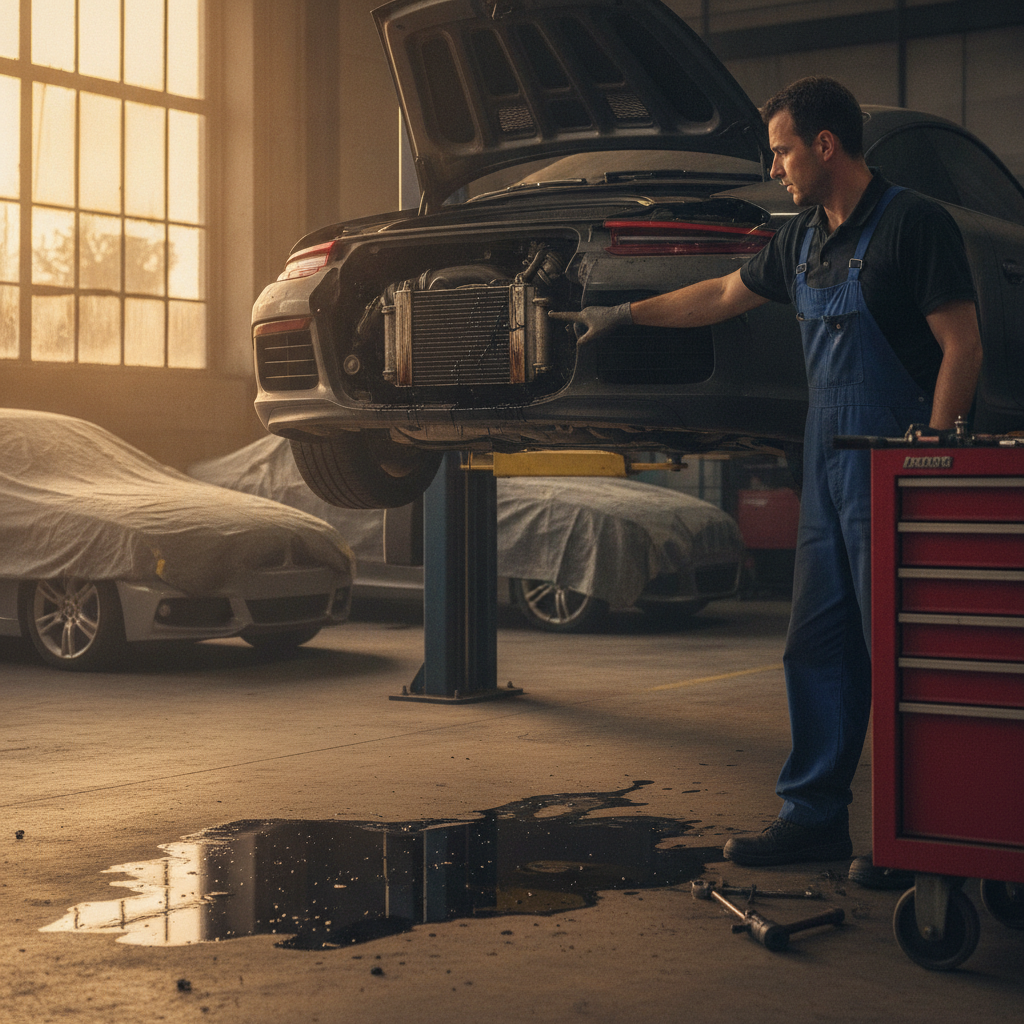
Why Is My Porsche or BMW’s Oil Cooler Leaking and Overheating the Engine? What Marietta and East Cobb Owners Should Know About European Oil Cooler Failure
If your Porsche or BMW has been running hotter than usual, leaving oily residue near the engine, or — worst of all — showing milky, coffee-colored oil on the dipstick, you may be dealing with oil cooler failure. For Marietta and East Cobb owners, this is not a warning light you dismiss until the weekend. A failing oil cooler on a European vehicle can quietly contaminate your engine oil with coolant, destroy lubrication throughout the motor, and turn a manageable repair into a catastrophic engine rebuild. The good news is that catching it early — with the right diagnostic tools and a technician who actually understands European engine architecture — makes all the difference.
What Does an Oil Cooler Actually Do on a BMW or Porsche?
Your engine oil does more than lubricate — it also carries heat away from critical internal components. On high-performance European engines like those in the BMW N54, N55, S55, or Porsche’s flat-six and V8 families, oil temperatures can climb fast, especially under load. The oil cooler is designed to regulate that temperature by using engine coolant to absorb excess heat from the oil before it circulates back through the engine.
On most BMWs and many Porsche models, the oil cooler is mounted directly to the engine block or integrated into the oil filter housing. That tight integration is part of what makes European engines so efficient — and so unforgiving when a seal or internal passage begins to fail. The oil and coolant circuits run parallel to each other with nothing but a gasket or thin aluminum wall between them. When that barrier fails, the two fluids mix, and neither can do its job properly.
Common Causes of Oil Cooler Failure in European Vehicles
Oil cooler failure doesn’t usually happen overnight. In most cases, it’s the product of years of thermal cycling — heating up and cooling down — that gradually degrades the gaskets and seals surrounding the cooler. Here’s what typically goes wrong:
- Oil cooler adapter gasket failure: On BMW N-series engines, the oil cooler adapter gasket is a known weak point. As the gasket deteriorates, coolant can leak externally or internally into the oil passages. This is one of the most underdiagnosed failure modes on high-mileage BMWs.
- Cracked or corroded cooler core: Over time, the aluminum or metal cooler core itself can develop small cracks from thermal stress, especially on vehicles that have experienced overheating events or deferred coolant maintenance.
- Contaminated coolant accelerating deterioration: If coolant service has been delayed, degraded antifreeze becomes acidic and attacks seals and aluminum surfaces throughout the cooling circuit — including inside the oil cooler.
- High-mileage seal hardening: Rubber seals dry out and lose their elasticity over time, especially on vehicles with 80,000 miles or more that haven’t had consistent preventative maintenance.
Georgia’s summer heat doesn’t help. Vehicles driven in stop-and-go traffic on I-75 through Marietta or on surface roads through East Cobb spend more time at elevated operating temperatures than their cooling systems were designed to handle continuously. That thermal stress accelerates wear on every seal and gasket in the engine bay — including the oil cooler.
Warning Signs Marietta and East Cobb Owners Shouldn’t Ignore
The tricky part about oil cooler failure is that it can masquerade as other problems — or produce no obvious symptoms at all until significant internal damage has already occurred. Here are the signs that should send you straight to a specialist:
- Milky or foamy oil on the dipstick or oil cap: This is the clearest sign that coolant is mixing with engine oil. It looks like a chocolate milkshake — and it’s just as damaging to your engine as it sounds.
- Coolant loss with no visible external leak: If you’re topping off the coolant reservoir regularly but you can’t find a puddle under the car, the coolant may be burning off internally or mixing with the oil.
- Engine running hotter than normal: Once the oil cooler can’t regulate temperatures properly, your engine temperature gauge may creep higher than usual, especially on longer drives or in heavy traffic.
- Oily residue near the oil filter housing or engine block: External oil cooler leaks often leave a greasy film or crusty brown residue around the base of the oil filter housing — visible during a close inspection of the engine bay.
- Low oil pressure warning: If a significant leak has reduced oil volume or viscosity, the oil pressure sensor may trigger a warning. At that point, you should pull over and have the car towed — not driven to a shop.
Why This Repair Requires a European Specialist — Not a General Shop
This is the section that most competitor shops in the Roswell and Marietta area gloss over, so let’s be direct about it: oil cooler repair on a BMW or Porsche is not a straightforward job. On many BMW models, accessing the oil cooler adapter requires removing the intake manifold, oil filter housing, and other surrounding components. Reassembling the system correctly — with proper torque specifications and OEM-grade gaskets — is what separates a repair that lasts 100,000 miles from one that fails again in 18 months.
A general repair shop using aftermarket gaskets and approximated torque values may get the job done on paper, but European engine tolerances are tight. Underbolt a fastener on the oil filter housing and you’ll be back with the same leak inside a year. Use an inferior gasket material and the seal may not hold up to the thermal cycling that BMW and Porsche engines experience regularly.
At Solo Motor Sports in Roswell, our technicians work exclusively on European and import vehicles. We use factory-level diagnostic equipment to confirm exactly which seals and passages are compromised before anything comes apart, and we source OEM or OEM-equivalent components to ensure the repair holds. For Marietta and East Cobb owners making the drive up GA-400 or cutting across to Roswell via Holcomb Bridge, the extra distance is worth it when the alternative is doing the same repair twice.
If you want to understand the full scope of what our engine repair process looks like, our engine repair page walks through what’s involved and what you should expect from a qualified European specialist.
What to Expect From an Oil Cooler Diagnosis and Repair
When you bring a BMW or Porsche in with suspected oil cooler failure, the diagnostic process should include more than a visual inspection. A thorough evaluation includes:
- Oil and coolant sample inspection to confirm fluid contamination
- Pressure testing the cooling system to isolate the source of the leak
- OBD-II diagnostic scan to check for any stored fault codes related to oil pressure, coolant temperature, or engine management
- Physical inspection of the oil cooler adapter, housing gaskets, and cooler core
Repair timelines vary depending on the severity of the failure and the specific model. A straightforward gasket replacement on a BMW N52 or N55 engine might be completed in a day. If internal contamination has affected the oil passages or if the cooler core itself has cracked, additional flushing and inspection of downstream components — particularly the oil passages and turbocharger oil supply lines on turbocharged engines — are necessary before the vehicle is safe to drive.
Turbo engines like the BMW N54 and N55 are especially sensitive to oil quality. The turbocharger bearings are lubricated entirely by engine oil, and coolant-contaminated oil will destroy those bearings quietly over weeks or months before you see any external symptoms. That’s why a complete system evaluation — not just replacing the leaking part — is the right approach.
Preventative Maintenance Is Cheaper Than an Engine Rebuild
The most effective way to avoid an oil cooler failure in the first place is consistent preventative maintenance. Regular oil changes using the correct fluid specification for your vehicle, timely coolant service to keep the antifreeze from turning acidic, and periodic inspection of engine seals and gaskets are what separate vehicles that run well at 150,000 miles from those that need major engine work at 90,000.
For Alpharetta and Sandy Springs owners who drive performance-oriented BMWs or Porsches hard on the weekends, it’s also worth scheduling a multi-point inspection at least once a year. An experienced technician will catch the early signs of oil cooler degradation — slight seepage, early gasket cracking, subtle coolant loss — long before those issues become expensive failures.
Frequently Asked Questions
Can I drive my BMW if the oil cooler is leaking?
It depends on the severity. A small external seep may allow limited driving to reach a shop, but if you’re seeing milky oil, a rising temperature gauge, or a low oil pressure warning, the vehicle should be towed immediately. Driving with contaminated oil or insufficient lubrication can destroy an engine within minutes.
Is oil cooler failure covered under warranty?
On newer vehicles still under a factory or extended warranty, it may be. For out-of-warranty Porsches and BMWs, the repair cost is out of pocket — another reason to use a specialist shop rather than a dealership, where the same repair often carries a significant markup.
How do I know if it’s the oil cooler or the head gasket causing coolant and oil to mix?
Both failures can produce similar symptoms. A proper pressure test of the cooling system combined with a cylinder leak-down test can help differentiate the two. On BMW N-series and many Porsche engines, oil cooler failure is considerably more common than head gasket failure — but you need a qualified technician with the right equipment to confirm which one you’re dealing with.
What does oil cooler repair typically involve on a Porsche Boxster or Cayenne?
On air-cooled and early water-cooled Porsche engines, the oil cooler location and access varies significantly by generation. On the Cayenne with a V6 or V8, the oil cooler is integrated into the engine block and requires substantial disassembly to access. It’s a labor-intensive repair that demands a technician familiar with the specific platform.
Why do so many BMW owners in North Fulton not notice this problem until it’s serious?
Because the early stages of oil cooler failure often produce no dramatic symptoms. Oil may appear slightly darker than usual, coolant loss may be gradual, and temperatures may only creep up slightly during longer drives. Without routine inspections from someone who knows what to look for on these specific engines, the problem goes undetected until it escalates.
Don’t Let a Small Leak Become an Engine Replacement
If you’re driving a BMW or Porsche in Marietta, East Cobb, or anywhere in the North Fulton County area and something about your engine’s temperature, oil, or coolant doesn’t seem right, don’t wait. The cost difference between catching an oil cooler failure early and addressing it after the engine has been running on contaminated oil for months is substantial — we’re talking about the difference between a gasket replacement and a partial or full engine rebuild.
Solo Motor Sports specializes exclusively in European and import vehicles. Our ASE-certified, factory-trained technicians have the tools, the diagnostic equipment, and the hands-on experience to diagnose and repair oil cooler failures on BMWs, Porsches, and every other European make we service — without the dealership wait times or inflated labor rates. Contact us today to schedule a diagnosis and get a straight answer about what your vehicle needs.