
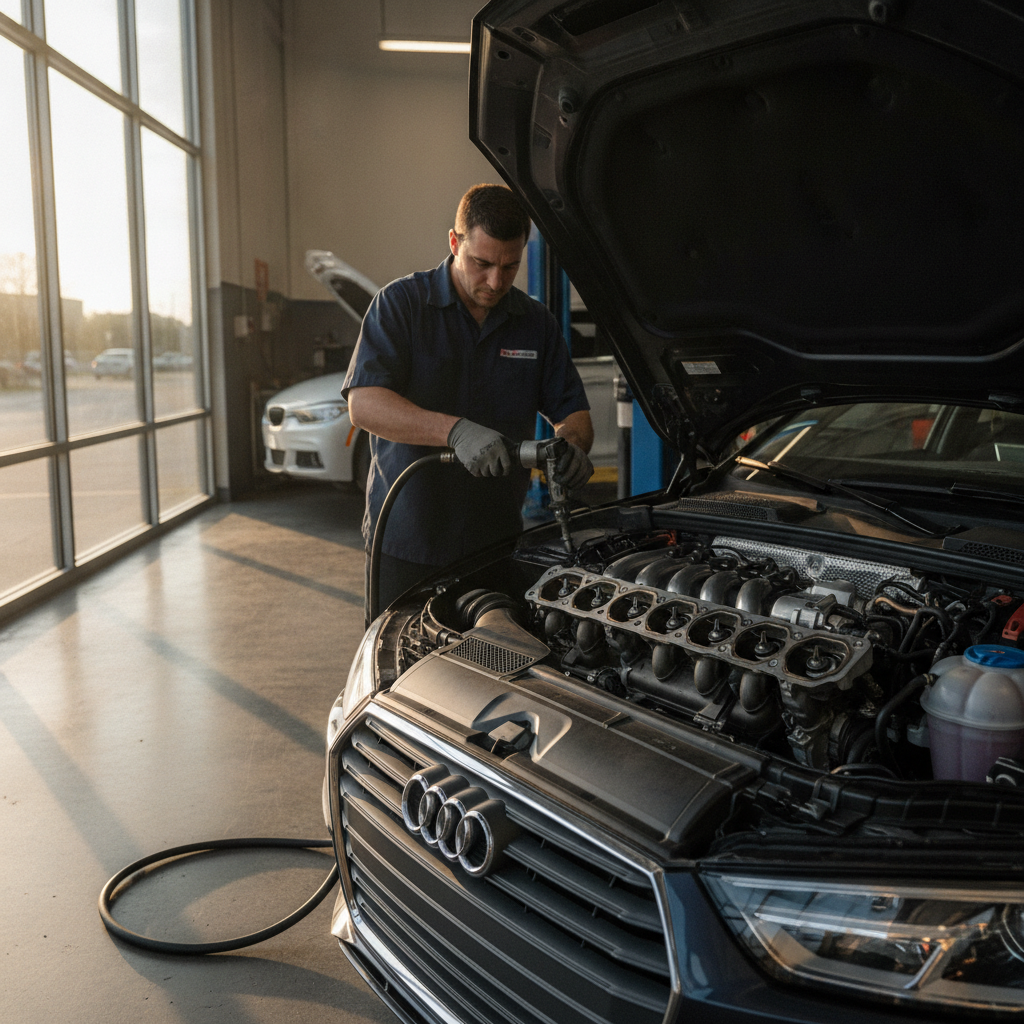
Why Is My Audi or BMW’s Fuel Injector Misfiring and Causing Rough Idle? What Johns Creek Owners Should Know About Direct Injection Carbon Buildup
If your Audi or BMW has started idling roughly, hesitating when you press the accelerator, or throwing a cylinder-specific misfire code — and your technician can’t find anything obviously wrong with the ignition system or fuel injectors themselves — carbon buildup on the intake valves is almost certainly what you’re dealing with. This is one of the most common and frequently misdiagnosed issues affecting modern European direct injection engines, and Johns Creek owners with higher-mileage BMWs and Audis are encountering it with increasing regularity. The good news: it’s entirely fixable. The frustrating part is that many shops either don’t recognize it quickly or don’t have the equipment to address it correctly.
What Makes Direct Injection Engines Prone to Carbon Buildup?
To understand why this happens, you need to understand how direct injection differs from older port injection systems. In a traditional port-injected engine, fuel is sprayed into the intake manifold just upstream of the intake valve. That constant fuel wash keeps the backside of the valve relatively clean. Direct injection (GDI, TFSI, TwinPower Turbo — different names, same principle) sprays fuel directly into the combustion chamber instead, bypassing the intake valve entirely. That sounds efficient — and it is, for performance and fuel economy — but it also means the back side of your intake valves never sees fuel washing over them. Oil vapor from the PCV system continues to deposit residue on those valves, and with no solvent action from the fuel spray to counteract it, that residue bakes into hard carbon deposits over time.
On BMW’s N54, N55, S55, and B58 engines, and across Audi and Volkswagen’s EA888 and EA839 TFSI families, this is essentially a design characteristic rather than a defect. The manufacturers know it happens. Some newer engines add port injection alongside direct injection to mitigate it — but if your car is a 2010–2020 model with a turbocharged four or six cylinder, you may not have that secondary system, and the valves are doing all the work without any cleaning benefit from the fuel itself.
How Carbon Buildup Causes Misfires and Rough Idle
As deposits accumulate on the intake valves — typically becoming noticeable between 50,000 and 80,000 miles, though it varies — airflow into the cylinder is disrupted. The deposits alter the charge motion in the combustion chamber, affect how the air-fuel mixture forms, and in severe cases, actually prevent the valve from seating fully. The result is:
- Rough idle, especially when cold
- Hesitation or stumble under light throttle
- Misfire codes on one or more cylinders (P030X series)
- Reduced power at low RPM, especially in stop-and-go traffic
- Occasionally, a slight ticking or rattling noise at startup that clears as the engine warms
The misfire codes often lead shops to replace spark plugs, ignition coils, or fuel injectors — none of which solve the underlying problem. If you’ve already been down that road without relief, carbon buildup deserves serious consideration. A proper diagnosis using factory-level scan tools can help rule out other causes and point directly at the intake side.
The Right Fix: Walnut Blasting and Intake Valve Cleaning
The correct solution for significant carbon deposit accumulation is intake valve cleaning using walnut shell media blasting. This procedure involves removing the intake manifold, covering the cylinders one at a time, and using a specialized blasting tool to direct finely crushed walnut shells at the deposit-coated valves. The walnut media is hard enough to remove the carbon but soft enough not to damage the valve or seat surface. It’s precise work that requires the right equipment and familiarity with the specific engine architecture — particularly on multi-valve European engines where access is tight.
Some shops attempt chemical cleaning as an alternative, using intake cleaners sprayed through the manifold. For light early-stage deposits, this can provide modest benefit. For moderate to heavy buildup — which is what most Johns Creek and Alpharetta owners with 60,000-plus miles are dealing with — chemical cleaning alone is not sufficient. You need the physical removal that walnut blasting provides. At Solo Motor Sports, we perform this service properly, with the manifold removed and each cylinder addressed individually, not as a shortcut procedure.
While the manifold is off, it’s also worth inspecting the PCV system. On many BMWs and Audis, a failing or stuck PCV valve accelerates the rate of oil vapor entering the intake tract, which means carbon returns much faster after cleaning. Addressing the PCV at the same time is a straightforward preventive measure that significantly extends the benefit of the cleaning.
Why This Is Frequently Missed at General Shops — and Even Some European Specialists
This is the content gap that most local competitors simply don’t address in any useful detail. A quick scan of the repair shop landscape in the Roswell and Johns Creek corridor reveals a lot of surface-level information about European auto service — but very little that actually explains the direct injection carbon problem in a way that helps an owner understand what’s happening, whether their car is affected, or what the procedure involves. That matters, because owners who don’t understand this issue are vulnerable to having the wrong repairs recommended, or worse, being told the engine has an internal problem when the intake valves just need to be cleaned.
If a shop is quoting you coil packs and fuel injectors for the third time on the same misfire without improvement, ask them directly: have you inspected the intake valves for carbon accumulation? If they hesitate, or if they don’t have walnut blasting equipment on site, it may be time for a second opinion from a shop with dedicated European engine experience. You can learn more about how we approach engine repair and diagnostics at Solo Motor Sports.
What to Expect from the Service
Intake valve cleaning on a BMW or Audi four or six cylinder is typically a half-day job when performed correctly. You should expect the technician to confirm the diagnosis with a borescope inspection before recommending the procedure — that’s the only way to visually confirm deposit accumulation and assess severity. If a shop skips that step and goes straight to recommending the service without visual confirmation, ask why. A thorough diagnosis before the wrench turns is non-negotiable on any European vehicle repair.
Following the cleaning, most owners notice an immediate improvement in idle quality and throttle response. Power delivery smooths out noticeably, especially at lower RPM where carbon-choked valves have the biggest impact. Misfire codes that have been recurring often disappear and stay gone — as long as the PCV system is also in good health.
For owners in Sandy Springs and Alpharetta who spend meaningful time in stop-and-go GA-400 traffic, it’s worth knowing that short trips and low-speed driving accelerate the carbon accumulation rate. Engines that spend most of their time idling or cruising at partial throttle don’t reach the temperatures that help slow the process down. If your commute is primarily local and your BMW or Audi is approaching 60,000 miles, a borescope inspection of the intake valves is a reasonable item to add to your next multi-point inspection.
Frequently Asked Questions
Does carbon buildup affect all BMW and Audi engines, or just certain models?
It primarily affects direct injection engines without a secondary port injection system. This includes BMW’s N54, N55, B46, B48, and B58 engines and Audi/Volkswagen’s EA888 and EA839 TFSI families. If your engine uses both direct and port injection — as some newer models do — buildup is significantly reduced but not fully eliminated.
How do I know if it’s carbon buildup versus a bad fuel injector or ignition coil?
The symptoms can overlap. The key differentiator is how the car responds to coil and plug replacement — if you’ve already replaced those components and the misfire or rough idle persists, and if the car has 50,000 or more miles, intake valve carbon is the logical next step to investigate. A borescope inspection confirms it visually before any repair is recommended.
Can I prevent carbon buildup, or is it inevitable?
You can slow it down but not eliminate it entirely on a pure direct injection engine. Using top-tier gasoline with enhanced detergent packages helps marginally. Keeping the PCV system healthy is important. Occasional extended highway drives help burn off light surface deposits. But beyond a certain mileage threshold, cleaning is the only real remedy.
How often does intake valve cleaning need to be done?
Most direct injection BMW and Audi engines benefit from a first cleaning somewhere between 50,000 and 80,000 miles depending on driving habits. After that, every 30,000 to 50,000 miles is a reasonable interval — though if the PCV system is functioning correctly and you use quality fuel, you may be able to extend that.
Is this covered under warranty?
On vehicles still under manufacturer warranty, this is worth discussing with the dealer — though coverage varies. On out-of-warranty vehicles, it is not covered by the factory. However, it’s a far less expensive service than the secondary repairs that often result from leaving significant carbon buildup unaddressed, including damaged injectors or loss of engine efficiency over time.
Get a Proper Diagnosis Before the Guesswork Gets Expensive
If your BMW or Audi is misfiring, idling roughly, or hesitating in a way that hasn’t responded to standard ignition or fuel system repairs, don’t keep replacing parts and hoping for a different result. The direct injection carbon buildup issue has a clear diagnosis path and a definitive fix — it just requires a shop with the right tools, the right experience, and the willingness to do the inspection correctly before recommending anything.
Solo Motor Sports serves Johns Creek, Roswell, Alpharetta, Sandy Springs, and the surrounding North Fulton County area with factory-trained, ASE-certified technicians who specialize in exactly this kind of European engine work. We use dealership-level diagnostic equipment, OEM and genuine parts, and we’ll show you the borescope images before we recommend any service. Contact us to schedule a diagnostic appointment — and let’s find out what’s actually going on with your engine before it becomes a bigger problem.