
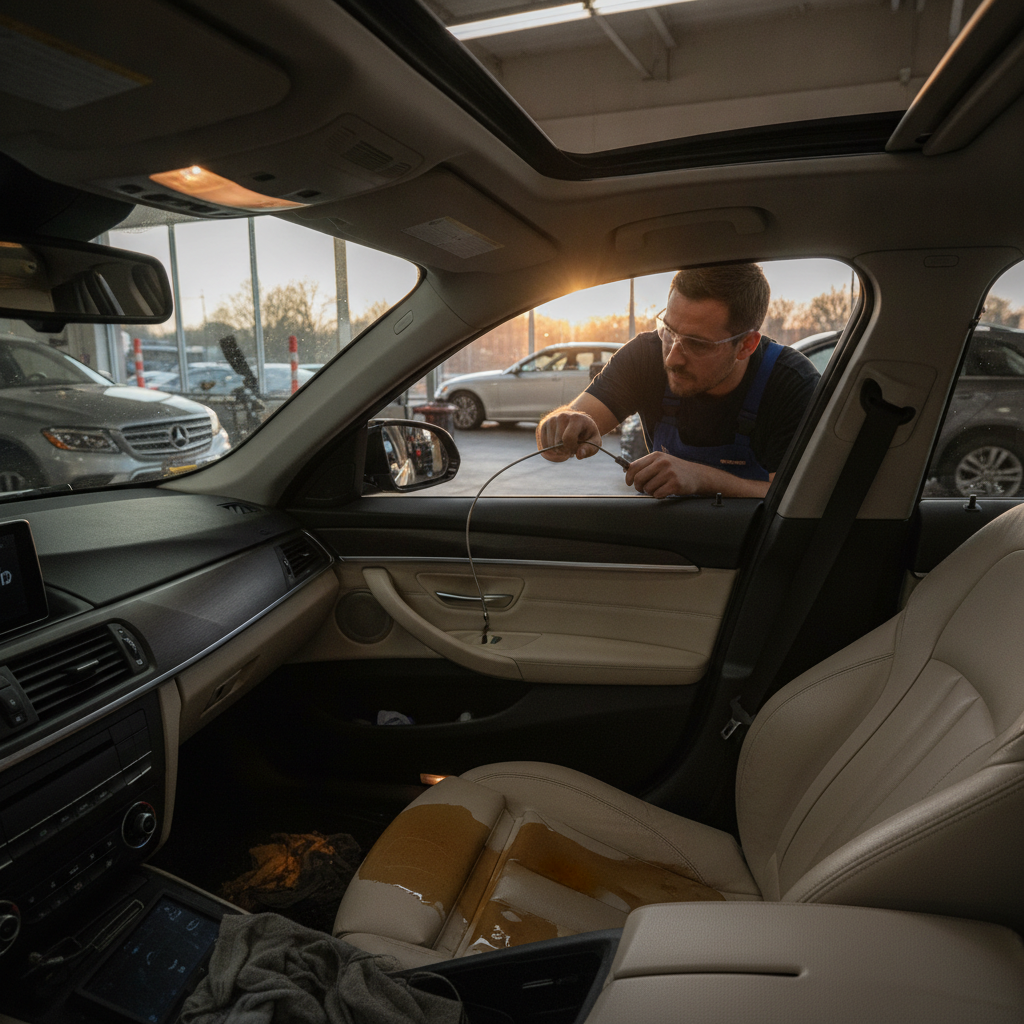
Why Is My Audi or BMW’s Sunroof Drain Clogged and Leaking Into the Cabin? What Sandy Springs Owners Should Know About Moonroof Water Damage
If you’ve noticed a musty smell in your BMW or Audi, wet carpet under the front seats, or moisture fogging up your interior glass on a clear day, there’s a good chance the culprit isn’t a failing window seal or a cracked windshield — it’s a clogged sunroof drain. This is one of the most frequently misdiagnosed sources of interior water intrusion in European vehicles, and for owners in Sandy Springs, Roswell, and the surrounding North Fulton area, Georgia’s humid climate and heavy spring rainfall make it especially worth understanding. The short answer: yes, a blocked moonroof drain tube can cause serious damage to your electronics, flooring, and control modules — and it’s far cheaper to address early than to repair after the water has already done its work.
How Sunroof Drain Systems Work on European Vehicles
Most European vehicles with panoramic or standard sunroofs are not designed to be completely watertight at the roof panel itself. Instead, they rely on a drainage system — a series of rubber or plastic tubes routed from the four corners of the sunroof tray, down through the door pillars, and out through small exits near the bottom of the vehicle. When you close your moonroof after rain, any water sitting in the tray flows into these tubes and drains harmlessly out the bottom of the car.
The problem develops gradually. Over time, debris — pollen, leaves, tree sap, road grime, and mold — accumulates in the drain tubes. Georgia’s tree canopy, particularly in neighborhoods near the Chattahoochee River corridor and throughout Sandy Springs and Johns Creek, means that cars parked outside are constantly exposed to organic debris. When the drain tubes partially or fully clog, water that should exit through the floor of your vehicle instead backs up into the sunroof tray and overflows — directly into your headliner, A-pillar trim, and ultimately your carpet.
What Interior Water Damage Actually Looks Like
Many owners don’t immediately connect wet carpet or a musty smell to a sunroof drain. The water often travels several feet from the drain exit point before pooling, which makes the source less obvious. Here are the most common signs that your European vehicle’s moonroof drain system has failed:
- Wet or damp floor mats under the front seats or in the rear footwells, especially after rain
- Musty or mildew odor that worsens when the HVAC blower runs
- Water stains on the headliner near the sunroof edges or along the A-pillar trim
- Electrical faults or warning lights that appear after rainy weather — often tied to a soaked Body Control Module (BCM), footwell module, or fuse box
- Fogging interior glass on dry days, caused by moisture trapped in the carpet padding
- Corrosion on connector pins discovered during unrelated diagnostics
On a BMW 3 Series or 5 Series, the front footwell modules are particularly vulnerable because they sit low in the floor and are easily reached by water migrating forward from the A-pillar. On Audi A4, A6, and Q5 platforms, the battery and control modules located under the rear seat or in the trunk are frequent casualties when rear drain tubes back up. Water and European electronics do not coexist peacefully — even a small amount of sustained moisture can corrode connector pins and cause cascading electrical faults that cost far more to diagnose and repair than the original drain cleaning would have.
Why This Problem Is Worse in the Atlanta Metro Area
Georgia’s climate isn’t doing your drain tubes any favors. The combination of high pollen counts in spring, summer humidity, and tree cover throughout North Fulton County creates an almost ideal environment for drain tube clogging. Owners who park under trees — common in neighborhoods throughout Sandy Springs, Alpharetta, and Roswell — see this problem accelerate significantly. Even a light coating of pollen and tree debris on the sunroof tray is enough to begin narrowing the drain openings over several seasons.
The stop-and-go commuting patterns along GA-400 and surface roads like Roswell Road also play a role. Vehicles that sit in traffic for long periods with the sunroof cracked for ventilation — which is extremely common in Atlanta summers — accumulate more debris in the tray and introduce more contaminants into the drain system over time.
What a Professional Drain Cleaning Actually Involves — and Why DIY Attempts Often Make It Worse
A proper sunroof drain service on a European vehicle isn’t simply running a compressed air hose into the drain hole and hoping for the best. That approach, commonly attempted at home or at general repair shops unfamiliar with European drain routing, frequently dislodges a partial clog and pushes it deeper into the tube — or worse, disconnects a drain tube from its fitting inside the door pillar, creating a new leak point that’s hidden inside your vehicle’s structure and far harder to reach.
A correct service involves locating all four drain tube exits, testing flow at each one, using a thin flexible drain snake or controlled low-pressure flush to clear blockages progressively, and then verifying that the tube connections at both the tray end and the exit end are fully seated and undamaged. On many BMW and Audi platforms, accessing the rear drain tubes requires removing interior trim panels — specifically the C-pillar or D-pillar covers — to inspect the routing and confirm the tube hasn’t kinked, cracked, or separated from its fitting.
If water has already entered the cabin, the service expands to include moisture assessment of the carpet padding and any affected control modules. Saturated carpet padding holds moisture for weeks and accelerates mold growth and corrosion of nearby electrical components. Addressing this properly — including drying, inspection, and connector cleaning — is what separates a complete repair from one that leaves you with a recurring musty smell or a mystery electrical fault six months later.
At Solo Motor Sports, the diagnostic process for suspected water intrusion starts with a thorough multi-point inspection that includes checking all four drain tube exits, probing carpet padding for moisture, and scanning for any stored fault codes that might indicate water-related module damage — before any unnecessary parts are replaced.
What Competitors in the Area Are Not Telling You
A review of European repair shops serving the Roswell and Sandy Springs corridor reveals a notable gap: almost none of them publish meaningful guidance on sunroof drain systems and interior water intrusion for European vehicles. You’ll find plenty of content about brakes, oil changes, and transmission service — but the water damage pathway that starts with a clogged drain tube and ends with a failed control module is almost entirely unaddressed. That’s a problem, because owners who don’t know to look for this often end up at a general shop that replaces the wrong parts, or at a dealership that charges a steep diagnostic fee just to identify the root cause.
Understanding this specific failure pathway matters because the repair escalation is real. A drain cleaning is a modest service. Replacing a waterlogged footwell module on a BMW, or a saturated BCM on an Audi, is a very different conversation — both in cost and in labor time. Catching it at the drain stage is always the better outcome.
How Often Should Sunroof Drains Be Serviced?
For European vehicles driven and parked in the North Fulton area — particularly those parked outdoors or under tree canopy — a drain inspection every 18 to 24 months is a reasonable interval. If you’ve never had it done on a vehicle you’ve owned for several years, it’s worth scheduling proactively. The best time to identify a partial blockage is before the first heavy rain of the season reveals it for you the hard way.
This service pairs naturally with a preventative maintenance visit, where fluid levels, filters, belts, and other systems are checked at the same time. Combining services keeps your vehicle’s condition current without unnecessary trips.
Frequently Asked Questions: Sunroof Drains and Water Intrusion on European Vehicles
Can a clogged sunroof drain really damage my car’s electronics?
Yes, and this is more common than most owners expect. When drain water overflows into the A-pillar and reaches the floor, it can soak control modules, fuse boxes, and wiring harnesses. On BMW and Audi platforms especially, the front footwell modules sit directly in the path of water that enters through a clogged front drain tube. Even partial water exposure can corrode connector pins and cause fault codes that appear unrelated to moisture.
How do I know if my sunroof drain is clogged versus my windshield seal is failing?
The location of the water and the timing are your best clues. Sunroof drain failures typically produce water that enters near the A-pillar or in the footwell area — not directly at the windshield base. Windshield seal leaks tend to show up as water running along the dash or pooling at the base of the glass. A proper diagnosis involves testing both, since both can occur simultaneously on high-mileage European vehicles.
Is this covered under warranty or insurance?
Sunroof drain cleaning is generally considered a maintenance item and is not covered under most extended warranties or factory warranty terms. If water damage to electronics or interior components resulted from a manufacturing defect — for example, a drain tube that was improperly routed at the factory — there may be a warranty or recall angle worth exploring. Your technician can help you identify whether a known service bulletin applies to your vehicle.
My car smells musty but the carpet seems dry. Could it still be a drain issue?
Absolutely. The carpet surface can appear dry while the padding underneath holds significant moisture. Padding acts like a sponge and can stay wet for weeks even after the source of water is resolved. If the musty smell is persistent and you have a sunroof, a drain inspection is one of the first things to rule out.
Does Solo Motor Sports service all European makes for this type of repair?
Yes. The team at Solo Motor Sports services BMW, Audi, Mercedes-Benz, Volkswagen, Porsche, Land Rover, Volvo, Mini Cooper, Maserati, and other European makes. Sunroof drain service, water intrusion diagnosis, and related interior moisture remediation are handled in-house with factory-level diagnostic tools and make-specific repair knowledge. You can learn more about the vehicles we service here.
Don’t Wait for the Next Rainstorm to Find Out
Water damage to a European vehicle’s interior and electrical systems is the kind of problem that seems minor until it isn’t. A clogged sunroof drain that goes unaddressed through one Georgia rainy season can turn a simple maintenance item into a multi-system repair. If you’re noticing any of the warning signs described above — or if you simply haven’t had your drain tubes inspected in the past two years — now is the right time to have it looked at by technicians who understand how these systems are engineered.
Solo Motor Sports serves owners throughout Sandy Springs, Roswell, Alpharetta, Johns Creek, and North Fulton County with dealership-level expertise and honest, transparent pricing. Schedule your inspection today at solomotorsportsroswell.com/contact-us/ or call us at (470) 282-1238. Don’t let a clogged drain tube become a flooded control module.