
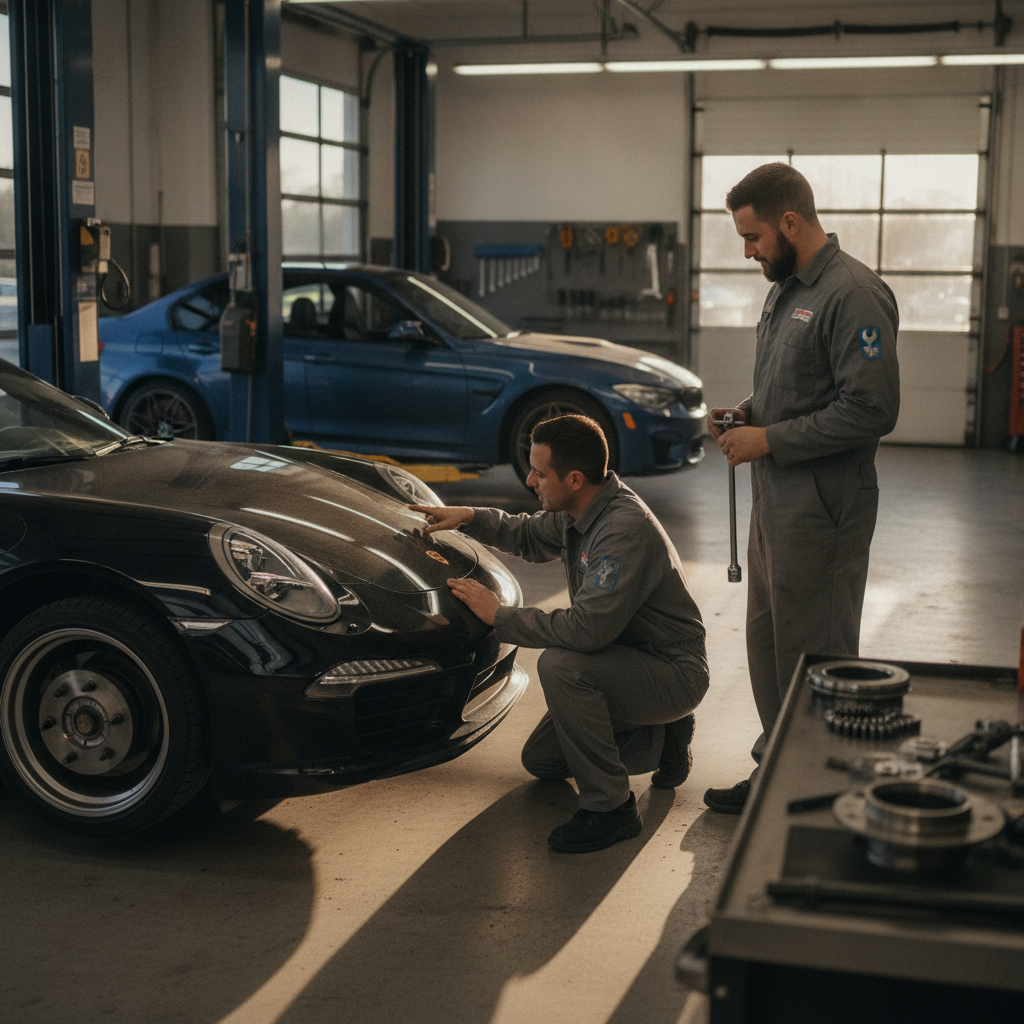
Why Is My Porsche or BMW’s Wheel Bearing Humming and Getting Worse at Highway Speed? What Roswell Owners Should Know About European Wheel Bearing Failure
That low, rhythmic hum rising up through your floorboard as you accelerate onto GA-400 is not road noise, and it is not something you should wait out. For Roswell owners driving a BMW or Porsche, a noise that grows louder with speed — especially one that shifts pitch when you gently change lanes — is almost always a wheel bearing in the early stages of failure. The good news is that catching it at this stage keeps the repair relatively straightforward. The bad news is that a worn European wheel bearing does not stay in the “early stage” for long, and the consequences of letting it go are serious.
What a Wheel Bearing Actually Does — and Why European Designs Are Different
Every wheel on your vehicle rides on a set of precision-machined bearings sealed inside a hub assembly. Their job is to allow the wheel to rotate smoothly while carrying the full weight of the vehicle through acceleration, braking, and cornering. In a properly functioning system, you never think about them. When one begins to wear, you feel and hear it immediately — though the sensation is often subtle enough at first that owners dismiss it as a tire issue or road surface variation.
On European performance vehicles, wheel bearings are engineered to tighter tolerances than those used in most domestic or Japanese platforms. A BMW 3 Series, 5 Series, or X5 uses integrated wheel bearing and hub assemblies — often referred to as hub units — that house the bearing, ABS sensor ring, and mounting flange in a single precision component. Porsche, particularly on the 911, Cayenne, and Macan, uses similarly integrated assemblies designed around the specific load characteristics of the vehicle’s suspension geometry. This precision is part of what gives these cars their handling feel. It also means that a worn or contaminated bearing degrades that feel well before it reaches the point of catastrophic failure.
How to Tell If It’s the Wheel Bearing — and Not Something Else
Wheel bearing noise is commonly misidentified as tire noise, because the two can sound similar in the cabin. Here is how to tell the difference. Tire noise tends to be consistent regardless of which lane you’re in or how you’re loading the suspension. Wheel bearing noise shifts. When you move the steering wheel slightly to the right, weight transfers to the left side of the vehicle. If the noise gets quieter, the worn bearing is likely on the left. If it gets louder, the right side is the problem. This simple test — done safely at moderate highway speed — is one of the first things a trained technician will ask you to try before pulling the vehicle into the bay.
Other symptoms that point toward a wheel bearing rather than tires or suspension:
- Humming or growling that is clearly speed-dependent and worsens above 50 mph
- A slight vibration in the steering wheel or floor at highway speed that wasn’t there six months ago
- ABS or stability control warning lights — a failing hub unit can corrupt the ABS sensor signal and trigger fault codes
- Looseness or play felt when the vehicle is lifted and the wheel is rocked side to side
- Uneven tire wear that doesn’t match your alignment history
On a BMW or Porsche, the ABS sensor integration point is especially important. Because the wheel speed sensor is built into the hub assembly, bearing wear can trigger stability management faults, traction control warnings, or DSC errors — which is one reason these vehicles sometimes come in for what the owner believes is an electrical or sensor issue, only for the technician to find a mechanical bearing failure underneath. Our diagnostic process at Solo Motor Sports always starts with the full picture, not just the symptom that brought you in.
Why North Fulton Roads Are Particularly Hard on Wheel Bearings
Wheel bearings are designed to last — but their lifespan is directly affected by road conditions, load cycles, and contamination. For drivers in Roswell, Alpharetta, Johns Creek, and Milton, the combination of high-speed GA-400 commuting and the stop-and-go surface streets near shopping and commercial corridors puts repeated stress on hub assemblies. Speed bumps in residential neighborhoods, unmarked railroad crossings, and pothole-damaged pavement on older roads near Historic Roswell and around Sandy Springs all contribute to impact loading that accelerates bearing wear — especially on lowered or sport-suspension vehicles where the geometry is already working harder.
Georgia’s humidity also plays a role. Moisture intrusion into a bearing seal — even a minor breach — leads to corrosion on the bearing races and accelerated wear. A bearing that might last 100,000 miles in a dry climate can begin showing symptoms significantly sooner in the Atlanta metro’s heat and humidity cycle. If you’re in a neighborhood with consistent flooding near the Chattahoochee River or Vickery Creek area and have driven through standing water repeatedly, that’s worth mentioning when you bring the car in.
What the Repair Actually Involves — and Why It Matters Who Does It
Replacing a wheel bearing on a BMW or Porsche is not a simple swap. On most modern European platforms, the hub unit must be pressed out and pressed back in with precision tooling — often with clearances measured in microns. Use the wrong press setup, apply force at the wrong angle, or use an aftermarket bearing that doesn’t meet OEM specification, and you can damage the knuckle, introduce new play, or find yourself back in the shop within 20,000 miles.
This is one of the areas where the cost difference between a European specialist and a general shop becomes most apparent — not in what you pay at the counter, but in what happens a year later. At Solo Motor Sports, we use OEM-grade or genuine manufacturer-specification hub assemblies and follow the press-fit procedures specified for each platform. On a Porsche Cayenne or BMW X5, where the rear hub must be torqued to spec and the ABS ring seated precisely, shortcuts in this process show up in the form of noise returning, sensor faults, or premature failure.
Timing also matters. A wheel bearing in the early humming stage is a contained repair. A wheel bearing that has been run to the point of significant play can damage the CV axle, the wheel speed sensor, the brake rotor, and in severe cases the knuckle itself. What starts as a bearing replacement can become a far larger job if it’s deferred. Most owners driving daily on GA-400 don’t realize how quickly the degradation accelerates once the bearing loses its lubrication seal. Porsche owners and BMW drivers who notice the hum early are almost always looking at a single component replacement — waiting turns that into a multi-component repair.
What Most Competitors Miss: The ABS and Stability System Connection
One gap that’s consistently underaddressed across local European repair content is the relationship between wheel bearing failure and electronic safety system faults. Owners frequently arrive with a stability control warning, a DSC fault, or an ABS light — having already paid to replace a wheel speed sensor at another shop — only to find the underlying problem was never the sensor itself. The sensor was reading incorrectly because the hub assembly it’s integrated into was failing.
On a BMW equipped with iDrive or a Porsche running PASM, stability and traction management systems rely on precise, consistent wheel speed data from all four corners. When a worn bearing causes the ABS ring to wobble or intermittently lose contact with the sensor, the system logs a fault and disables stability intervention. This is a safety issue — not just an inconvenience. Clearing the code without replacing the hub unit means the fault will return, and the vehicle is operating without its full suite of active safety systems in the meantime.
If your European vehicle has been in for a wheel speed sensor replacement that didn’t resolve the warning light, a bearing inspection should be the next step. Our technicians use factory-level diagnostic tools to distinguish between a sensor failure and a mechanical hub issue before any parts are ordered.
Frequently Asked Questions
How long can I drive on a bad wheel bearing before it becomes dangerous?
It depends on the severity. In the early humming stage, the bearing still has structural integrity and the vehicle is generally safe to drive for a short period — but it should be inspected within a week or two. Once you notice looseness, vibration in the steering wheel, or associated warning lights, you should not defer the repair. A bearing that fails completely can cause wheel wobble severe enough to affect steering control.
Will my BMW or Porsche’s warning lights tell me the bearing is failing?
Not directly. There is no specific “wheel bearing” warning light. What you’ll often see is an ABS, DSC, or traction control fault caused by the corrupted wheel speed signal from the integrated sensor in the hub unit. If those lights appear alongside a humming noise, the bearing is a likely culprit.
Can I replace just one wheel bearing, or do they need to be done in pairs?
On most European platforms, you only need to replace the failing bearing — not the opposite side. However, if your vehicle has high mileage and one bearing has failed, it’s reasonable to ask your technician to inspect and load-test the opposite bearing. If it shows early wear, replacing both at the same visit saves labor costs.
Does wheel bearing failure affect alignment or tire wear?
Significant play in a wheel bearing can affect camber, which leads to uneven inner or outer tire wear. If your alignment has been drifting or your tires are wearing unevenly on one side, a wheel bearing inspection should be part of the diagnostic process — not just a camber adjustment.
How much does a wheel bearing replacement cost on a BMW or Porsche in Roswell?
Costs vary by model, axle location, and whether additional components need replacement. Front hub assemblies on most BMW and Porsche models involve more labor than rear units on some platforms, and sport or all-wheel-drive variants can be more involved. Contact us directly for an accurate estimate on your specific vehicle — we don’t believe in quoting ranges that have no bearing on what you’ll actually pay.
Schedule a Wheel Bearing Inspection at Solo Motor Sports in Roswell
If you’re hearing a hum that changes with speed or lane position, don’t wait until the noise becomes a grind. The technicians at Solo Motor Sports in Roswell have the factory-level tooling and European platform experience to diagnose wheel bearing failure accurately and repair it correctly the first time — with OEM-specification parts and warranty-backed service. We serve owners throughout North Fulton County, including Alpharetta, Johns Creek, Milton, and Sandy Springs, and we’re straightforward about what your vehicle needs and why.
Contact Solo Motor Sports today to schedule your inspection — and get a clear answer before a manageable repair becomes a much bigger one.