
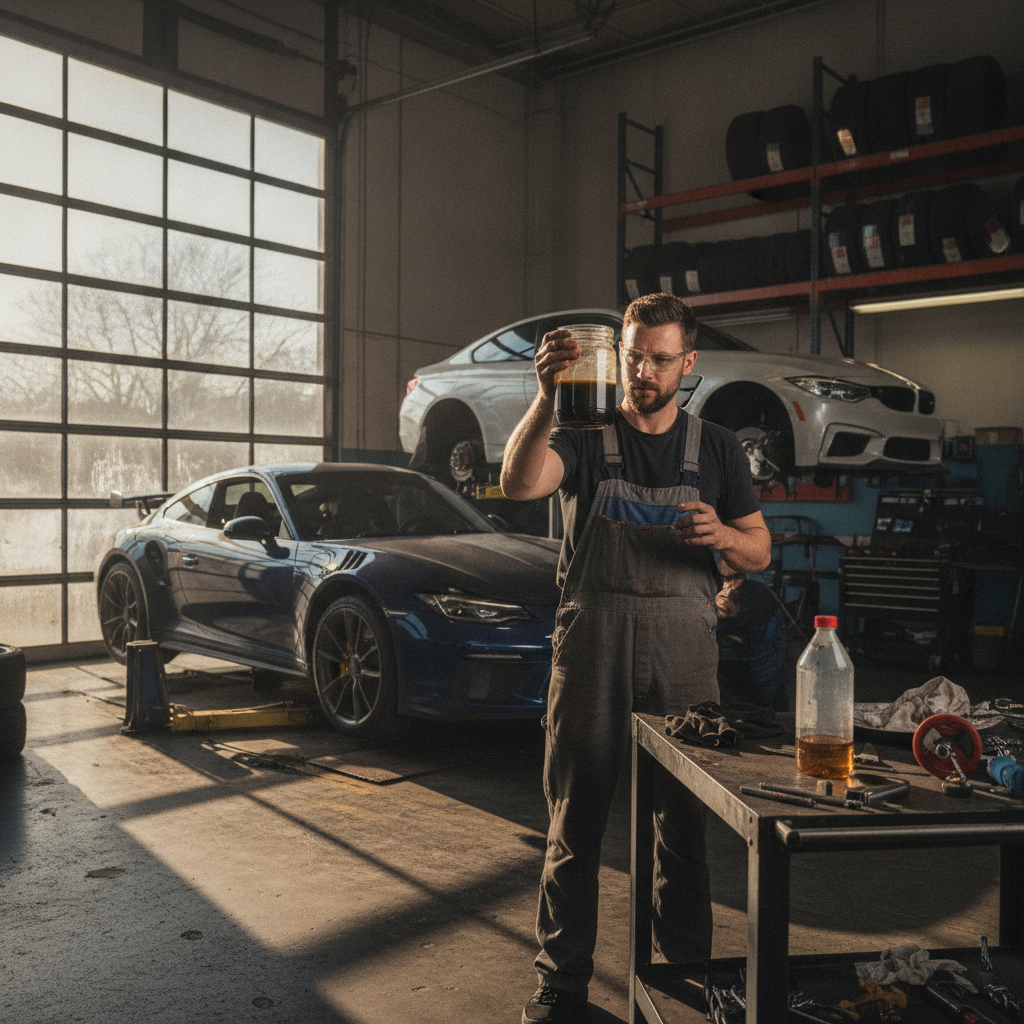
Why Is My Porsche or BMW’s Brake Fluid Dark and Contaminated? What Alpharetta Owners Should Know About European Brake Fluid Service
If the brake fluid reservoir on your Porsche or BMW looks more like dark tea than the pale amber or clear fluid it started as, your brake system is telling you something important. Contaminated brake fluid isn’t just a cosmetic issue — on a performance-tuned European vehicle, it’s a genuine safety concern that can compromise your stopping power exactly when you need it most. For drivers in Alpharetta, Johns Creek, and the broader North Fulton area, where GA-400 stop-and-go commutes and high-speed highway stretches put real thermal stress on brake systems, this is a maintenance item that deserves more attention than most shops give it.
What Makes Brake Fluid Go Bad — and Why It Happens Faster in European Performance Vehicles
Brake fluid is hygroscopic, meaning it naturally absorbs moisture from the air over time. That moisture doesn’t just sit in the reservoir — it works its way into the brake lines, calipers, and ABS modulator. Every percentage point of water absorption lowers the fluid’s boiling point. On a standard economy car, that degradation might take years to become a real problem. On a Porsche 911, a BMW M3, or even a heavily loaded Land Rover, where braking temperatures are significantly higher under normal use, that same moisture contamination can cause brake fade in situations where you absolutely cannot afford it.
The standard DOT 4 fluid used in most European makes has a dry boiling point around 446°F and a wet boiling point (after absorbing just 3.7% water) of around 311°F. Some Porsche models specify DOT 4 LV — a low-viscosity variant required by certain ABS and stability control systems. If a shop tops off or replaces your fluid with the wrong spec, it can affect the responsiveness of your electronic braking aids. This is a detail that a general oil-change chain or budget shop is almost certain to overlook.
How Georgia’s Climate Accelerates Brake Fluid Degradation
North Fulton County’s summer humidity is hard on European brake systems in ways that many owners don’t consider. Moisture in the air enters the brake system more aggressively in humid climates, meaning that a two-year interval — which might be perfectly fine in a dry climate — may not be adequate here. If you’re driving a Porsche Cayenne through Alpharetta traffic in August, or commuting down GA-400 in a BMW 5 Series every weekday, your braking system is absorbing heat and humidity simultaneously. The result is contaminated fluid that looks dark, smells slightly burnt, and has a measurably lower boiling point than spec.
The dark color itself comes from accumulated metallic particles shed by brake calipers, ABS components, and master cylinder internals, combined with oxidized fluid. When you see that dark fluid, you’re looking at evidence of ongoing internal corrosion that compounds over time if left unaddressed.
What a Proper European Brake Fluid Flush Actually Involves
This is an area where many competitors in the Roswell and Alpharetta corridor fall short in their published information — and where owners often get incomplete service without knowing it. A brake fluid flush on a European vehicle is not the same as cracking the bleeder screws and pushing fluid through until it runs clear at one wheel. Done correctly, it means:
- Evacuating the old fluid from the reservoir completely, not just topping off
- Bleeding each caliper in the sequence specified by the manufacturer — which varies between makes and sometimes between model years
- Using the exact fluid specification required by your vehicle (DOT 4, DOT 4 LV, or DOT 5.1 depending on make and model)
- Activating ABS and stability control solenoids during the bleed process to purge old fluid trapped in the modulator — a step that requires proper diagnostic software, not just a hand pump
- Inspecting rubber brake hoses for internal deterioration, which can introduce contamination even after fresh fluid is installed
On vehicles with electronic parking brakes — which includes most current BMW, Audi, Mercedes-Benz, and Porsche models — the rear calipers cannot be properly serviced without factory-level diagnostic software that commands the parking brake motor to retract. Attempting a brake service without that capability leads to damaged caliper pistons and an incomplete fluid exchange in the rear circuit.
At Solo Motor Sports, our technicians use professional-grade diagnostic tools capable of performing ABS bleeds and electronic parking brake resets across all the European makes we service. Learn more about our brake repair and service process here.
How Often Should You Flush Brake Fluid on a European Vehicle?
Most European manufacturers recommend a brake fluid flush every two years regardless of mileage. Porsche, BMW, and Mercedes-Benz all publish this interval in their factory maintenance schedules. In practice, Georgia’s heat and humidity make sticking to that two-year cycle especially important. If you’re not sure when your fluid was last changed — or if the vehicle you purchased used didn’t come with complete maintenance records — a boiling point test with a professional-grade tester can give you an objective reading rather than a guess based on color alone.
Owners in Milton and Johns Creek who drive performance variants — Porsche GTS models, BMW M cars, AMG-spec Mercedes vehicles — should consider flushing on a shorter interval, especially if the car sees any track use, spirited canyon roads, or extended mountain driving. Heat cycles accumulate quickly on high-performance brake setups.
Warning Signs That Your Brake Fluid Needs Attention Now
Don’t wait for the two-year mark if you notice any of these symptoms:
- Spongy or soft brake pedal — Air or vapor pockets in contaminated, degraded fluid create compressibility in a system that should be hydraulically solid
- Brake pedal fading under prolonged use — Extended downhill driving or repeated hard stops cause overheated fluid to vaporize, causing pedal travel to increase
- ABS or DSC warning lights — Contaminated fluid with metallic particles can interfere with ABS modulator solenoids and trigger fault codes
- Visible dark or cloudy fluid in the reservoir — Clear indication that the fluid has absorbed moisture and accumulated particulate
- Unusual burning odor after braking — Can indicate overheated fluid boiling within the system
If your dashboard is showing brake-related warnings alongside any of these physical symptoms, the fluid service is only part of the picture. A full diagnostic scan will reveal whether ABS solenoids, wheel speed sensors, or pressure sensors are also involved. A multi-point inspection is a practical starting point if you’re unsure where your vehicle stands.
Why This Matters More on a Porsche or BMW Than on a Domestic Vehicle
European performance and luxury vehicles are engineered to significantly tighter tolerances than most domestic makes. Their braking systems — particularly the integration between the ABS modulator, electronic stability control, and electronically adjustable dampers — depend on hydraulic pressure that is clean, consistent, and within spec. Contaminated fluid doesn’t just threaten your stopping distance in isolation. On a Porsche equipped with PASM or a BMW with Dynamic Stability Control, degraded hydraulic fluid degrades the system’s ability to make split-second pressure adjustments across individual wheels during emergency maneuvers. That’s a cascading failure, not just a maintenance oversight.
Sandy Springs and North Fulton owners who invest in European and luxury vehicles deserve maintenance service that matches the engineering standards built into those vehicles — not a generic service that treats a Porsche’s braking system the same as a pickup truck’s.
Frequently Asked Questions: Brake Fluid Service for European Vehicles Near Alpharetta
Can I just top off my brake fluid instead of flushing it?
No — and doing so can make things worse. Topping off dilutes the contaminated fluid with fresh fluid but does nothing to remove the moisture, particulate, or oxidized compounds already in the system. It also masks the warning sign (low fluid level) that might indicate a brake fluid leak elsewhere in the system. A flush and full replacement is the only correct service.
How long does a brake fluid flush take?
On most European vehicles, a proper flush — including ABS modulator bleeding with diagnostic software — takes approximately 45 minutes to an hour. It is not a quick, walk-in service if done correctly, but it also should not require leaving your vehicle overnight.
Does brake fluid brand matter for a Porsche or BMW?
Yes. The fluid must meet the OEM specification for your specific model. Using a non-approved DOT rating or a fluid that doesn’t meet Porsche or BMW’s published specs can affect ABS performance, damage rubber seals in the calipers and master cylinder, and void warranty coverage on related components. We use fluids that meet or exceed manufacturer specifications for every make we service.
Is a brake fluid flush something that needs to be done at a dealership?
Not at all — provided the independent shop has the correct diagnostic software for your vehicle’s ABS bleed procedure and electronic parking brake. At Solo Motor Sports, we have the tools and factory-trained experience to perform this service correctly on BMW, Porsche, Mercedes-Benz, Audi, Land Rover, and every other European make we specialize in, without dealership pricing.
What happens if I skip brake fluid service entirely?
Over time, moisture-saturated fluid accelerates corrosion inside brake calipers, the master cylinder bore, and ABS modulator passages. What starts as a relatively inexpensive fluid flush can become a caliper replacement, master cylinder replacement, or ABS modulator repair — all of which carry significantly higher costs. More immediately, degraded fluid increases your risk of brake fade in a hard-stop emergency.
Schedule Your Brake Fluid Service at Solo Motor Sports
If you’re driving a Porsche, BMW, Mercedes-Benz, Audi, or any European import in Alpharetta, Roswell, Johns Creek, or the surrounding North Fulton area, and you can’t remember the last time your brake fluid was tested or replaced, now is the right time to address it. At Solo Motor Sports, our technicians bring factory-level knowledge to every service — without the dealership overhead or the upsell pressure.
Brake fluid is one of the least glamorous maintenance items on a European performance vehicle. It’s also one of the few where cutting corners has immediate safety consequences. Contact us today to schedule your brake fluid flush or request a full brake system inspection. We serve owners across the Roswell, Alpharetta, Milton, Sandy Springs, and Johns Creek corridor, and we’ll give you a straight answer about what your vehicle actually needs.