
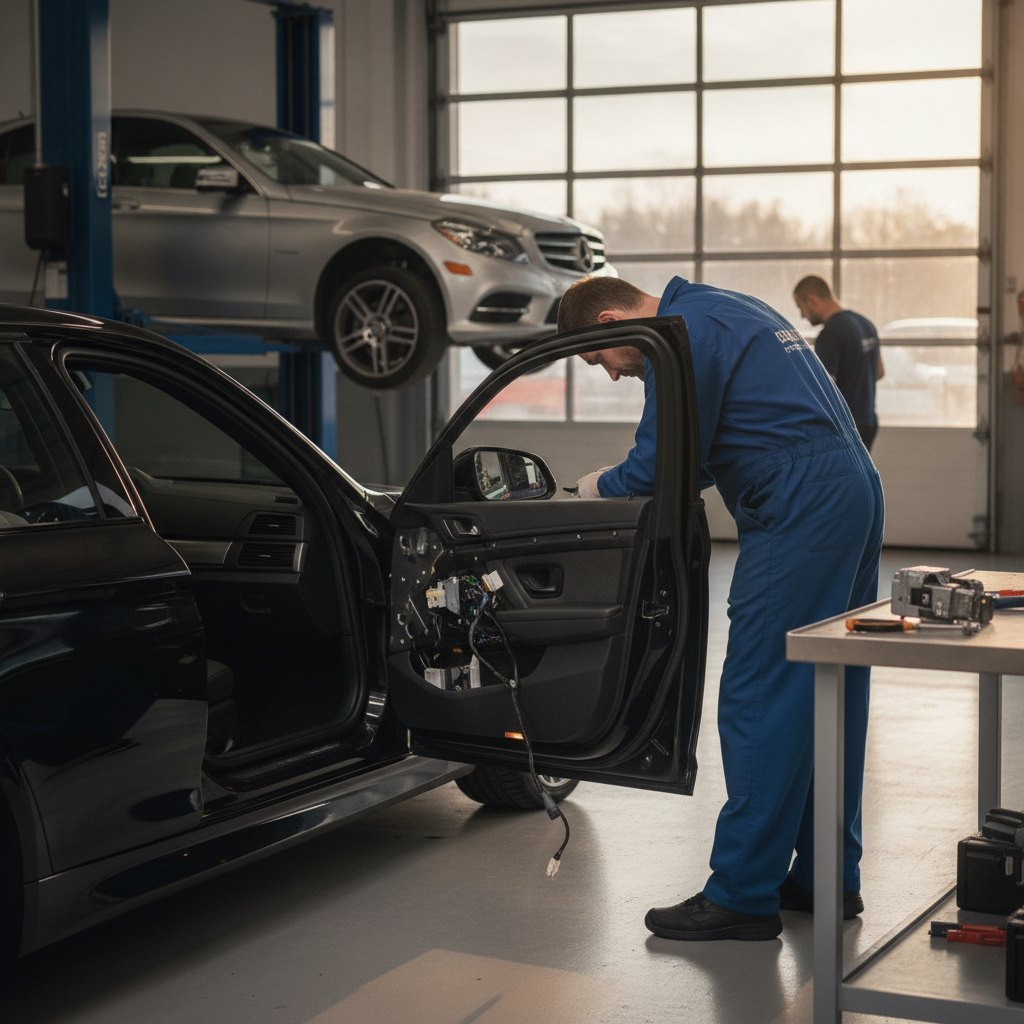
Why Is My BMW or Mercedes Door Lock Not Working From the Inside? What Roswell Owners Should Know About Central Locking System Failure
If your BMW or Mercedes door won’t unlock from inside the cabin — or if you’re climbing out and realizing the interior handle is doing nothing at all — you’re almost certainly dealing with a failed door latch actuator, a broken locking linkage rod, or a fault in the central locking control module. In Roswell and across North Fulton County, this is one of the more common yet underappreciated complaints we see on European vehicles: the door appears fine from the outside, key fob works, but once you’re inside, you’re trapped or manually fighting to get out. That’s not just an inconvenience — it’s a safety issue, and on a BMW or Mercedes, it rarely fixes itself.
What the Central Locking System on a BMW or Mercedes Actually Does
European manufacturers don’t build central locking systems the way a domestic truck does. On a BMW 3 Series, 5 Series, or X5 — and on Mercedes C-Class, E-Class, GLE, or GLC models — the central locking system is an integrated network of electric actuators, control modules, and body bus communication lines. Each door has its own actuator that physically moves the locking mechanism. Those actuators are tied to the body control module (BCM) or the door control unit, which receives signals from your key fob, the interior handle switch, and sometimes even the door position sensor.
When one actuator fails, the symptom is usually isolated to that door — you can lock and unlock from the key fob and other doors work fine, but from inside that specific door, the handle feels dead or the lock doesn’t engage. When the control module or wiring has a fault, you may see a cascade: multiple doors behaving oddly, the central locking cycling erratically, or fault codes appearing alongside the symptom even when nothing obvious is broken mechanically.
The Three Most Common Causes on BMW and Mercedes Vehicles
1. Failed Door Latch Actuator
This is the most frequent culprit, and it’s largely a wear-and-tear issue. The actuator is a small electric motor inside the door latch assembly. Over years of use — compounded by Georgia’s heat and humidity cycling the door seals and internal components — the motor brushes wear out, the plastic gears crack, or the mechanism seizes. You’ll often hear a faint click or grinding sound when you try to lock or unlock from inside, right before it stops working entirely. On BMWs, the rear doors tend to fail first. On older Mercedes E-Class and C-Class models, the driver’s door actuator is a known weak point.
2. Broken or Disconnected Door Lock Linkage
Inside the door panel, plastic rods and clips connect the interior handle to the latch mechanism. These linkage rods are surprisingly fragile on European vehicles — they’re engineered for a specific range of motion and designed to flex rather than absorb impact. If a door has been slammed repeatedly, if a child has yanked on the handle forcefully, or if a prior repair was done incorrectly, a clip can pop off or a rod can snap. The interior handle then moves freely with no resistance — because it’s connected to nothing. This is purely mechanical and doesn’t throw a fault code, which is why a generic shop running a basic scan will often come back and tell you they found nothing wrong.
3. Central Locking Module Fault or Wiring Issue
Less common but more expensive to diagnose if you go to the wrong shop: a fault in the door control unit or body control module can cause selective locking failures. BMW’s LCM (lamp control module) and Mercedes’ SAM (signal acquisition module) both communicate locking commands across the vehicle’s CAN bus. A corroded connector, a failing module, or a software glitch can cause one or more doors to stop responding to interior commands while still functioning via the key fob. This type of failure requires factory-level diagnostic software — not a generic OBD-II scanner — to read the proprietary fault codes stored in the door module itself.
Why This Isn’t a Job for a General Repair Shop
Most general repair shops in the area are comfortable replacing an actuator on a domestic vehicle. On a BMW or Mercedes, the job involves more steps: the interior door panel has hidden clips and trim pieces that break if you pry in the wrong place, the vapor barrier must be resealed properly or you’ll end up with water intrusion inside the door, and on some models, the latch assembly comes as an integrated unit rather than a standalone actuator. Using an aftermarket latch on a BMW or Mercedes is also a gamble — cheap overseas actuators fail within a year in Georgia’s heat, and you’re right back where you started.
At Solo Motor Sports, our technicians use OEM or OEM-equivalent parts for door latch and actuator replacements, and we have the factory-level diagnostic tools to confirm whether the issue is mechanical, electrical, or module-related before we ever pull a panel. That distinction matters — because misdiagnosing a linkage failure as a module fault sends you down a much more expensive path. You can learn more about how we approach European vehicle diagnostics on our auto repairs and services page.
The Safety Risk Owners in Roswell and Johns Creek Shouldn’t Ignore
A door that won’t open from the inside isn’t just inconvenient. It’s a genuine safety hazard. In an emergency — an accident, a sudden need to exit the vehicle, any scenario where seconds matter — a failed interior latch can trap you or a passenger. This is especially critical for rear passenger doors, where children are seated. If you’re noticing a rear door that requires extra effort from inside, or a door that only opens with the exterior handle, don’t delay getting it looked at. A door latch actuator replacement is a straightforward repair when caught early. If the latch assembly itself is damaged or the wiring harness has deteriorated, the repair becomes more involved.
We see a fair number of these come through from owners in Johns Creek, Alpharetta, and Sandy Springs who’ve been putting off the repair for months because the car still drives fine and the door opens from outside. By the time they bring it in, the latch mechanism has sometimes done additional damage to the surrounding assembly.
What the Repair Actually Involves — and What to Expect
A straightforward actuator replacement on a BMW or Mercedes typically takes one to three hours of labor depending on the door and model. The technician will remove the interior door panel carefully, inspect the actuator, linkage rods, and wiring, and confirm the root cause before ordering parts. If a control module is involved, diagnostic time increases. Most actuator repairs are completed same-day at Solo Motor Sports when parts are in stock.
We never recommend repairs without first confirming the actual failure point. If your door handle feels loose, the lock cycles but doesn’t fully engage, or you’re getting an intermittent issue that comes and goes with temperature changes — those details help us narrow the diagnosis quickly. Georgia summers and the temperature swings between seasons can accelerate plastic component failure inside doors, so if you drive a BMW or Mercedes with higher mileage, this is worth mentioning during your next service visit.
Our BMW repair specialists and Mercedes technicians handle door latch and central locking repairs regularly, and we back the work with a warranty on both parts and labor.
Frequently Asked Questions
Can I still drive my BMW or Mercedes if the door won’t open from inside?
Technically yes, but we don’t recommend it for more than a short trip to get the car serviced. A door that can’t be opened from inside is a safety hazard in any emergency situation, and in some cases a failing latch can also affect how securely the door stays closed while driving.
Will the problem show up on a standard OBD-II scan?
Not always. A broken linkage rod or worn actuator gear may not generate any fault codes at all — the failure is purely mechanical. A module-related locking fault will generate codes, but only factory-level diagnostic software can read the proprietary fault codes stored in BMW or Mercedes door control units. Generic scanners often miss these entirely.
Is it safe to replace a BMW or Mercedes door actuator with an aftermarket part?
We strongly advise against it. Aftermarket actuators sourced from overseas suppliers are frequently made with substandard motor brushes and plastic gears that fail prematurely in Georgia’s climate. OEM or OEM-equivalent parts are the right call for a repair that’s expected to last.
My key fob locks and unlocks the door fine. Does that mean the actuator is okay?
Not necessarily. Some actuators fail selectively — they can respond to the electronic signal from the key fob but fail under the mechanical load of the interior handle linkage. If your door locks and unlocks via fob but the interior handle does nothing, the latch actuator or linkage is still the likely suspect.
Does Solo Motor Sports service other European makes with central locking issues?
Yes. We see similar door latch and central locking failures on Audi, Volkswagen, Volvo, Land Rover, Porsche, and Mini Cooper. The systems differ by manufacturer, but the diagnostic and repair process follows the same principle: confirm the failure point precisely before replacing parts. You can review the full list of vehicles we service at our vehicles we service page.
Don’t Wait on a Door That Won’t Open
If your BMW or Mercedes has a door that’s stopped working from the inside — whether it’s the driver’s door, a rear passenger door, or something that comes and goes — bring it to Solo Motor Sports in Roswell before it becomes a safety issue or a more expensive repair. We have the factory-level tools, the OEM parts, and the European vehicle expertise to diagnose it correctly the first time. Reach out through our contact page to schedule an appointment or ask about your specific vehicle. Same-day service is available for most door latch repairs when parts are in stock.