
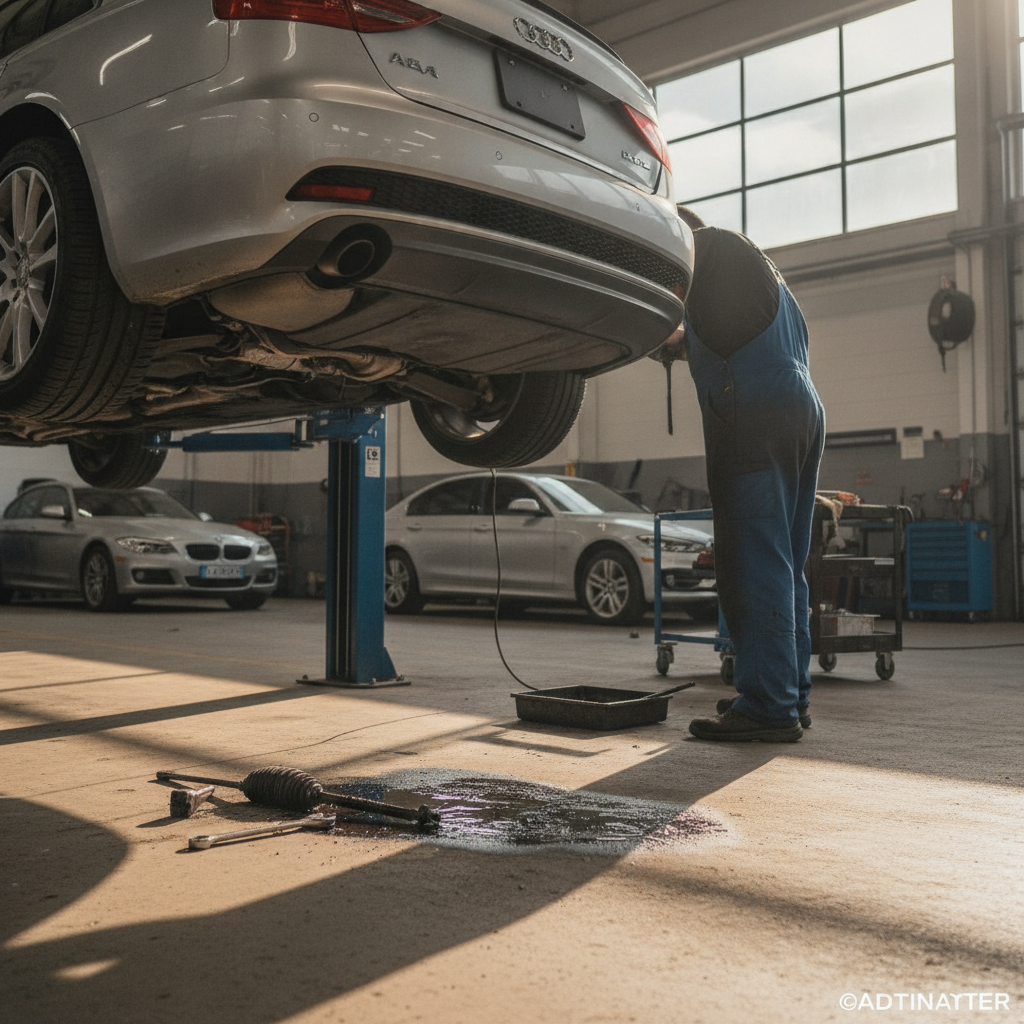
Why Is My Audi or BMW’s Steering Rack Leaking Power Steering Fluid? What Johns Creek and Alpharetta Owners Should Know About Rack and Pinion Failure
If you’ve noticed a small puddle of reddish or amber fluid under the front of your car, a greasy film accumulating beneath the engine bay, or a steering wheel that suddenly requires more effort to turn, your Audi or BMW may have a leaking steering rack. This is one of the more overlooked failure points in European hydraulic steering systems — and in Johns Creek and Alpharetta, where high-mileage luxury vehicles are common and daily commutes through GA-400 traffic put consistent load on steering components, it’s a problem worth understanding before it becomes an emergency.
The good news: a leaking rack and pinion doesn’t always mean an immediate catastrophic failure. The bad news: if you ignore it, you’ll eventually lose steering assist entirely — and the rack itself can sustain internal scoring damage that turns a seal replacement into a full rack replacement. Here’s what you need to know.
What the Steering Rack Actually Does — and Why European Designs Are Different
The steering rack translates your steering wheel inputs into lateral movement at the front wheels. In vehicles with hydraulic power steering — still common across a wide range of BMW 3 Series, 5 Series, Audi A4, A6, Q5, and Q7 models — the rack is pressurized by a belt-driven pump and uses hydraulic fluid to provide steering assist. That system operates under significant pressure, and it depends on a series of internal seals and O-rings to stay leak-free.
European manufacturers, particularly BMW and Audi, engineer their steering racks to very tight tolerances. That precision is part of what gives these vehicles their characteristic feedback and responsiveness — but it also means that when a seal begins to fail, the leak can progress quickly, especially under the kind of stop-and-go driving that characterizes the GA-400 corridor between Alpharetta and Sandy Springs. Every full-lock turn in a parking lot, every steering correction at highway speed — these cycles add up, and over time, the seals simply wear.
Common Causes of Steering Rack Leaks on BMWs and Audis
A few patterns show up consistently in European vehicles brought to us from the Johns Creek and Alpharetta areas:
- Aged or hardened seals: The internal seals in a hydraulic rack have a finite service life. Heat cycling — which is accelerated by Georgia summers — causes rubber seals to lose elasticity and eventually crack or shrink. Once a seal starts weeping fluid, the problem compounds itself, because low fluid levels allow air into the system, which increases internal wear.
- Contaminated power steering fluid: Many owners don’t realize that power steering fluid degrades over time and should be flushed at manufacturer-recommended intervals. Degraded fluid becomes acidic and attacks the very seals it’s supposed to lubricate. We see this frequently on vehicles that have followed a basic maintenance schedule but where the power steering flush was never addressed.
- Rack end seal failure at the boots: The rubber boots that cover each end of the steering rack protect the inner tie rod ends and the exposed shaft area. When these boots crack — something Georgia heat and UV exposure accelerates — road grime enters and damages the shaft surface, making a clean seal impossible.
- High-mileage wear: BMWs and Audis regularly go well beyond 100,000 miles in North Fulton County, and at those mileages, steering rack seals are simply reaching the end of their service window. There’s nothing wrong with the vehicle — it’s a maintenance reality that comes with owning a precision-engineered car and keeping it long-term.
Warning Signs You Shouldn’t Ignore
The signs of a leaking or failing steering rack on an Audi or BMW are usually progressive, which means you have a window to address the problem before it escalates. Watch for:
- A low-level reddish, amber, or light brown fluid puddle under the front of the vehicle after it’s been parked
- Steering that feels heavier than usual, especially at low speeds or when parking
- A whining or groaning noise when turning the wheel, particularly when the wheel is near full lock
- A steering wheel that drifts or pulls subtly to one side, which can indicate uneven rack pressure
- A visible wet or oily buildup along the steering rack housing or on the inner fender wells
If you’re experiencing the whining noise symptom specifically, that’s worth understanding in more detail — power steering noise can originate from the rack, the pump, or the fluid lines, and correctly diagnosing the source requires factory-level diagnostic equipment and hands-on inspection, not guesswork.
What Repair Actually Involves — and Why This Isn’t a Generic Job
A steering rack repair on a European vehicle isn’t a job you want handed to a general shop without specific experience on your make. The tolerances involved in Audi’s progressive-ratio rack systems, or BMW’s Servotronic variable-assist configurations, mean that an improperly rebuilt or mismatched replacement rack will immediately affect steering feel and potentially trigger fault codes through the steering angle sensor.
At Solo Motor Sports in Roswell, our technicians approach steering rack work with make-specific knowledge and OEM-quality or genuine parts — not aftermarket units sourced to hit a price point. When we replace or reseal a rack, we also flush the power steering system completely, inspect the pump, tie rod ends, and boots, and verify the steering angle sensor calibration after reassembly. Skipping any of those steps on a BMW or Audi invites a comebacks.
If you drive a vehicle with electric power steering — which is now standard on newer BMW and Audi platforms — a “leak” in the traditional sense doesn’t apply, but electric rack failures have their own signature: sudden increases in steering effort, jerky or inconsistent assist, and fault codes related to the EPS motor or torque sensor. Those require their own diagnostic approach, and they’re equally critical to address early. You can learn more about what we cover in our auto repairs overview.
What Competitors in the Roswell Area Aren’t Telling You About Steering Rack Service
Reviewing what’s available from other European shops in the area, one thing stands out: there’s almost no detailed guidance for owners on the difference between a rack seal repair, a rack rebuild, and a full rack replacement — and why that distinction matters enormously for cost and long-term reliability on a BMW or Audi specifically.
Here’s the practical breakdown:
- Seal repair (reseal): Possible if the rack shaft and internal bore are not scored or damaged. Significantly less expensive than replacement. Requires disassembly, precision cleaning, and correct seal kits for your specific rack model. Not every shop has access to the correct OEM seal kits for European applications — generic kits often don’t hold under European fluid pressures.
- Rack rebuild: A more involved process where the rack is fully disassembled, inspected, and rebuilt with new internal components. Appropriate when there’s minor internal wear but the rack housing is undamaged. Often available through remanufactured rack suppliers with a warranty.
- Full rack replacement: Necessary when the rack bore is scored, the shaft is damaged, or the rack has failed internally beyond what a reseal or rebuild can correct. This is the most expensive option but is sometimes the only reliable one for high-mileage vehicles or those that were run with critically low fluid for an extended period.
Knowing which path is appropriate for your vehicle requires a proper inspection — not a blanket recommendation. If a shop quotes you a full rack replacement over the phone without looking at the vehicle, that’s worth questioning. A thorough multi-point inspection is the right starting point.
Alpharetta and Milton Owners: Factor in Your Driving Patterns
If you’re commuting regularly from Johns Creek or Milton through Alpharetta on GA-400, your steering system is working harder than you might think. High-speed lane changes, frequent on-ramp corrections, and the constant parking and maneuvering in the Avalon area or North Point corridor put meaningful cumulative load on the rack and pump. That’s not a reason for alarm — it’s simply context for why preventative attention to your steering system is worth building into your service schedule, especially once you’re past 70,000 miles on a hydraulic-steering BMW or Audi.
Frequently Asked Questions
How much does it cost to fix a leaking steering rack on a BMW or Audi?
The range is wide because it depends on whether you need a reseal, a rebuilt rack, or a full replacement — and on your specific model. A reseal on a simpler rack can be significantly less expensive than a full replacement on a complex variable-assist unit. We don’t quote steering rack work without inspecting the vehicle first, because an honest answer requires knowing what you’re actually dealing with.
Can I drive my BMW or Audi with a leaking steering rack?
Briefly, yes — but it’s not advisable to ignore it. As fluid levels drop, the power steering pump runs dry, which damages it. If you lose steering assist completely at highway speed, that’s a serious safety situation. Have it inspected promptly.
Is a remanufactured steering rack a good option?
On most BMW and Audi applications, a quality remanufactured rack with a warranty is a legitimate option — provided it’s the correct unit for your vehicle’s specific steering configuration. The key is using a supplier that rebuilds to OEM specifications, not just generic tolerances. We only install parts we’d put on our own vehicles.
How do I know if the problem is the rack or the power steering pump?
That’s exactly the right question to ask before authorizing any repair. A leaking pump and a leaking rack can present with similar symptoms. The physical location of the leak, the behavior under full-lock conditions, and the noise pattern during diagnosis all help isolate the source. This is where factory-level diagnostic knowledge earns its value.
Does Solo Motor Sports service steering racks on other European makes?
Yes. We work on steering systems across all the European and import vehicles we service — including Mercedes-Benz, Porsche, Volkswagen, Volvo, and others. If your make isn’t listed here, contact us directly and we’ll let you know what we can do for you.
Talk to a Specialist Before the Problem Gets Worse
A leaking steering rack on your Audi or BMW isn’t something to put on the back burner. The repair window where a reseal is possible closes quickly once you’re running low on fluid or the rack shaft develops surface damage. The owners who end up with the largest repair bills are almost always the ones who noticed the early signs and waited.
Solo Motor Sports is located in Roswell and serves European vehicle owners throughout Johns Creek, Alpharetta, Sandy Springs, Milton, and the surrounding North Fulton County area. Our technicians are factory-trained and ASE-certified, and we use OEM-quality parts backed by a warranty. If you’re seeing signs of a steering rack leak, contact us to schedule an inspection — we’ll give you an honest assessment and a clear explanation of your options before any work begins.