
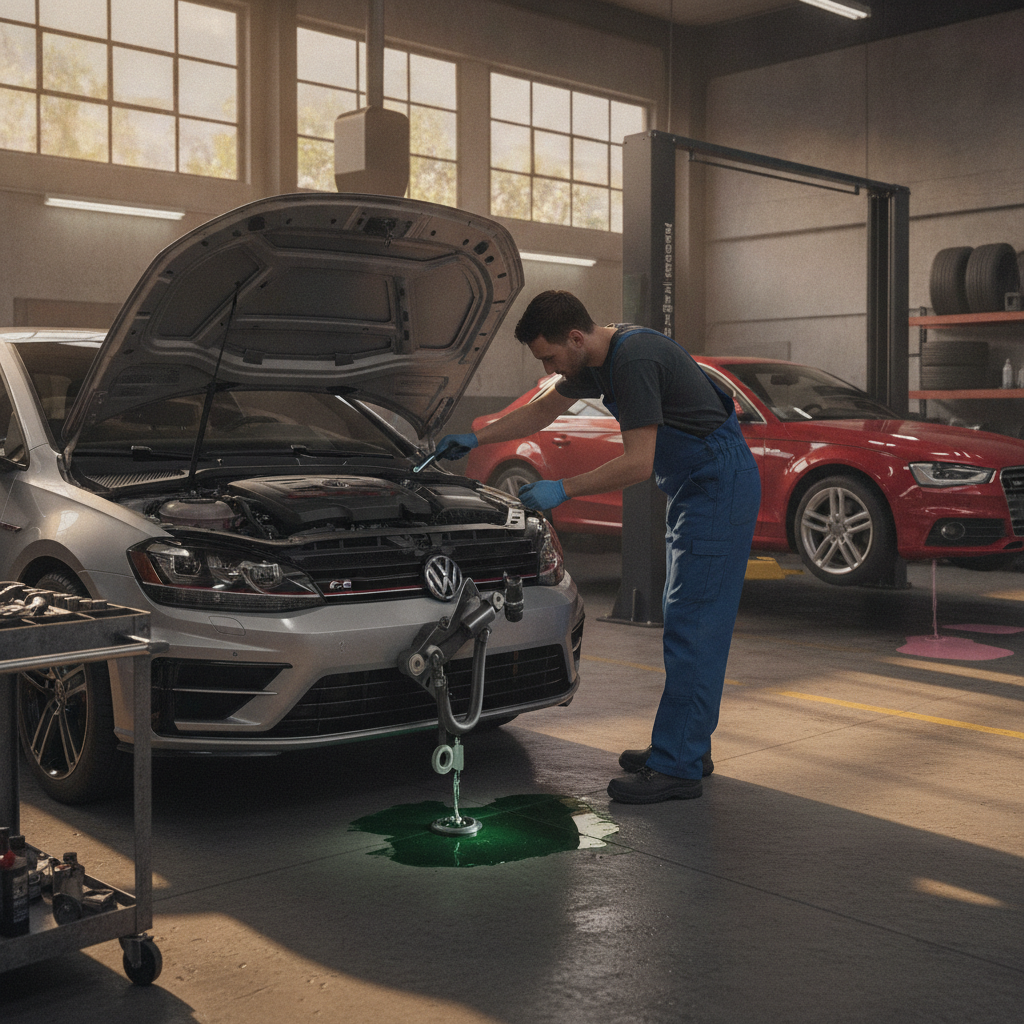
Why Is My Volkswagen or Audi’s Coolant Flange Cracking and Leaking? What Roswell Owners Should Know About Plastic Cooling System Components
If you own a Volkswagen or Audi and you’ve recently noticed a faint sweet smell coming from under the hood, a small puddle of green or pink fluid where you park, or your temperature gauge nudging higher than usual — there’s a very real chance your coolant flange has cracked. This is one of the single most common failure points on VAG-platform engines, and it’s one that catches a lot of Roswell owners completely off guard because the early signs are so subtle. By the time you see steam or a full-on warning light, you’re often already looking at potential engine damage. The good news is that catching a coolant flange failure early is a straightforward, affordable fix. Missing it is not.
What Exactly Is a Coolant Flange — and Why Does Volkswagen Use Plastic?
The coolant flange — sometimes called a coolant pipe, coolant neck, or coolant distribution housing depending on the engine — is the component that routes coolant between the engine block, the radiator, the heater core, and various other parts of the thermal management system. On most VAG-platform engines (the 1.8T, 2.0T TSI, 2.5L five-cylinder, VR6, and many of the EA888 units powering everything from a Golf GTI to an A4 to a Passat), these flanges are made almost entirely of plastic.
Volkswagen and Audi use plastic for a reason: it’s lighter, cheaper to manufacture, and thermally efficient. The tradeoff is longevity. Plastic becomes brittle over years of heat cycling — expanding when hot, contracting when cold, day after day. Georgia’s climate accelerates this. The combination of summer heat regularly pushing past 90°F and the stop-and-go thermal stress of GA-400 and surface roads through Roswell and Alpharetta puts real strain on plastic cooling components. After 60,000 to 100,000 miles, that plastic doesn’t flex — it cracks.
The Warning Signs Roswell VW and Audi Owners Should Never Ignore
Coolant flange failures rarely happen all at once. More commonly, you’ll see a slow progression of symptoms over weeks or months before the flange gives way completely. Here’s what to watch for:
- A sweet, syrupy smell from the engine bay — especially after the engine has warmed up or shortly after you shut it off. Coolant has a distinctive odor that’s hard to confuse with anything else once you know it.
- Low coolant warnings or needing to top off frequently — if you’re adding coolant every few weeks without an obvious puddle, you likely have a slow seep somewhere in the system.
- Visible white residue or dried crust around a plastic fitting — coolant evaporates and leaves behind a chalky deposit. Look around hose connection points and plastic housings.
- Temperature gauge running slightly higher than normal — especially during stop-and-go traffic or on hot days. The system is working harder to compensate for a reduced coolant volume.
- Coolant pooling under the front of the vehicle — a larger crack will produce a visible puddle, often green or pink depending on the coolant type used.
None of these symptoms should be dismissed as minor. A European vehicle’s cooling system operates under significant pressure, and what starts as a hairline crack in a plastic flange can fail suddenly and catastrophically — leaving you stranded on GA-400 or, worse, dealing with a warped cylinder head from running hot.
Why This Repair Is More Involved Than It Looks
One detail that surprises many owners: on several VW and Audi engines, the coolant flange is tucked deep in the engine bay, often behind or beneath other components. On the 2.0T TSI, for example, the main coolant flange sits near the rear of the cylinder head and can require partial disassembly of surrounding hardware to access properly. A shop that isn’t familiar with VAG engine architecture may either miss the flange entirely during a visual inspection or take significantly longer to complete the job due to unfamiliarity with the layout.
This is also a repair where part quality matters enormously. Aftermarket plastic flanges sourced from low-cost suppliers often replicate the same brittleness problems as the original — sometimes failing even sooner. At Solo Motor Sports, the approach is to use OEM or OEM-equivalent components that meet Volkswagen and Audi’s original specifications, so the repair lasts. Paired with a full coolant system inspection and a proper coolant flush using the correct G13 or G12+ spec fluid, you’re not just fixing the flange — you’re restoring the integrity of the entire cooling circuit.
Learn more about Volkswagen repair services at Solo Motor Sports.
What Competitors Miss: The Full-System Approach to Coolant Flange Repair
Most local shops that do handle coolant flange work on VW and Audi vehicles treat it as a single-component replacement — swap the cracked flange, refill the coolant, done. What they often skip is the broader inspection that this failure almost always warrants. If one plastic cooling component has reached the end of its service life, others are typically close behind. The thermostat housing, the coolant reservoir cap, auxiliary water pump seals, and associated hose connections are all worth evaluating at the same time.
Doing that work proactively — while the cooling system is already partially drained and disassembled — saves you from coming back six months later with a different coolant leak from a different plastic component. It’s the kind of comprehensive, honest assessment that’s standard practice at a specialist shop and often missing from a quick-turnaround general repair center.
A Note for Owners in Johns Creek, Milton, and Alpharetta
If you’re commuting daily from Johns Creek or Milton down GA-400 into Atlanta, your European vehicle’s cooling system is working harder than you might think. High-speed highway runs followed by slow city traffic, combined with Georgia’s seasonal heat, create the exact thermal cycling pattern that accelerates plastic component degradation. Owners in these communities who are approaching 70,000 to 80,000 miles on a VW or Audi should treat a coolant system inspection as genuinely preventative — not just reactive — maintenance.
Sandy Springs and North Fulton County owners are also well-served by getting ahead of this. The cost of replacing a coolant flange proactively is a fraction of what you’ll spend addressing an overheating event, a blown head gasket, or the towing bill and emergency repair that come with a sudden failure on the highway.
See how Solo Motor Sports approaches preventative maintenance for European vehicles.
What the Repair Actually Involves
When you bring your Volkswagen or Audi to Solo Motor Sports for a suspected coolant leak or flange failure, the process starts with a thorough diagnosis — not a guess. The technician will perform a cooling system pressure test to confirm where the leak is originating, visually inspect the flange, associated hoses, and nearby housing components, and check coolant condition and concentration. From there, you’ll get a clear explanation of what needs to be replaced, why, and what to expect in terms of turnaround time.
Coolant flange replacements on most VW and Audi platforms are typically completed same-day or the following morning, depending on parts availability and the scope of additional work needed. You won’t be waiting days for a simple job, and you won’t be handed a vague estimate with a list of upsells you don’t need.
Learn more about Audi-specific repair and maintenance at Solo Motor Sports.
Frequently Asked Questions
How do I know if my VW or Audi coolant flange is cracked versus a hose leak?
Both produce similar symptoms — fluid loss and a sweet smell — but the location of the residue or drip tells the story. Hose leaks tend to appear at connection points or along the hose body itself. Flange cracks often show dried coolant deposits on the plastic housing or at threaded fittings. A cooling system pressure test will confirm the source definitively.
Can I drive my Volkswagen or Audi if it’s leaking coolant?
Not safely, and not for long. Even a slow leak reduces the coolant volume in the system, which reduces your engine’s ability to manage heat. If the temperature gauge begins rising or a coolant warning appears, pull over and let the engine cool before doing anything else. Driving through an overheating event risks serious and expensive engine damage.
Is a plastic coolant flange an OEM design flaw, or just wear and tear?
It’s both, honestly. Volkswagen and Audi have used plastic cooling components across many engine families, and the failure pattern is well-documented within the enthusiast and technician community. It’s not a defect that will trigger a recall, but it is a known wear item that should be on your radar once your vehicle passes 60,000 miles — especially in a warm climate like Georgia’s.
What coolant should I use in a Volkswagen or Audi after a flange replacement?
VAG-platform vehicles require a specific coolant specification — typically G13 (pink/purple) or G12+ (pink/red), depending on the model year. Using the wrong coolant type can cause corrosion in the cooling system and void the repair warranty. Your technician should always refill with the correct spec fluid and verify the concentration is appropriate for Georgia’s climate.
How much does it cost to replace a coolant flange on a VW or Audi in Roswell?
Costs vary by engine type and how accessible the flange is on your specific vehicle. The repair is generally far less expensive than any secondary damage caused by ignoring it. Contact Solo Motor Sports for an accurate estimate based on your year, make, and model.
Don’t Wait for This One to Become a Bigger Problem
A cracked coolant flange on your Volkswagen or Audi is the kind of repair that rewards acting quickly and punishes delay. If you’ve noticed any of the warning signs above — or if your VW or Audi is approaching 70,000 miles and has never had a cooling system inspection — now is the right time to get it looked at by a shop that knows these engines thoroughly.
Solo Motor Sports serves Roswell and the surrounding North Fulton County area with factory-trained, ASE-certified technicians who work exclusively on European and import vehicles. You’ll get a straight answer, a transparent quote, and a repair backed by a warranty — without the dealership markup. Contact us today to schedule your inspection or request an appointment online.