
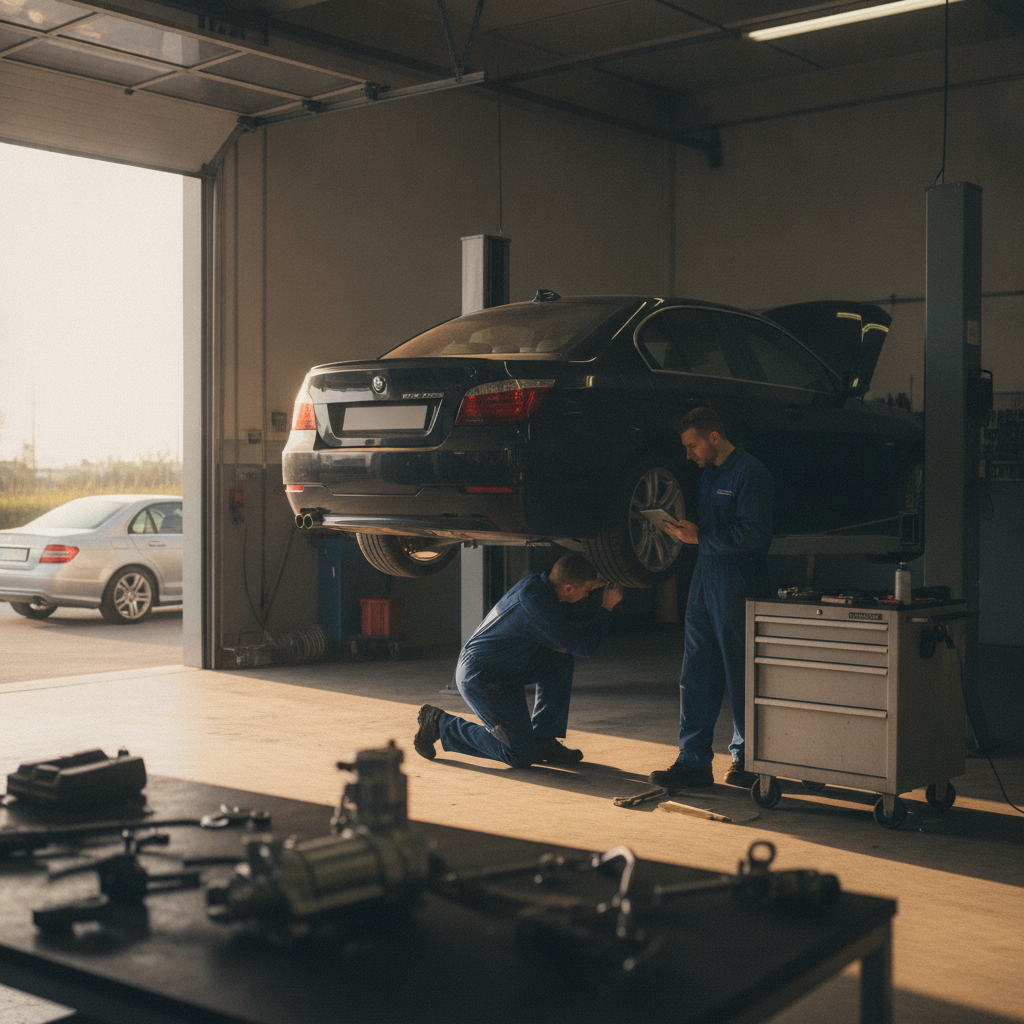
Why Is My BMW or Mercedes Fuel Pump Whining and Losing Pressure? What Roswell Owners Should Know About High-Pressure Fuel Delivery Failure
If your BMW or Mercedes has started making a faint whine from underneath or toward the rear of the car — especially if it coincides with hard starts on a hot morning, a brief stumble at highway speed, or that unsettling moment where your engine simply refuses to build power — your fuel delivery system deserves a close look. For owners in Roswell and across the North Fulton County corridor, high-pressure fuel pump (HPFP) failure is one of the more commonly misdiagnosed problems on European vehicles, largely because the symptoms mimic ignition issues, throttle body problems, and even transmission concerns. Getting the correct diagnosis early is what separates a clean, affordable repair from a tow truck call on GA-400.
How European High-Pressure Fuel Pumps Actually Work — And Why They Fail
Unlike older vehicles with low-pressure carbureted fuel systems, modern BMWs and Mercedes-Benz engines use direct injection technology that demands extremely precise, high-pressure fuel delivery — often in the range of 200 to 2,000 psi depending on the engine load. Your vehicle actually has two pumps working in concert: a low-pressure lift pump inside or near the fuel tank, and a high-pressure pump mounted at the engine that pressurizes fuel just before it enters the injectors.
The HPFP is mechanically driven by the camshaft and is under constant stress. Over time — and particularly in vehicles with higher mileage or those that have gone long stretches between oil changes — the pump’s internal rollers and cam followers wear down. In BMW N20, N54, and N55 engines, this is a well-documented failure mode. Mercedes M271 and M272 engines have similar vulnerabilities, especially as the fuel pressure regulator inside the pump begins to degrade.
Georgia’s summer heat compounds the issue. When ambient temperatures push into the upper 90s, as they routinely do in Roswell and Johns Creek from June through September, fuel vaporization pressure increases and thermal stress on pump components accelerates wear. If you’ve noticed the problem worsening after a hot weather stretch or a long idle in traffic, that’s not a coincidence.
Warning Signs You Should Not Ignore
Fuel pump problems rarely announce themselves dramatically at first. More often, they present as subtle performance changes that are easy to chalk up to “bad gas” or a rough morning. Watch for:
- A high-pitched whine or hum that seems to come from under the rear seat or cargo area — this is usually the low-pressure lift pump struggling
- Hard or extended cranking on cold or hot starts — the engine turns over but takes longer than usual to fire
- Hesitation or stumbling under acceleration, particularly when merging onto highways or pulling away from a stop
- Sudden loss of power at cruising speed, sometimes followed by a momentary recovery
- A check engine light with codes pointing to low fuel rail pressure, fuel system lean conditions, or injector performance faults
- Rough idle that smooths out at higher RPM — classic low fuel pressure behavior under light load
Any one of these symptoms on its own warrants a proper fuel pressure diagnostic. All of them together means you need to get your vehicle in before the pump fails completely.
Why Generic Shops Miss This Diagnosis
Here is where many vehicle owners in the Sandy Springs and Alpharetta area run into trouble: they take a stumbling BMW or Mercedes to a general repair shop, the technician reads the fault codes, sees something related to fuel trim or a lean condition, and replaces the oxygen sensors or spark plugs. The car feels slightly better for a week. Then the problem returns.
Accurate HPFP diagnosis requires live fuel rail pressure data logged across multiple operating conditions — not just a static fault code read. You need factory-level or equivalent diagnostic tooling that can monitor actual pump output in real time while the engine is under load. At Solo Motor Sports, our technicians use professional-grade European diagnostic equipment to measure fuel pressure at idle, during acceleration, and at operating temperature. That’s how you isolate whether the fault is at the lift pump, the high-pressure pump, the pressure regulator, or the fuel injectors themselves.
Replacing the wrong component is expensive and leaves the root problem unresolved. Getting the diagnosis right the first time matters — both for your wallet and for the long-term health of your engine. You can learn more about how we approach engine repair and diagnostics at our Roswell location.
What the Repair Involves — and What to Expect
The scope of a fuel pump repair on a European vehicle depends on which component has failed and to what extent.
- Low-pressure lift pump replacement: Usually involves dropping or accessing the fuel tank. Straightforward but labor-intensive, particularly on sedans where the pump sits beneath rear seat cushions or the cargo floor.
- High-pressure fuel pump replacement: Located at the engine, often requiring removal of engine covers and related components. On N54 and N55 BMWs, accessing the HPFP also involves the camshaft area, which requires precision reassembly.
- Fuel pressure regulator replacement: Sometimes the regulator integrated into the HPFP is the failed component. On some Mercedes applications, this can be replaced independently.
- Complete fuel system flush: If the pump has shed internal material, debris can contaminate the fuel rail and injectors. A thorough flush and injector inspection is worth doing at the same time.
We use OEM-specification or OEM-equivalent parts for every fuel system repair — not generic aftermarket components that may not hold up to the precise pressure tolerances European engines demand. All repairs at Solo Motor Sports are warranty-backed, so you leave with confidence rather than crossed fingers.
Why Milton and Johns Creek Owners Drive to Roswell for European Fuel System Work
Owners across the North Fulton area — from Milton down through Johns Creek and into Sandy Springs — face a familiar dilemma: the dealership will handle the repair, but the service advisor quote is frequently eye-watering, and the turnaround can stretch to a week or more. Independent general shops are closer and cheaper, but they often lack the make-specific knowledge and tooling to get it right.
Solo Motor Sports exists precisely in that space. Our technicians have factory-trained, ASE-certified experience with the specific fuel delivery architectures used in BMW, Mercedes-Benz, Audi, Porsche, and Volkswagen vehicles. We’re located on Alpharetta Highway in Roswell — easy to reach whether you’re commuting in from Johns Creek or cutting down from Milton — and we focus exclusively on European and import vehicles. That specialization means we’ve seen this failure pattern dozens of times and know exactly where to look.
If your vehicle is still running but showing early warning signs, a preventative maintenance check that includes fuel system pressure testing is the most cost-effective step you can take right now.
Frequently Asked Questions
How long can I drive with a failing fuel pump?
It depends on how far along the failure is. A pump that’s weakening will often keep running intermittently, but complete failure can leave you stranded without warning. If you’re experiencing hard starts or power loss, don’t put this off — especially if you regularly drive GA-400 or long highway stretches where being stranded poses real risk.
Is fuel pump failure covered under BMW or Mercedes warranty?
If your vehicle is still within the manufacturer’s bumper-to-bumper warranty period (typically 4 years/50,000 miles for BMW, 4 years/50,000 miles for Mercedes), the HPFP may be covered. Beyond that window, it falls to you. Extended warranties vary — check your specific coverage terms before authorizing any repair.
Can bad fuel cause premature fuel pump failure?
Yes. European high-pressure fuel pumps rely on fuel for lubrication and cooling. Low-quality fuel, fuel contaminated with water, or ethanol blends higher than the manufacturer specifies can all accelerate wear. Always use the octane rating specified in your owner’s manual — for most BMW and Mercedes performance engines, that’s 91 octane minimum, with 93 preferred.
Will a failed HPFP damage my fuel injectors?
Potentially, yes. If the pump begins shedding metal debris internally, that material can travel through the fuel rail and into the injectors, causing additional damage. This is why it’s important to have a shop inspect the entire fuel system — not just swap the pump — when a failure is confirmed.
How do I know if it’s the fuel pump or the ignition system causing my hesitation?
The symptoms can overlap significantly. Live fuel pressure data logged under load is the most reliable differentiator. If your mechanic is only reading stored fault codes and not performing dynamic pressure testing, you may not get an accurate answer. Ask specifically whether fuel rail pressure was measured during the diagnostic process.
Get Your BMW or Mercedes Fuel System Properly Diagnosed in Roswell
A whining pump and a stumbling engine are your car telling you something specific — and it’s worth listening. At Solo Motor Sports in Roswell, we have the tooling, the training, and the hands-on experience with European fuel systems to diagnose this correctly the first time and repair it with parts built to the standards your vehicle requires. No guesswork, no unnecessary replacements, and no dealership markup.
If you’re in Roswell, Alpharetta, Johns Creek, Sandy Springs, Milton, or anywhere across North Fulton County and you’re noticing any of the symptoms described above, reach out to our team today. Schedule your diagnostic appointment at Solo Motor Sports and let’s get to the bottom of it before the pump takes the decision out of your hands.