
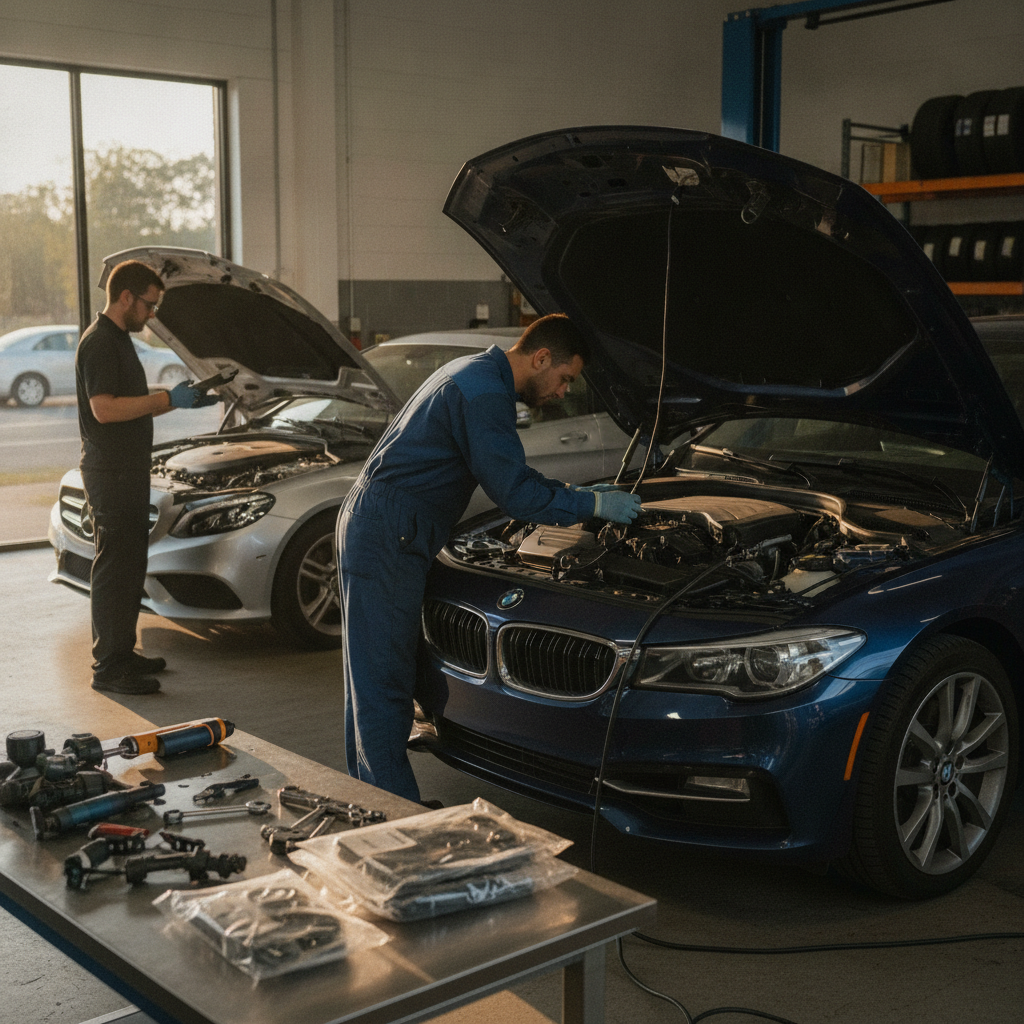
Why Is My BMW or Mercedes Timing Chain Rattling on Cold Start? What Roswell Owners Should Know About Timing System Failure
That sharp, metallic rattle you hear for the first few seconds after starting your BMW or Mercedes on a cool Roswell morning isn’t something to write off as normal engine noise. In many European engines — particularly BMW’s N20, N26, and N47 four-cylinders, and Mercedes-Benz’s M271 and M274 inline-fours — a cold-start timing chain rattle is one of the earliest and most recognizable signs that your timing system is wearing out. Left unaddressed, it escalates from an inexpensive tensioner replacement into a full timing chain kit job — or worse, catastrophic engine failure. Here’s what you need to know.
What the Timing Chain Actually Does — and Why BMW and Mercedes Are Prone to This Problem
Your engine’s timing chain synchronizes the crankshaft and camshaft rotation so valves open and close at precisely the right moment in each combustion cycle. Unlike a timing belt, a chain is designed to last the life of the engine — but that assumption only holds true when the rest of the timing system is healthy. What fails first is usually not the chain itself, but the tensioner: a spring-loaded or hydraulically actuated component that keeps constant pressure on the chain to prevent slack.
On BMW’s N47 diesel and N20 gasoline engines, the timing chain runs at the rear of the engine block — an engineering choice that makes replacement labor-intensive and expensive. Mercedes-Benz’s M271 engine (found in many C-Class and E-Class models from 2002 through the mid-2010s) is notorious for timing chain stretch and tensioner failure, particularly in vehicles that see a lot of stop-and-go driving — exactly the kind of daily commuting many Sandy Springs and Johns Creek owners do on GA-400.
When the tensioner loses its ability to maintain proper chain tension, the chain develops slack. On a cold start — before oil pressure fully builds — that slack causes the chain to slap against the guide rails, producing the distinctive rattle most owners describe as a “diesel-like clatter” that disappears after 5 to 10 seconds. That disappearing act gives many owners false comfort. The noise goes away because oil pressure eventually takes over. But every cold start is adding wear.
Warning Signs You Should Not Ignore
Timing chain problems rarely announce themselves all at once. The progression is gradual, which is why so many BMW and Mercedes owners in the Alpharetta and Milton area end up bringing in vehicles that are much further along than they realized. Watch for:
- A metallic rattle on cold start that lasts a few seconds and then quiets down
- Check engine light with codes related to camshaft timing (P0016, P0017, P0341, or similar)
- Rough idle or hesitation that appears alongside the rattle
- Reduced engine performance or fuel economy as timing drifts out of specification
- Engine running rough at idle even when fully warmed up, indicating the chain has stretched significantly
- Oil consumption or low oil pressure warnings — a worn tensioner may allow debris to accelerate internal wear
If your vehicle is throwing camshaft position or crankshaft correlation codes alongside that rattle, the timing chain has likely already stretched beyond the tensioner’s ability to compensate. At that point, you’re not just replacing a tensioner — you need the full kit: chain, tensioners, guides, and often sprockets.
What Makes This Repair Different on European Engines
This is the section most general repair shops in the area either skip entirely or handle incorrectly. Timing chain service on a BMW or Mercedes is not the same as on a domestic V8. The tolerances are tighter, the components are more integrated, and using anything other than OEM or OEM-equivalent parts introduces risk.
On BMW’s rear-chain N47 and N57 engines, the timing system is accessed from the back of the engine, which often requires partial transmission removal. Skimping on labor time here — or using aftermarket chains and plastic guides that don’t meet BMW’s specification — is a shortcut that frequently leads to repeat failures within 20,000 miles. We’ve seen it.
On Mercedes M271 and M274 engines, the tensioner must be replaced with a revised OEM unit (Mercedes updated the part number after widespread early failures). Installing the original-spec tensioner on a repair is a mistake. A shop that doesn’t know that revision history is a shop that hasn’t worked on enough of these engines.
At Solo Motor Sports, our factory-trained technicians work with BMW and Mercedes systems daily. Every engine repair we perform uses genuine or OEM-equivalent parts, and our work is warranty-backed — so you’re not gambling on whether the repair holds.
The Real Cost of Waiting — and Why Timing Matters Literally
When owners ask about timing chain repair costs, the honest answer is: it depends heavily on how far the damage has progressed. A tensioner replacement caught early — before the chain has stretched or guides have cracked — is a very different job than replacing a full timing kit on an engine that has been rattling for 15,000 miles.
What we tell every owner who brings in a rattling BMW or Mercedes is this: the diagnostic appointment is the most valuable thing you can do today. We use the same dealership-level diagnostic tools the dealer uses, but without the dealership markup on labor. A proper assessment tells you exactly where the timing system stands — whether you’re looking at a tensioner, a kit, or something in between — so you can make an informed decision with real numbers, not guesswork.
Ignoring the rattle and hoping it resolves itself is the most expensive option. A jumped timing chain can cause catastrophic valve-to-piston contact in interference engines — which includes virtually every modern BMW and Mercedes four-cylinder. That turns a repair into an engine replacement.
Oil Change Intervals: The Hidden Factor Most Shops Don’t Mention
Here’s something most of our competitors’ websites don’t discuss at all: timing chain wear on BMW and Mercedes engines is directly accelerated by extended oil change intervals. Both brands have historically pushed long oil change intervals — sometimes 10,000 to 15,000 miles — through their onboard maintenance systems. In Georgia’s heat and humidity, with the kind of short-trip city driving that dominates around Historic Roswell and the GA-400 corridor, that interval is too long for most real-world driving conditions.
Dirty, degraded oil loses its ability to maintain hydraulic pressure in the timing tensioner. When that happens on a cold start — when the oil is at its thickest and pressure takes the longest to build — the chain rattles. The fix isn’t just the tensioner. It’s also committing to oil changes at intervals that match how you actually drive, not just what the dashboard reminds you every 12 months.
Our preventative maintenance program is designed specifically around European manufacturer specifications and real-world North Fulton driving patterns — not whatever interval the OEM set assuming you drive 60 miles of open highway every day.
Frequently Asked Questions
How long can I drive with a timing chain rattle before it becomes dangerous?
There’s no safe timeline. Some engines rattle for months before anything catastrophic happens; others fail suddenly with no additional warning. The rattle tells you the timing system is compromised — the only responsible answer is to have it inspected immediately.
Does the cold-start rattle mean the entire timing chain needs to be replaced?
Not always. If caught early, the tensioner alone may be the failure point. But once the chain has stretched, replacing just the tensioner won’t restore correct timing. A diagnostic inspection tells you exactly what’s involved before any work begins.
Is timing chain repair covered under extended warranty or third-party warranty plans?
Many extended warranties do cover timing chain components, but coverage varies by plan and mileage. We can provide detailed documentation of the failure and repair scope to support your warranty claim.
Why does the rattle disappear after the engine warms up?
Once oil pressure builds fully, the hydraulic tensioner compensates for the chain slack. The chain tightens and the rattle stops — but the underlying wear doesn’t go away. It worsens with every cold start.
Can I continue using the BMW or Mercedes OCI (oil change indicator) with a rattling timing chain?
No. If your timing system is showing wear, you should switch to a more frequent oil change interval immediately. Fresh, clean oil with proper viscosity helps the tensioner maintain pressure and slows further wear until the repair is completed.
Get a Definitive Answer — Not Just a Quote
If your BMW or Mercedes is making a cold-start rattle in Roswell, Alpharetta, Johns Creek, or anywhere across North Fulton County, the team at Solo Motor Sports can diagnose it accurately and give you a straight answer about what needs to be done. No upsells, no vague estimates, no guesswork.
We specialize exclusively in European and import vehicles, and our technicians know these timing systems inside and out — from BMW’s rear-chain engines to Mercedes’s revised tensioner specifications. Contact us today to schedule a diagnostic appointment and find out exactly where your timing system stands before a manageable repair becomes a major one.