
Why Is My BMW or Mercedes Headlight Flickering or Going Dark? What Roswell Owners Should Know About HID, LED, and Adaptive Headlight Failure
If one of your BMW or Mercedes headlights is flickering on startup, dims noticeably at idle, or goes completely dark without warning, you’re dealing with something more involved than a burned-out bulb. European headlight systems — especially the HID xenon, full-LED, and adaptive units found on BMWs and Mercedes-Benz models from the last two decades — are sophisticated, electronically governed assemblies with multiple failure points. For Roswell owners who drive these vehicles after dark on GA-400 or through the unlit stretches near the Chattahoochee, a failing headlight isn’t just an inconvenience. It’s a legitimate safety hazard, and diagnosing it incorrectly the first time is an expensive mistake.
European Headlights Are Not Like Standard Bulb Assemblies
Most domestic and economy-car owners think of a headlight problem as a $10 bulb swap. On a BMW 5 Series, X5, or Mercedes E-Class or GLE, the headlight housing is a complex electro-optical system. Depending on the model year and trim, your headlights may involve one or more of the following:
- HID xenon bulbs — High-intensity discharge lamps that require a ballast to generate the high-voltage arc needed to ignite the gas inside the bulb
- Ballast and igniter units — Control the startup current (which can spike to 25,000 volts) and ongoing power delivery to the xenon bulb
- LED headlight modules — Found on newer models, these use integrated LED strips or matrix arrays controlled by a dedicated LED driver module
- Adaptive headlight actuators — Stepper motors that physically pivot the headlight beam in the direction of steering input, governed by the AHL (Adaptive Headlight) control module
- Headlight control units (LCM/FRM) — BMW’s Light Control Module or Footwell Module manages power distribution to the entire lighting system and communicates over the CAN bus
When one of these layers fails, the symptom you see — a flicker, a dim output, a headlight that cuts out at speed — can come from five or six different root causes. That’s why guessing and replacing parts without a proper scan is a quick way to spend several hundred dollars and still have the same problem.
The Most Common Causes of BMW and Mercedes Headlight Flickering
1. Ballast Failure (HID Systems)
On xenon-equipped BMWs and Mercedes, the ballast is the most frequent culprit behind a headlight that flickers on startup, takes several seconds to reach full brightness, or cuts out intermittently at operating temperature. Ballasts are sensitive to heat and moisture — both of which are plentiful in the Georgia climate — and they degrade over time. A failing ballast often produces a characteristic blue or purple flicker before the light stabilizes, or the headlight may simply shut off after the vehicle warms up.
Replacing just the ballast is sometimes sufficient, but if the igniter (the component that actually initiates the arc) has also degraded, you may see the same symptoms return within weeks. A proper diagnosis identifies which component is actually failing rather than replacing both speculatively.
2. HID Bulb End-of-Life
Xenon bulbs do eventually wear out, typically between 70,000 and 100,000 miles or around 10 years of use. An aging bulb loses the gas charge that produces the bright white output and begins producing a noticeably yellower, dimmer light — or starts flickering as it struggles to maintain a stable arc. If one headlight looks visibly different in color from the other, the bulb on the dimmer side is usually approaching the end of its service life. Always replace HID bulbs in pairs for consistent output.
3. LED Driver Module Failure (Newer Models)
On more recent BMW and Mercedes models equipped with full-LED or matrix LED headlights, the LED driver module — a printed circuit board embedded in or near the headlight housing — controls power to the individual LED segments. These modules can fail due to heat exposure, condensation ingress, or electrical surges. When they do, you may see individual LED segments go dark, the entire headlight output drop to a fraction of normal brightness, or a headlight malfunction warning appear in the instrument cluster or iDrive/MBUX system.
Replacing a failed LED driver module on a late-model BMW M5 or Mercedes S-Class is not cheap — the modules are make- and model-specific, and some require calibration after installation. This is not a job for a general shop guessing at part numbers.
4. Adaptive Headlight Actuator or AHL Module Fault
Many BMW and Mercedes owners first notice the adaptive headlight system when a yellow headlight range or check headlamp warning appears. The adaptive system uses a small stepper motor inside each headlight housing to pivot the beam. When the motor seizes or the AHL control module loses its calibration data — something that can happen after a minor front-end impact, a suspension component replacement, or even a battery disconnect — the system disables adaptive function and may default the headlights to a fixed, non-compliant aim.
This fault almost always requires a scan tool capable of reading BMW or Mercedes proprietary fault codes and performing an AHL calibration reset — not a generic OBD-II reader from an auto parts store.
5. Light Control Module (LCM/FRM) Problems on BMW
BMW’s Footwell Module (FRM3 in particular, common on E-series and some F-series BMWs) is one of the most failure-prone modules in the BMW electrical ecosystem. When the FRM fails or becomes corrupted — often due to a battery voltage drop or an incorrect module programming procedure — it can take out headlights, turn signals, interior lighting, and other electrical functions simultaneously. Symptoms range from intermittent headlight flickering to headlights that won’t turn on at all.
FRM repair or replacement requires module coding specific to the vehicle’s VIN. Installing an uncoded used FRM will not solve the problem and can create new faults. This is exactly the kind of repair where dealership-level diagnostic capability at an independent specialist shop makes a real difference for owners in Roswell and across North Fulton County. You can learn more about the diagnostic tools and expertise at Solo Motor Sports on the About Us page.
Why Georgia’s Climate Accelerates Headlight Failure
The heat and humidity in the Atlanta metro area — and in Roswell and Alpharetta specifically during summer — create conditions that accelerate headlight system degradation. Condensation cycles inside headlight housings wear down seals and promote moisture ingress into ballasts, LED drivers, and wiring connectors. UV exposure from the intense Georgia sun degrades plastic headlight lenses and, over time, internal reflector coatings. High ambient temperatures during stop-and-go GA-400 commutes push heat-sensitive ballasts and LED modules toward their thermal limits repeatedly.
Owners in Sandy Springs and Johns Creek who drive long daily commutes in and out of Atlanta tend to see headlight system failures earlier than national averages suggest, simply because the thermal cycling is more aggressive here than in cooler climates.
What a Proper Headlight Diagnosis Actually Looks Like
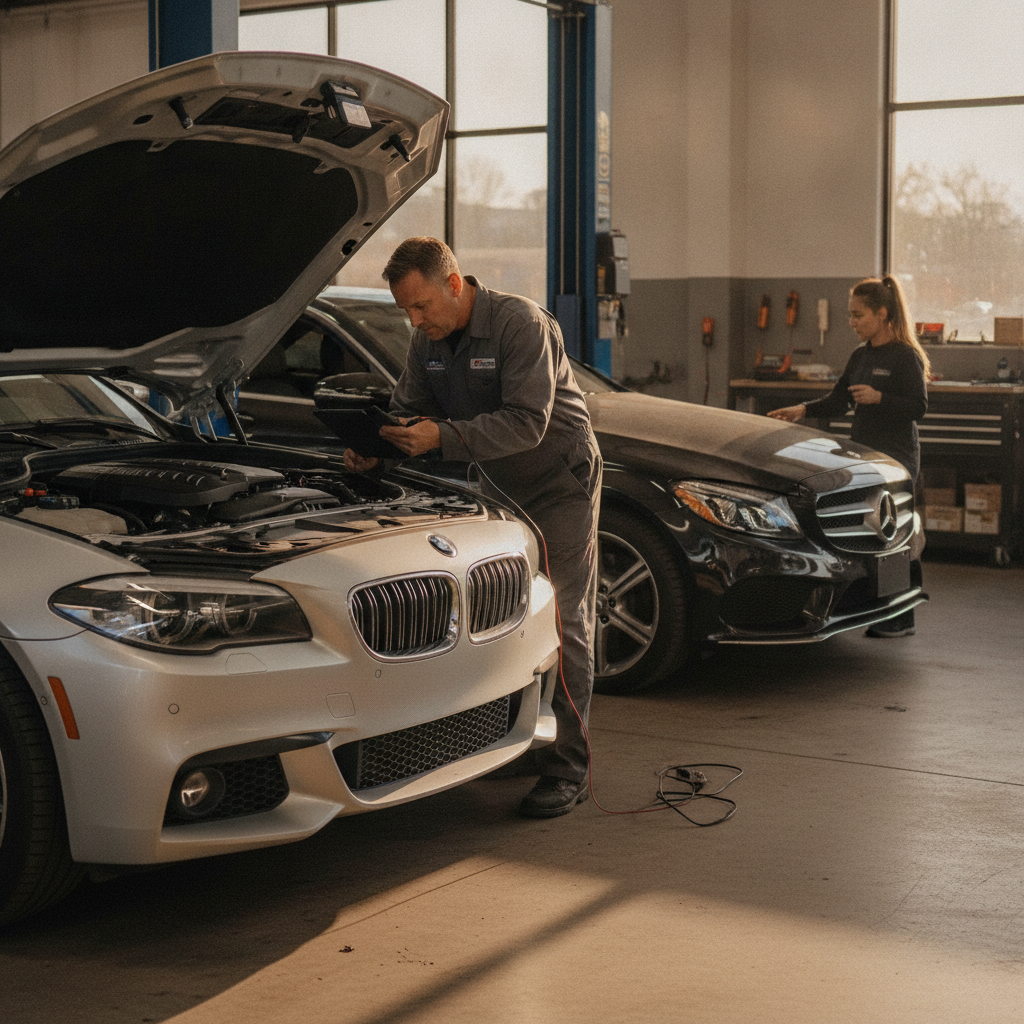
A competent European specialist doesn’t start by replacing the most likely part. They start by connecting a factory-level diagnostic tool — the kind that speaks the actual protocols used by BMW, Mercedes-Benz, and other European manufacturers — and pulling all stored and pending fault codes across the lighting and body control modules. From there, live data from the LCM, FRM, or LED driver module narrows the failure to a specific component before anything is ordered.
For adaptive headlight faults, the process also includes a physical inspection of the actuator motor and a calibration procedure after any repair. For HID systems, voltage testing at the ballast and igniter under load distinguishes a ballast failure from a bulb failure from a wiring fault.
This is the diagnostic process that Solo Motor Sports applies to every headlight concern — the same depth of analysis a dealer would use, without the dealer markup on parts and labor. If your BMW, Mercedes, or another European vehicle is showing headlight issues, a multi-point inspection is a good starting point to catch any related electrical or lighting concerns before they compound.
What Owners in Milton and Alpharetta Often Get Wrong
One of the most common mistakes owners in the North Fulton area make is ordering an aftermarket ballast or LED module online and having a general shop install it. Aftermarket HID ballasts vary significantly in quality, and low-cost units often fail within a year — and occasionally damage the igniter or bulb in the process. On late-model BMW and Mercedes vehicles with LED systems, aftermarket driver modules frequently cause fault codes and may not communicate correctly with the vehicle’s CAN bus, leaving you with a warning light that won’t clear.
OEM or OEM-equivalent parts, installed by technicians who understand the system architecture, are the right approach for these vehicles. It costs more upfront and saves significantly over repeated part replacements at cut-rate shops.
Frequently Asked Questions
Can I drive my BMW or Mercedes with one headlight out?
Legally and practically, no. A non-functioning headlight is a moving violation in Georgia and a genuine safety risk on unlit roads. More importantly, on adaptive headlight-equipped vehicles, the system may partially disable or misaim the working headlight as a failsafe response. Get it diagnosed promptly.
How much does it cost to replace a BMW HID ballast or xenon bulb in Roswell?
Costs vary by model and whether the ballast, igniter, bulb, or all three need replacement. It’s not a comparison-shop situation — the right diagnosis is what determines the right repair. Contact Solo Motor Sports for an accurate estimate specific to your vehicle.
My Mercedes headlight warning came on but both headlights appear to work. What does that mean?
On Mercedes-Benz vehicles, a headlight warning can be triggered by an adaptive leveling sensor fault, an LED segment failure that isn’t visible from the driver’s seat, or a module communication error — even when both headlights appear illuminated. A scan of the body and lighting modules will identify the specific fault code.
Can a failing headlight system on a BMW cause other electrical problems?
Yes, particularly if the issue involves the Footwell Module (FRM) or Light Control Module. These modules manage multiple systems simultaneously, and a corrupted or failing FRM can affect turn signals, interior lighting, and even window switches. If you’re seeing multiple seemingly unrelated electrical gremlins, a module diagnostic is the correct first step.
How long does headlight repair take on a European vehicle?
A straightforward HID ballast or bulb replacement on most BMW and Mercedes models can be completed the same day. LED module replacements and adaptive system calibrations typically require a day, depending on part availability. Solo Motor Sports prioritizes same-day turnaround whenever diagnostics and parts allow.
Get Your BMW or Mercedes Headlights Diagnosed by a European Specialist in Roswell
Flickering, dimming, or dark headlights on a BMW or Mercedes are not a problem to defer. The diagnostic complexity of these systems means that getting the right answer the first time requires the right tools and the right experience — not a parts-swapping approach or a generic scan at a big-box auto parts store.
Solo Motor Sports serves BMW and Mercedes owners throughout Roswell, Alpharetta, Sandy Springs, Johns Creek, Milton, and the broader North Fulton area with factory-level diagnostics, OEM and OEM-equivalent parts, and technicians who know these vehicles. Contact Solo Motor Sports to schedule a diagnostic appointment and get a clear, honest answer about what your headlight system actually needs.