
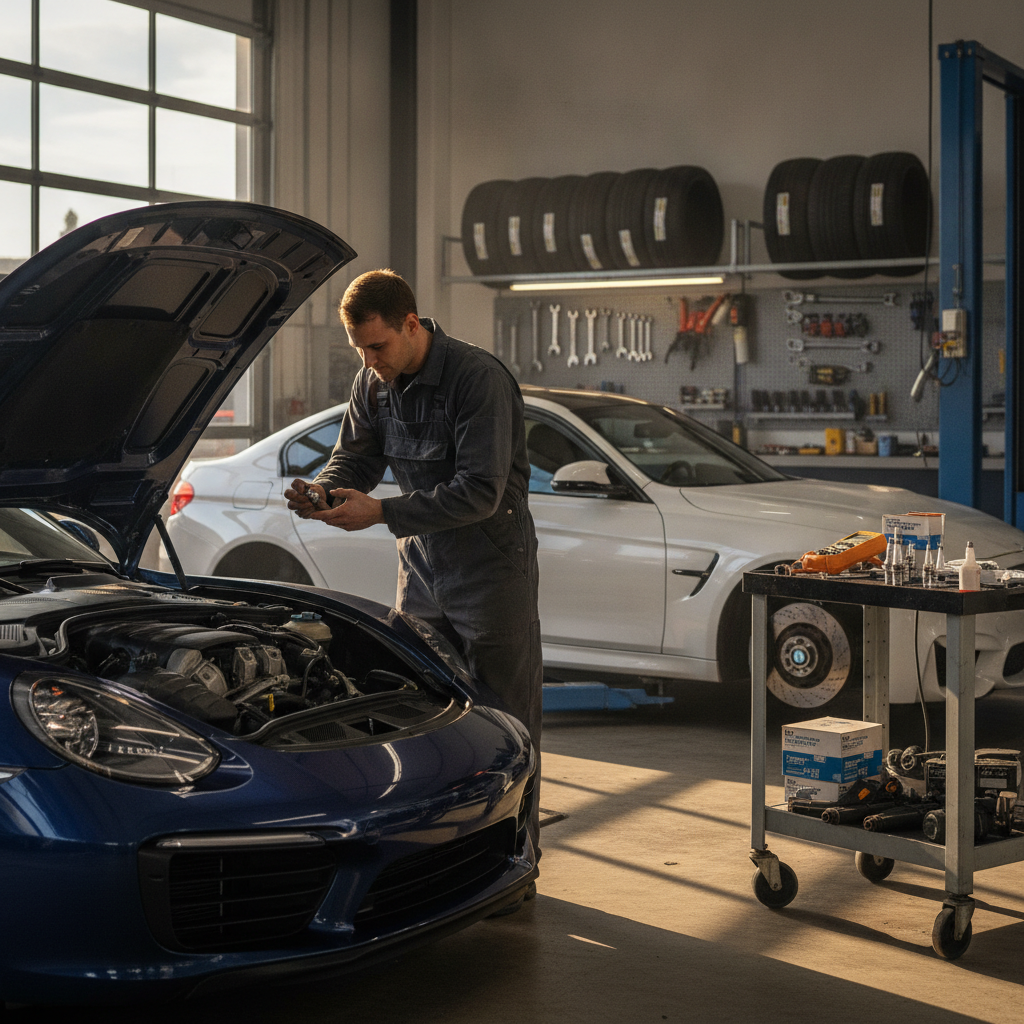
Why Is My Porsche or BMW’s Engine Misfiring at Idle? What Norcross and Peachtree Corners Owners Should Know About Ignition Coil and Spark Plug Failure
If your BMW or Porsche is shuddering at a stoplight, stumbling when you accelerate from a standstill, or running rough after a cold start, you’re almost certainly dealing with an ignition misfire — and in European performance engines, the most common culprits are a failed ignition coil or worn spark plugs. For owners in Norcross, Peachtree Corners, and across the greater Roswell area, this is not a “wait and see” situation. A misfire that goes unaddressed can escalate from a minor tune-up item into a catalytic converter replacement, and those don’t come cheap on a Porsche 911 or BMW M3.
What an Engine Misfire Actually Feels Like in a BMW or Porsche
An ignition misfire is what happens when one or more cylinders fails to fire correctly — the air-fuel mixture doesn’t ignite at the right moment, so that cylinder contributes nothing to the engine’s power stroke. In a high-compression European engine, even a single misfiring cylinder is immediately noticeable.
You might feel a rhythmic shudder at idle that smooths out (or doesn’t) once the engine warms up. You might notice a hesitation when pulling onto Peachtree Parkway or merging onto GA-400 at speed. Your check engine light will likely be on, often flashing — which is the vehicle’s way of telling you the misfire is severe enough to damage the catalytic converter right now, not eventually.
Other common signs include:
- Rough or uneven idle, especially when cold
- Noticeable power loss during acceleration
- A slight fuel smell from the exhaust
- Decreased fuel economy
- The engine stumbling under load at low RPM
These symptoms can be subtle at first, but they compound quickly — especially if you’re commuting in stop-and-go traffic, which is a daily reality for most drivers coming through Norcross toward Atlanta.
Why BMW and Porsche Engines Are Especially Vulnerable to Ignition Component Failure
Modern BMW and Porsche engines are engineering achievements, but that sophistication cuts both ways. High compression ratios, direct injection, turbocharging, and tight operating tolerances mean that ignition components work harder and wear faster than they would in a conventional domestic engine. BMW’s inline-six and V8 platforms — and Porsche’s flat-six and turbocharged four-cylinder engines — both have documented ignition coil failure patterns that any experienced European specialist recognizes immediately.
BMW in particular has seen widespread ignition coil failures across multiple generations of N52, N54, N55, and S55 engines. One coil fails, and the adjacent coils — which have accumulated identical heat cycles and operating stress — are usually not far behind. Replacing a single coil and calling it done is a short-term fix. The smarter approach is to assess the condition of all coils at the same time, which is exactly what a multi-point inspection at Solo Motor Sports will reveal.
Porsche’s Boxster, Cayman, and 911 platforms have their own ignition system sensitivities — particularly the flat-six engines, where spark plug access requires more labor and where using non-OEM plugs can produce misfires even on an otherwise healthy engine.
The Real Risk: What Happens When You Delay This Repair
This is the section that most competitors in the Roswell and Alpharetta corridor skim over, and it’s arguably the most important thing to understand as a BMW or Porsche owner.
When a cylinder misfires, unburned fuel passes through the exhaust system and into the catalytic converter. The catalytic converter — already operating at extreme temperatures — is forced to burn off that raw fuel, which generates heat far beyond its design limits. Do this long enough, and the converter substrate melts, reducing your car’s exhaust flow, triggering additional fault codes, and leaving you with a repair that can cost several times more than the original ignition service would have.
On a Porsche, catalytic converters are a significant cost. On certain BMW M cars, they’re even more so. A flashing check engine light is not a suggestion — it is the vehicle’s active warning that converter damage is happening in real time.
Beyond the converter, persistent misfires can wash the cylinder walls with unburned fuel, diluting engine oil and accelerating wear on piston rings and cylinder bores. In a turbocharged BMW or Porsche, uneven combustion can also affect turbo behavior and longevity. The cascade of secondary damage from an untreated misfire is precisely why European specialists consistently advise against driving any distance on a flashing check engine light.
Diagnosis: Why Generic Code Readers Miss the Full Picture
A generic OBD-II reader from an auto parts store will tell you that cylinder four has a misfire (P0304, for example). What it won’t tell you is whether the root cause is a failed ignition coil, a worn spark plug, a clogged fuel injector, low compression, a vacuum leak, or a cam timing issue — all of which can produce an identical fault code.
Proper diagnosis on a BMW or Porsche requires factory-level diagnostic software — the kind that reads manufacturer-specific fault data, live cylinder contribution values, and misfire event counters across the full RPM range. At Solo Motor Sports in Roswell, our ASE-certified technicians use professional-grade European diagnostic equipment to isolate the actual cause of the misfire before a single part is ordered. That matters because installing a new coil on a cylinder that was misfiring due to a dead injector means the misfire continues and you’ve spent money without solving anything.
If you’re based in Johns Creek or Alpharetta and have already been to a general repair shop that replaced one coil without improvement, this is almost certainly what happened. Accurate diagnosis is the entire foundation of a proper repair — and it’s where a European specialist earns the difference in price over a quick-lube shop.
OEM vs. Aftermarket Ignition Parts: It Matters More Than You Think
Not all ignition coils and spark plugs are created equal, and the difference is magnified on high-performance European engines. BMW specifies NGK or Bosch spark plugs with precise heat ranges for each engine variant. Porsche flat-six engines have similarly tight tolerances. Installing an aftermarket coil or a generic spark plug from an overseas supplier can introduce its own misfire — not because the part failed, but because it never met the specification to begin with.
Solo Motor Sports uses genuine OEM-spec ignition components on every BMW and Porsche ignition service. That’s not a marketing point — it’s the only way to deliver a repair that actually resolves the misfire, protects the catalytic converter, and holds up over time. Every repair is backed by a warranty, so you leave with confidence rather than crossed fingers.
For a closer look at our approach to engine repair and diagnostics, including the makes and engine families we specialize in, our service page gives you the full picture.
What to Expect from an Ignition Service at Solo Motor Sports
When you bring your BMW or Porsche to us for a misfire diagnosis, the process is straightforward and transparent. We’ll connect to the vehicle’s control modules with factory-level software, pull full fault histories, and run live data tests to identify exactly which cylinder is affected and why. From there, we’ll walk you through what we found, what needs to be replaced, and what the timeline looks like — usually same-day for a standard ignition coil and spark plug service.
We’ll also tell you honestly whether the remaining coils show signs of impending failure, because replacing them now during the same labor window saves you from returning in three months for the same job. That kind of transparency is what differentiates a specialist from a shop that just clears the code and sends you on your way.
Frequently Asked Questions
Can I drive my BMW or Porsche with a misfiring engine?
If your check engine light is solid and the car runs only slightly rough, you can typically drive it short distances to a shop — but don’t delay. If the check engine light is flashing, you should stop driving immediately. A flashing light means the misfire is severe enough to actively damage your catalytic converter with every mile you drive.
How often should spark plugs be replaced on a BMW or Porsche?
Most BMW and Porsche engines with iridium or platinum spark plugs are recommended for replacement every 40,000 to 60,000 miles, depending on the specific engine and how the vehicle is driven. High-performance variants and turbocharged engines often benefit from more frequent replacement. Check your factory service manual or ask a European specialist for the interval specific to your model.
Why does my BMW misfire only when the engine is cold?
Cold-start misfires are particularly common with ignition coil failure. Coil insulation degrades over time, and when the coil is cold and contracted, cracked insulation may allow the spark to arc to ground rather than fire the plug. Once the coil warms and expands slightly, it may function well enough to hide the fault. This is a classic sign that coil replacement is imminent — don’t wait for it to fail completely at operating temperature.
Will replacing ignition coils fix my check engine light?
If ignition coil failure was the confirmed root cause of the misfire, yes — replacing the faulty coil and clearing the fault codes should resolve the check engine light. If the light returns, it indicates either a secondary issue, a failed replacement part, or that the root cause was something else entirely, which is why accurate diagnosis before any parts replacement is so important.
How much does an ignition coil replacement cost on a BMW or Porsche?
Costs vary by model, engine, and how many coils require replacement. Rather than quote a number that may not apply to your specific vehicle, the most accurate way to get a fair, transparent estimate is to contact Solo Motor Sports directly. We’ll assess the situation, tell you exactly what’s needed, and give you honest pricing before any work begins.
Don’t Let a Misfire Become a Much Bigger Repair
A rough idle or stuttering engine in your BMW or Porsche is your car asking for attention — and the sooner you respond, the less expensive the answer tends to be. Whether you’re in Norcross, Peachtree Corners, Roswell, or anywhere across North Fulton County, Solo Motor Sports has the factory-trained expertise, professional diagnostics, and OEM parts to get your ignition system sorted correctly the first time.
Contact Solo Motor Sports today to schedule a diagnostic appointment or ask a question about what your BMW or Porsche is doing. We’ll give you a straight answer and a clear path forward — no upsells, no guesswork, no dealership markup.