
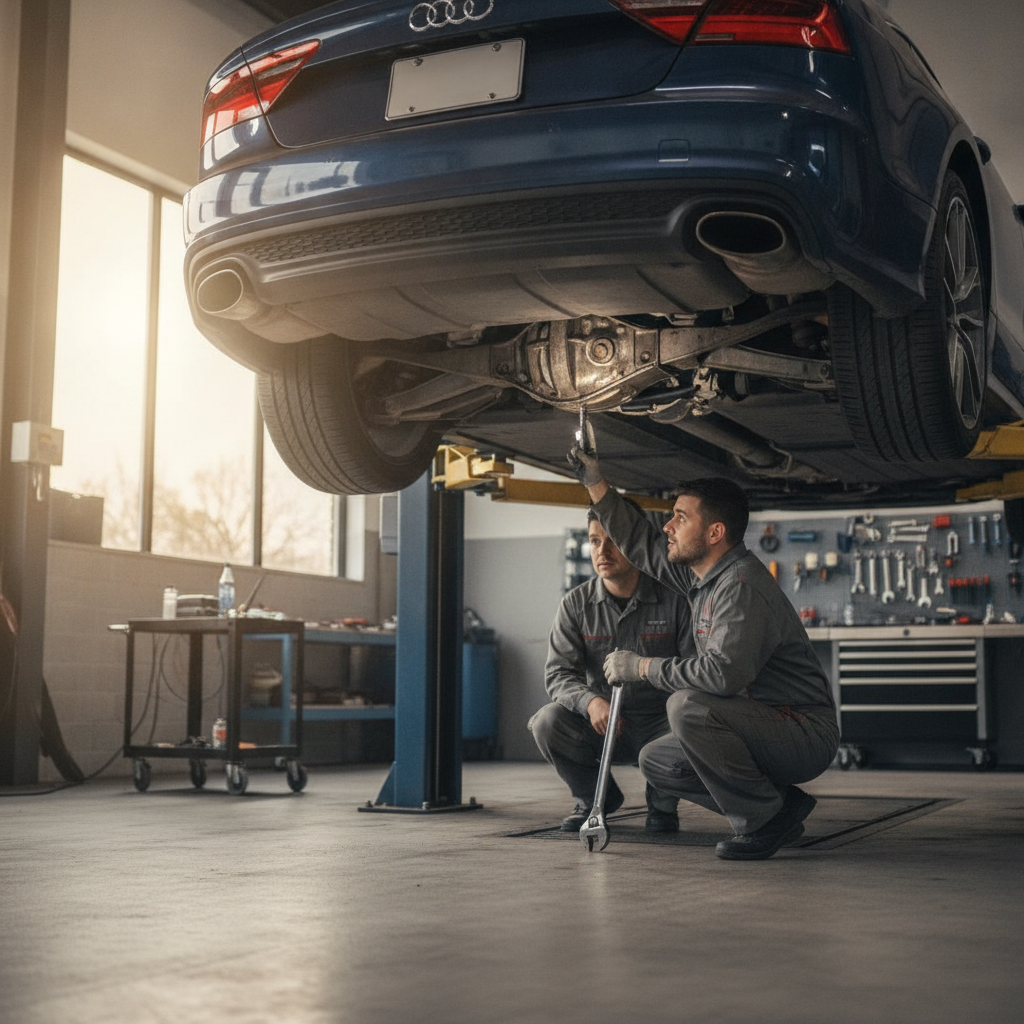
Why Is My BMW or Audi’s Differential Making a Grinding Noise Under Acceleration? What Dunwoody and Sandy Springs Owners Should Know About Rear Differential Failure
If you’re hearing a grinding, growling, or whirring noise that seems to rise from somewhere beneath the rear of your BMW or Audi — especially when you accelerate or go through a curve — your rear differential is almost certainly trying to tell you something. For drivers navigating the stop-and-go stretches of I-285, GA-400, or the surface streets between Dunwoody and Sandy Springs, that sound is not something to put off until your next oil change. Left alone, a failing differential can progress from a fluid problem you fix in an afternoon to a full drivetrain replacement that sidelines your vehicle for days and costs significantly more.
The good news is that rear differential problems in European vehicles follow a fairly predictable pattern, and most of them are diagnosable and repairable before they become catastrophic — if you act on them early.
What the Rear Differential Actually Does — and Why It Matters So Much in a BMW or Audi
The rear differential is the component that splits power from the driveshaft and distributes it to your rear wheels, allowing them to spin at different speeds when you’re turning. In a rear-wheel-drive BMW, that differential is doing a lot of work every single time you accelerate from a light, merge onto the highway, or navigate a curve. In a BMW xDrive or Audi quattro model, the differential is integrated into a more complex all-wheel-drive system, and a failure there can affect torque distribution to all four wheels — not just the rear pair.
BMW and Audi engineer their differentials to exacting tolerances. The ring and pinion gears, carrier bearings, and clutch packs inside a limited-slip differential (LSD) — common on performance trims — require clean, properly viscous fluid to stay lubricated and cool. When that fluid breaks down, gets contaminated, or is simply never changed, those precision-machined components start wearing against each other. That’s where the grinding begins.
The Sounds You Shouldn’t Ignore
Rear differential problems in BMWs and Audis tend to announce themselves in a few specific ways. If any of these sound familiar, it’s time to have the drivetrain properly inspected:
- A low, cyclic growl or rumble that increases with vehicle speed — often confused with a wheel bearing but localized farther inward and toward the center of the rear axle
- A grinding or crunching sensation under hard acceleration, especially noticeable when merging or pulling away from a standstill
- Vibration or shudder during tight, slow-speed turns — a telltale sign of limited-slip clutch pack wear in performance differentials
- A whining noise that appears or worsens on deceleration but quiets on a steady cruise — often pointing to pinion bearing wear or gear mesh problems
- Clunking on initial takeoff from a complete stop, particularly in colder morning starts
Any of these symptoms in isolation warrants a diagnosis. More than one at the same time means you should not be waiting.
Why Differential Fluid Service Is the Most Overlooked Maintenance Item on European Vehicles
Here’s a gap that almost no one in the local repair industry talks about clearly: differential fluid service is one of the single most neglected preventative maintenance items on European vehicles — and it is a direct cause of early differential failure. BMW and Audi both specify a fluid change interval for their differentials, but because it’s not on a light or a dashboard reminder, most owners never know it’s due. And dealerships, frankly, don’t always volunteer that information unprompted.
In the Atlanta metro climate — where summer heat pushes underhood and underbody temperatures well above what you’d see in cooler regions — differential fluid oxidizes and loses its protective qualities faster than the factory interval assumes. If you’re in Dunwoody or Sandy Springs and your vehicle spends meaningful time sitting in traffic on I-285 or commuting through Sandy Springs toward Roswell, that thermal stress compounds over time. Fluid that looks clean at 30,000 miles may be chemically depleted well before that point.
For most rear-wheel-drive and all-wheel-drive BMWs and Audis, a differential fluid change is a straightforward, affordable service. It is dramatically cheaper than the alternative. Preventative maintenance done on schedule is what separates a vehicle that reaches 150,000 miles cleanly from one that needs a major drivetrain repair at 90,000.
BMW xDrive and Audi quattro: When the Differential Problem Is Bigger Than You Think
In all-wheel-drive BMW xDrive and Audi quattro platforms, the differential doesn’t work in isolation. It communicates with the transfer case, the front differential (in quattro models), and the vehicle’s stability and traction control systems through a network of sensors and control modules. A grinding rear differential in one of these vehicles can cascade into drivability symptoms that seem unrelated — torque vectoring errors, AWD warning lights, vibration felt through the floor — because the system is continuously trying to compensate for a component that’s no longer performing within spec.
This is exactly why a dealership-level diagnostic approach matters for this type of repair. You need a shop with the right factory-level scan tools to read the actual drivetrain control data — not just pull a generic OBD-II code and guess. At Solo Motor Sports in Roswell, our factory-trained technicians approach drivetrain diagnosis the same way BMW and Audi-certified shops do, using proper diagnostic tooling to confirm what the noise is, where it’s originating from, and what the actual repair scope looks like before any work begins.
What Differential Repair or Replacement Actually Involves
Depending on what the diagnosis reveals, the repair path for a failing differential typically falls into one of three categories:
- Fluid service and flush — If caught early enough, degraded fluid is the root cause and a complete drain-and-refill with the correct OEM-spec fluid resolves the problem before any mechanical damage has occurred.
- Bearing or seal replacement — Worn pinion or carrier bearings and leaking seals can be replaced without replacing the entire differential unit, provided the ring and pinion gears haven’t been damaged by running dry or contaminated.
- Differential unit replacement — In cases where the internal gear set is damaged, replacement of the differential assembly with a remanufactured or OEM unit is the appropriate repair. For performance models with limited-slip differentials, this requires sourcing the correct clutch pack specification for your trim level.
Timeline and cost vary considerably based on the specific model, drive configuration, and how far the damage has progressed. What we will always do at Solo Motor Sports is give you a straight answer after diagnosis — what’s wrong, what it will take to fix it, and what happens if you defer the repair. No upsells, no pressure.
Serving Dunwoody, Sandy Springs, Johns Creek, and Alpharetta Owners Who Expect More
North Fulton County and the communities along the GA-400 corridor have a high concentration of performance and luxury European vehicles — BMWs, Audis, Porsches, and more — and owners here tend to research before they choose a shop. They want dealership-level knowledge and tooling, not a general repair shop that has seen the make once or twice. Solo Motor Sports was built specifically for that owner. We service BMWs, Audis, Mercedes-Benz, Porsches, and a wide range of other European makes with the precision and accountability those vehicles require.
If you’re coming from Dunwoody, Sandy Springs, Johns Creek, or Alpharetta, we’re an easy drive up GA-400 — and you will leave with a clear diagnosis, a documented repair, and a warranty on the work performed.
Frequently Asked Questions
How do I know if the grinding noise is my differential or my wheel bearing?
Both can produce a growl or rumble at speed, but wheel bearing noise typically changes when you shift your weight left or right on a straight road (changing lateral load on the bearing). Differential noise tends to be more consistent and is often most pronounced under load — acceleration or deceleration — rather than simply at steady speed. A proper inspection and road test will differentiate the two quickly.
How often should the rear differential fluid be changed on a BMW or Audi?
Factory recommendations vary by model and year, but as a general guideline, most BMW and Audi differentials benefit from a fluid service every 30,000 to 50,000 miles. In the Georgia heat and with Atlanta metro driving patterns, we often recommend the shorter end of that range. If your vehicle has never had a differential fluid service and you’re past 60,000 miles, it’s overdue.
Can I drive my BMW or Audi if I hear grinding from the rear differential?
Not without risk. Continued operation with a failing differential accelerates internal wear rapidly. What might be a fluid change or bearing repair today can become a full differential replacement within a few thousand miles if you keep driving. We strongly recommend getting it diagnosed promptly.
Does Solo Motor Sports work on Audi quattro all-wheel-drive systems?
Yes. We work on the full drivetrain in quattro-equipped Audis, including the center differential, rear differential, and transfer case components, using factory-level diagnostic tools to properly assess the AWD system before and after repair.
Is a rear differential repair covered under any warranty at Solo Motor Sports?
Yes. All repairs at Solo Motor Sports are backed by a warranty on both parts and labor. We use genuine OEM or OEM-equivalent parts to ensure the repair holds and your vehicle performs the way it was engineered to.
Hear Something Unusual Under Your BMW or Audi? Don’t Wait on It.
Differential problems are one of those repairs where the cost of waiting almost always exceeds the cost of acting early. If you’re in Dunwoody, Sandy Springs, Roswell, or anywhere in North Fulton County and you’re hearing something that doesn’t sound right from the rear of your BMW or Audi, bring it in for a proper diagnosis before a manageable repair becomes a major one.
Contact Solo Motor Sports today to schedule your diagnostic appointment. Our factory-trained technicians will give you a clear, honest answer — and get your drivetrain back where it belongs.