
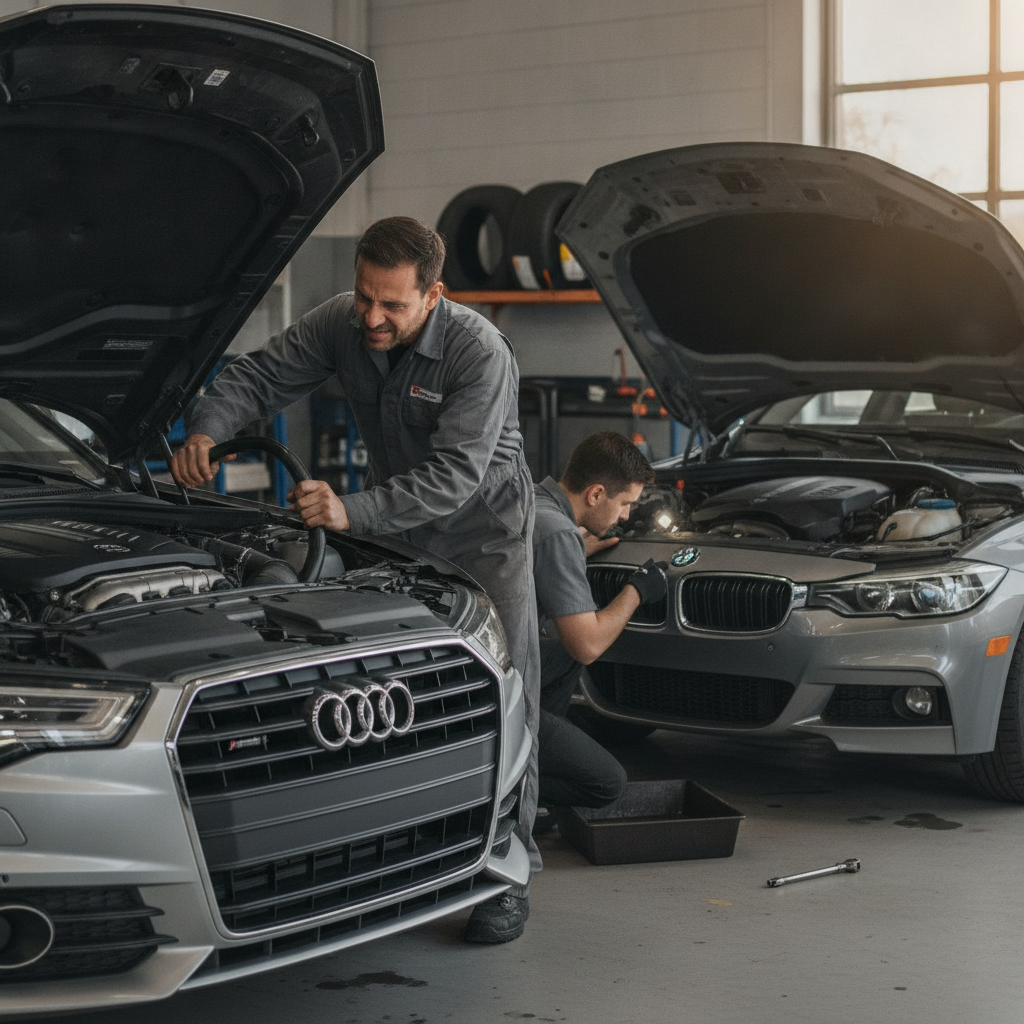
Why Is My Audi or BMW’s Power Steering Groaning When I Turn? What Roswell Owners Should Know About Hydraulic and Electric Power Steering Failure
If your Audi or BMW has started groaning, whining, or feeling unexpectedly stiff when you turn the wheel — especially during low-speed maneuvers or parking — your power steering system is trying to tell you something. In Roswell and throughout North Fulton County, this is one of the more frequently misdiagnosed complaints we see on European vehicles, largely because modern BMWs and Audis use two fundamentally different types of power steering that fail in completely different ways. Knowing which system your car has, and what symptoms mean what, can save you from a dangerous situation and an expensive repair bill that could have been avoided.
Hydraulic vs. Electric Power Steering: Why It Matters for Your Audi or BMW
Not all power steering systems are built the same, and the diagnosis process differs significantly depending on what’s under your hood. Older BMW models — many E-series 3, 5, and 7 Series — and some Audi platforms use a traditional hydraulic power steering (HPS) system, which relies on a belt-driven pump, a reservoir of power steering fluid, and high-pressure hoses to assist steering effort. Newer platforms, including most current BMW F- and G-series models as well as recent Audi B9 and B10 platforms, use an electric power steering (EPS or EPAS) system, which replaces the pump entirely with an electric motor mounted either on the steering column or directly on the rack.
This distinction is critical because the failure modes are completely different. A groaning or whining sound on a hydraulic system almost always points to the pump, the fluid, or a leak somewhere in the high-pressure circuit. A sudden heaviness or jerk on an electric system, on the other hand, may have nothing to do with mechanical wear at all — it could be a software fault, a failing torque sensor, or a corroded connector. Generic repair shops that aren’t deeply familiar with European steering architecture often misread one for the other, and the result is parts replaced that didn’t need replacing.
Hydraulic Power Steering Failure: What’s Actually Happening
On hydraulic systems, the groaning you hear when turning the wheel — especially at full lock during a three-point turn or when pulling out of a parking space — is typically the pump cavitating. Cavitation happens when the fluid level drops low enough, or the fluid is so degraded, that the pump is pulling in air along with fluid. Left unaddressed, this causes rapid wear inside the pump itself and can damage the steering rack seals as well.
Common hydraulic power steering failure points on European vehicles include:
- Low or contaminated power steering fluid — often the first and most overlooked cause
- Cracked or leaking high-pressure hoses — these are under significant pressure and degrade over time, especially in Georgia’s heat and humidity
- Failing or seized power steering pump — particularly common on higher-mileage E46, E90, and B6/B7 Audi A4 platforms
- Worn steering rack seals — often accompanied by a wet, oily residue along the rack and a vague or loose feel on center
- Collapsed or deteriorating return hose — causes fluid restriction and can mimic pump failure
Stop-and-go traffic along GA-400 puts a real strain on hydraulic steering systems. The pump runs any time the engine is running, and repeated full-lock inputs — think parking, U-turns, tight lots — heat the fluid rapidly. If that fluid hasn’t been changed on schedule, the pump is fighting degraded fluid under thermal stress every day.
Electric Power Steering Failure: When the Warning Light Comes On — or Doesn’t
Electric power steering failure is trickier because it often presents with warning lights that a general scanner can’t properly decode, or with intermittent symptoms that seem to disappear on their own. You might feel the wheel suddenly resist your input at low speed, notice a slight jerk or pull when the EPS motor initializes, or find that the steering assist cuts out entirely for a few seconds before returning. On some BMW and Audi models, the steering wheel will vibrate or feel artificial, as if the system is hunting for feedback.
The root causes we see most frequently on electric systems include:
- Failing EPS motor or control module — the motor itself can develop internal winding faults that only show under load
- Torque sensor failure — this sensor tells the EPS motor how much assist to provide; when it fails, the system either over-assists or under-assists erratically
- Steering angle sensor faults — often triggered after an alignment or wheel replacement if the sensor isn’t properly calibrated
- Corroded or loose wiring harness connections — Georgia’s humidity accelerates connector corrosion on exposed steering column wiring
- Software or calibration issues — on some BMW and Audi platforms, EPS behavior is partially governed by software that can drift out of specification or require reprogramming after a module replacement
This is exactly why factory-level diagnostic tools matter. Our Audi repair specialists use manufacturer-level scan tools that can read EPS-specific fault codes, live torque sensor data, and steering angle calibration status — the kind of depth you simply won’t get from a generic OBD-II reader or a shop that’s guessing based on a steering feel complaint alone.
What Happens If You Ignore It
Power steering problems rarely resolve themselves. A hydraulic leak will continue until the pump runs dry and seizes, at which point you’re looking at a full pump and potentially a rack replacement — often two to three times the cost of catching the leak early. An electric system running a degraded torque sensor will continue placing incorrect demands on the EPS motor until the motor itself fails, which is a significantly more expensive repair than replacing the sensor.
More critically, power steering failure is a safety issue. A sudden loss of assist at highway speeds — which can happen when an EPS system fails completely — requires significantly more physical effort to steer and dramatically increases the risk of losing vehicle control. Owners in Milton and Johns Creek who do regular highway driving on GA-400 should treat any steering complaint as urgent, not something to monitor for a few more weeks.
Why This Repair Requires a European Specialist, Not a General Shop
One of the clearest gaps we see in how other local shops handle this repair is the tendency to replace the most expensive component first — the rack or the pump — without properly diagnosing whether that component is actually at fault. On an electric system, replacing the steering rack when the torque sensor is the real culprit costs hundreds of dollars unnecessarily. On a hydraulic system, replacing the pump when a $40 hose is leaking produces the same outcome.
Proper European power steering diagnosis requires the ability to read live data from the EPS module, pressure-test a hydraulic circuit, and interpret steering angle calibration values — tools and training that not every shop in the Roswell or Alpharetta area has invested in. At Solo Motorsports Roswell, our factory-trained technicians diagnose the system before recommending any parts, and we use OEM-quality components that match your vehicle’s original specifications and engineering tolerances.
If you’re driving a BMW or Audi in Sandy Springs or Alpharetta and you’ve noticed anything unusual about your steering feel, don’t wait for the problem to escalate. Explore our full range of European repair and maintenance services — or reach out directly to schedule a diagnostic appointment.
Frequently Asked Questions
How do I know if my BMW or Audi has hydraulic or electric power steering?
The easiest way is to open the hood and look for a power steering fluid reservoir — typically a small white or black plastic tank near the firewall. If there’s no reservoir, your car almost certainly has electric power steering. You can also check your owner’s manual or ask a specialist to confirm based on your VIN and build date.
Can I drive with a groaning power steering pump?
In the short term, yes — but you shouldn’t. A groaning pump is usually low on fluid or beginning to fail internally. Continued driving accelerates wear and risks a sudden loss of assist, which makes steering significantly harder and less predictable. Have it inspected promptly.
How often should power steering fluid be changed on a European vehicle?
Most European manufacturers recommend a fluid flush every 50,000 to 75,000 miles, though this varies by model. Degraded fluid loses its lubricating and anti-corrosion properties and accelerates internal pump and rack wear. If you’re unsure when yours was last serviced, it’s worth checking during your next multi-point inspection.
Why does my EPS warning light come on and then disappear?
Intermittent EPS warnings are common with torque sensor faults, software glitches, or wiring issues that worsen under certain temperatures or driving conditions. The fact that it clears doesn’t mean the fault is resolved — fault codes are stored even after the light goes out, and a proper diagnostic scan will retrieve them. Don’t ignore a light just because it stopped illuminating.
Will a wheel alignment affect my electric power steering system?
Yes. Many BMW and Audi EPS systems require a steering angle sensor calibration after a wheel alignment or suspension work. If this step is skipped, you may notice the steering feeling off-center, the lane-keeping system behaving erratically, or even an EPS fault code being triggered. Always confirm that any shop performing an alignment on your European vehicle includes sensor recalibration in the process.
Schedule Your Power Steering Diagnosis at Solo Motorsports Roswell
Whether your Audi is groaning through every parking lot turn or your BMW’s steering feels heavier than it should on the highway, this isn’t a symptom to wait out. Solo Motorsports Roswell specializes in European vehicle steering systems — hydraulic and electric — with the factory-level tools and OEM-quality parts to diagnose it correctly the first time. We serve owners across Roswell, Alpharetta, Sandy Springs, Johns Creek, Milton, and the surrounding North Fulton area, and we back our work with a warranty you can count on.
Contact us today to schedule your diagnostic appointment. You’ll get honest answers, transparent pricing, and the confidence that your steering system is in the hands of specialists who actually know your car.