
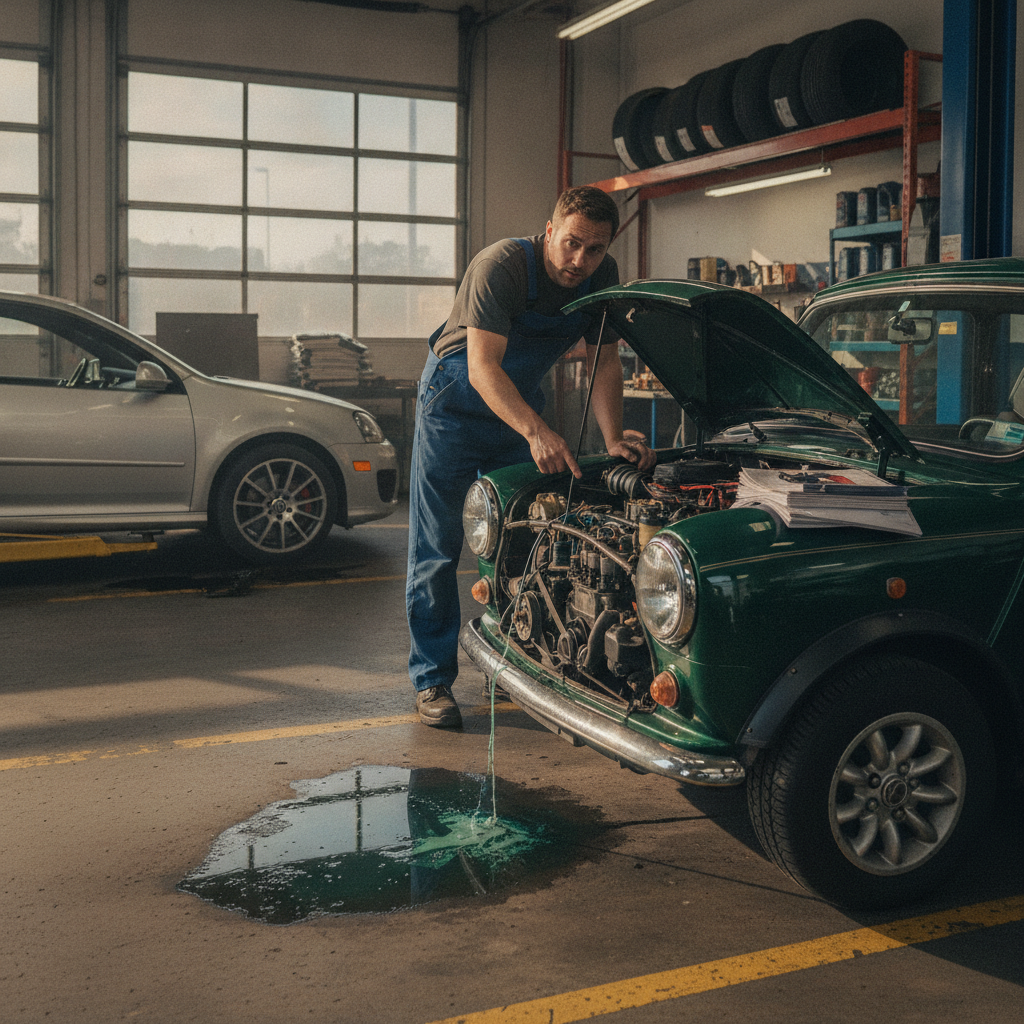
Why Is My Mini Cooper or Volkswagen’s Thermostat Stuck Open or Closed? What Roswell Owners Should Know About European Coolant Thermostat Failure
If your Mini Cooper or Volkswagen is taking forever to warm up, running hotter than usual, or your temperature gauge is behaving erratically, a failing coolant thermostat is one of the most likely culprits — and one of the most overlooked. In Roswell, where stop-and-go GA-400 traffic and Georgia’s sweltering summers push cooling systems to their limits year-round, a thermostat that isn’t doing its job can escalate from a minor inconvenience to a full engine repair in a surprisingly short window of time.
What Does the Thermostat Actually Do in a European Vehicle?
The thermostat is a small, spring-loaded valve that sits between your engine and your radiator. Its job is deceptively simple but absolutely critical: it keeps your engine coolant inside the engine until the engine reaches its optimal operating temperature, then opens to allow coolant to flow through the radiator and cool down before recirculating. This regulation keeps your engine running in a precise temperature window — typically between 195°F and 220°F depending on the make and model.
In a Mini Cooper or Volkswagen, that window matters more than in a generic domestic vehicle. These engines are engineered to tight tolerances. They’re tuned to run efficiently, cleanly, and powerfully within a defined thermal envelope. When the thermostat fails — either sticking open (so the engine never fully warms up) or sticking closed (so coolant can’t escape and the engine overheats) — the consequences compound quickly.
Stuck Open vs. Stuck Closed: Two Very Different Problems
Stuck Open: The Slow, Silent Performance Killer
A thermostat that’s stuck open is the failure mode most owners miss entirely — because the car keeps running. Coolant is constantly flowing to the radiator whether the engine needs it or not, so the engine never reaches full operating temperature. You’ll notice a few telltale signs:
- The temperature gauge stays low or takes an unusually long time to climb, especially on short trips
- Your heater blows lukewarm air even when set to maximum heat
- Fuel economy drops noticeably — the engine is running rich because it thinks it’s still in warm-up mode
- You may see reduced performance, as the engine management system holds back full power until operating temp is reached
In Georgia’s climate, where winters are mild and owners rarely experience dramatic cold-start symptoms, a stuck-open thermostat on a Mini Cooper or Volkswagen GTI can go undetected for months. The car feels fine. But your catalytic converter is taking extra wear, your oil isn’t burning off moisture properly, and your fuel trims are quietly running inefficient. It adds up.
Stuck Closed: The Dangerous Failure
A thermostat stuck in the closed position is far more urgent. Coolant can’t reach the radiator, so heat builds inside the engine unchecked. In Roswell summer traffic — crawling down Alpharetta Highway or queued up approaching the GA-400 interchange — an engine with a stuck-closed thermostat can go from normal operating temp to dangerously hot in minutes. Warning signs escalate fast:
- Temperature gauge climbs into the red or rises sharply above normal
- A coolant or steam smell from under the hood
- Heater suddenly blowing very hot air when it wasn’t before
- Engine warning lights illuminating — particularly a coolant temperature warning
If you see your temperature gauge heading toward the red, pull over safely and shut the engine down. Continuing to drive an overheating European engine risks warped cylinder heads, a blown head gasket, or in severe cases, complete engine failure. That’s a repair that can cost thousands — and all of it was preventable.
Why Mini Coopers and Volkswagens Are Particularly Prone to Thermostat Issues
Both Mini Cooper and Volkswagen have historically used plastic-housing thermostat assemblies — especially in the N-series Mini engines (shared with BMW) and in VW’s EA888 four-cylinder found in the Golf, Jetta, Passat, and Tiguan. These plastic housings degrade over time from heat cycling, and the integrated thermostat elements can fail earlier than metal-housed counterparts in older European designs.
Volkswagen’s map-controlled thermostat — used in many modern VW and Audi applications — adds another layer of complexity. Rather than a purely mechanical wax-element thermostat, it’s electronically modulated by the ECU to vary coolant temperature based on load conditions. When the electrical control element fails, the ECU loses the ability to regulate coolant temperature dynamically. Generic scan tools often miss this distinction. Diagnosing it properly requires dealership-level diagnostic equipment that can communicate with the engine management system and read coolant temperature sensor data in real time.
At Solo Motorsports Roswell, our technicians work with factory-level diagnostic tools and have hands-on experience with both the BMW-derived Mini Cooper powertrains and VW’s EA888 and EA211 engine families. We’re not guessing — we’re reading live data and pinpointing the failure accurately before any parts are ordered.
What the Repair Actually Involves — and What to Expect
On most Mini Cooper and Volkswagen models, thermostat replacement is a moderate-complexity repair. In many cases, the thermostat is integrated into a housing assembly that also connects to coolant hoses, the coolant temperature sensor, and sometimes the water pump. Replacing the thermostat alone without inspecting the housing, hoses, and adjacent components is a shortcut that often leads to a repeat visit.
A proper thermostat repair at Solo Motorsports Roswell includes:
- Diagnostic scan to confirm thermostat failure vs. a sensor reading error or water pump issue
- Replacement with OEM or OEM-equivalent parts — not generic aftermarket thermostats that may not open at the correct temperature
- Full coolant system inspection including hoses, clamps, and reservoir
- Coolant flush and refill with the correct specification fluid (VW G13 or Mini/BMW specification coolant — not universal green antifreeze)
- Post-repair road test with live temperature monitoring to confirm the system is operating correctly
Using the wrong coolant specification in a European vehicle isn’t just a minor error — it can cause premature water pump seal degradation and accelerated corrosion in aluminum engine components. This is one of the areas where generic shops and quick-lube chains consistently cut corners on European vehicles.
If you want to understand the broader scope of what a cooling system inspection covers as part of routine care, our multi-point inspection service includes a full review of your cooling system alongside brakes, tires, fluids, and suspension.
What Competitors in the Area Aren’t Telling You About Thermostat Failure
Most European repair shops in the Roswell and Alpharetta corridor treat thermostat failure as a simple parts swap — pull the old one, drop in a new one, done. What they’re not discussing is the map-controlled thermostat technology in modern VW and Audi platforms, the importance of coolant specification, or the diagnostic steps needed to rule out coolant temperature sensor failure before assuming the thermostat is the problem. Replacing a thermostat when the actual issue is a faulty sensor is a wasted repair. We see it come through the door regularly from owners who’ve already paid someone else for the wrong fix.
For owners in Johns Creek, Milton, and Sandy Springs driving daily in North Fulton County’s heat and traffic, getting the diagnosis right the first time isn’t just about saving money today — it’s about protecting an engine that may have 80,000 or 120,000 miles of life left in it if it’s maintained correctly.
You can learn more about how we approach European engine repairs and what our technicians look for during a full engine diagnostic by visiting our engine repair page.
Frequently Asked Questions: Thermostat Failure in Mini Cooper and Volkswagen
How do I know if my thermostat is failing or if it’s just the temperature sensor?
A faulty coolant temperature sensor can mimic thermostat failure symptoms on your dashboard, but the actual coolant temperature will be normal. Proper diagnosis requires a scan tool that reads live engine data alongside a physical inspection of the cooling system — not just pulling a code and replacing parts.
Can I drive my Mini Cooper or Volkswagen with a stuck-open thermostat?
You won’t break down immediately, but you will damage your engine over time through incomplete combustion, excess fuel wash on cylinder walls, and oil degradation. It’s not an emergency stop-immediately situation, but it should be repaired within a week or two — not ignored indefinitely.
What coolant does my Volkswagen or Mini Cooper need?
Volkswagens require G12, G13, or G13+ specification coolant (typically pink or purple). Mini Coopers with BMW-derived engines require BMW’s blue coolant (OAT type). Using universal green or orange antifreeze in either vehicle can cause internal corrosion and seal damage. Always confirm the spec with your technician before any coolant service.
How often should the coolant be changed on a European vehicle?
Most European manufacturers recommend a coolant flush every 4–5 years or roughly 50,000–60,000 miles, though this varies by model. Degraded coolant loses its corrosion inhibitors and becomes acidic over time, accelerating wear on the water pump, thermostat housing, and radiator — particularly in aluminum-heavy European engines.
Is thermostat replacement covered under any warranty at Solo Motorsports Roswell?
Yes — all repairs at Solo Motorsports Roswell come with a warranty on parts and labor. We use OEM-quality components and stand behind our work. Contact us directly for current warranty terms on your specific repair.
Get It Diagnosed Right the First Time
If your Mini Cooper or Volkswagen is showing any signs of temperature irregularity — whether it’s slow to warm up, running hotter than normal, or your heater isn’t performing the way it should — don’t wait for the gauge to hit the red. Roswell’s summer heat and metro Atlanta traffic don’t give your cooling system much margin for error.
Solo Motorsports Roswell serves Mini Cooper and Volkswagen owners throughout Roswell, Alpharetta, Johns Creek, Sandy Springs, Milton, and the broader North Fulton County area. Our ASE-certified, factory-trained technicians use dealership-level diagnostic equipment and genuine parts — without the dealership markup or the upsell pressure.
Contact Solo Motorsports Roswell today to schedule your diagnostic appointment or ask us about your cooling system concern. We’ll tell you exactly what’s going on, what it will take to fix it, and what it will cost — before we touch a thing.