
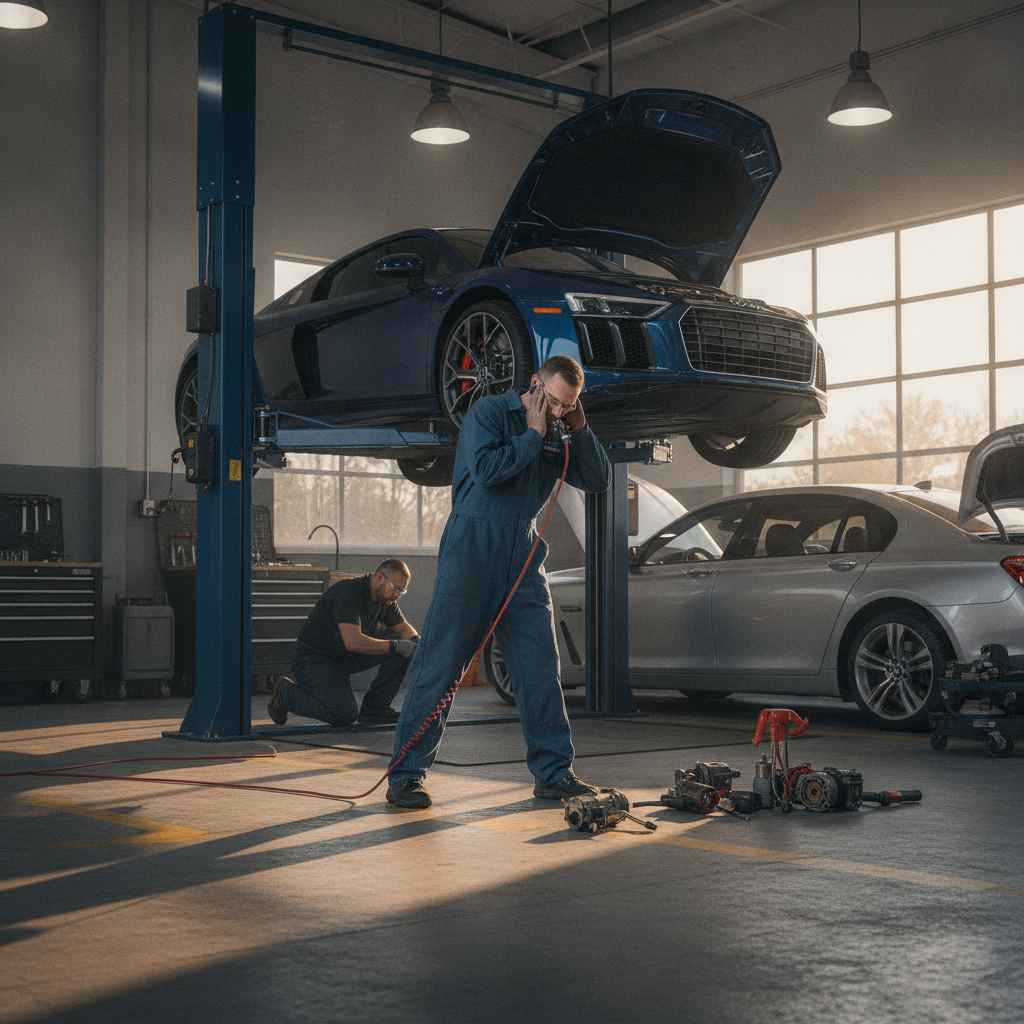
Why Is My Audi or BMW’s Fuel Pump Making a Whining Noise? What Alpharetta Owners Should Know About High-Pressure Fuel System Failure
If you’ve started noticing a high-pitched whine coming from your Audi or BMW — especially when you first turn the ignition or when you’re accelerating on GA-400 — don’t write it off as a background quirk. That sound is frequently the earliest warning your high-pressure fuel pump (HPFP) gives before it fails completely. And when it does fail, you don’t get much warning: one day your car starts normally, and the next it cranks without firing, or it surges and stumbles under load. For Alpharetta owners who depend on their vehicle for long commutes and daily highway driving, catching this early makes the difference between a scheduled repair and an emergency tow.
What Makes European High-Pressure Fuel Pumps Different — and Why They Fail
BMW N54, N55, and B58 engines, along with Audi’s 2.0T TFSI and 3.0T units, all use gasoline direct injection (GDI). Unlike older port-injection systems where fuel enters the intake manifold, direct injection sprays fuel directly into the combustion chamber at extremely high pressure — often between 1,500 and 3,000 PSI depending on the load. That’s a fundamentally different mechanical challenge than what a conventional fuel pump handles, and it demands components engineered to exact tolerances.
The high-pressure fuel pump in these systems is mechanically driven off the camshaft, not electrically driven like the low-pressure pump in your fuel tank. It relies on a cam follower (sometimes called a bucket lifter) that rides against a lobe on the camshaft. Over time — especially if oil changes are delayed or the wrong specification oil is used — that cam follower wears down. When it does, the HPFP can’t build adequate pressure, and you’ll hear the whine, experience rough starts, or notice hesitation and stumbling under acceleration. In BMW N54 engines in particular, this is one of the most well-documented failure patterns, and it’s something many general repair shops simply don’t have the tooling or experience to diagnose correctly.
Symptoms You Should Not Ignore
The whining noise is often the first thing owners notice, but it’s rarely the only symptom by the time a vehicle comes into our shop. Here’s what to watch for in your Audi, BMW, or similar European vehicle:
- A high-pitched whine or mechanical buzzing at startup or under hard acceleration, coming from the engine bay near the top of the engine
- Rough or extended cranking before the engine catches, particularly on cold mornings or after the car has sat for several days
- Hesitation or stumbling when accelerating from a stop or merging onto the highway
- A check engine light with codes related to fuel trim, fuel pressure (P0087, P0088), or injector circuit faults
- Reduced power under load, often accompanied by a surging or flat feeling in the throttle response
- Sudden no-start condition — in severe cases, the pump fails without additional warning
If you’re seeing two or more of these symptoms together, the HPFP — or its associated cam follower — should be at the top of your diagnostic list.
Why This Is One of the Most Misdiagnosed Problems at General Shops
This is where a lot of Alpharetta and Johns Creek owners run into trouble. A general repair shop with a generic OBD-II scanner may pull a fuel pressure or lean mixture code and immediately recommend replacing injectors, oxygen sensors, or the low-pressure fuel pump in the tank. Those components may look like the culprit based on surface-level codes, but they’re not the source of the problem. The high-pressure mechanical pump and cam follower won’t appear as obvious failures on a basic scan — diagnosing them correctly requires live fuel pressure data at both the low- and high-pressure circuits, a factory-level scan tool capable of reading manufacturer-specific parameters, and a technician who actually knows where to look on these specific engine families.
At Solo Motorsports Roswell, our technicians use the same diagnostic tooling and live data access that BMW and Audi dealers rely on. We can pinpoint whether the problem is in the high-pressure pump itself, the cam follower, the pressure relief valve, or the low-pressure supply — and we don’t replace parts speculatively. Every diagnostic step is intentional. You can learn more about our approach on our About Us page.
The Cam Follower Problem: What Most Shops Miss Entirely
One of the most significant gaps in coverage across local European repair shop websites is any meaningful discussion of cam follower wear as it relates to HPFP failure. Most competitors in the Roswell and Alpharetta area either don’t mention it at all, or they lump it generically under “fuel system service” without explaining what’s actually happening mechanically.
On BMW N54 and N55 engines especially, the cam follower that drives the high-pressure fuel pump is a known wear item. It’s a small, inexpensive component — but when it wears through, the camshaft begins to contact the HPFP directly, causing accelerated pump failure and in some cases damage to the camshaft itself. The repair cost difference between catching a worn cam follower early (relatively affordable) versus replacing both the HPFP and a damaged camshaft (significantly more expensive) is substantial.
Proactive cam follower inspection is part of how we approach preventative maintenance on direct-injection BMW and Audi engines — especially for vehicles with higher mileage or extended oil change intervals. If your vehicle has over 50,000 miles and you’ve never had this checked, it’s worth asking about at your next service visit.
What the Repair Involves — and What to Expect
A proper high-pressure fuel pump replacement on an Audi or BMW is not a simple job, and it should never be treated like one. Depending on the engine, accessing the HPFP requires removing intake components, engine covers, and in some configurations, additional accessory components to reach the pump and its mounting point on the camshaft.
We use OEM or OEM-equivalent parts from trusted European suppliers — not aftermarket pumps of uncertain origin. Fuel system components at this pressure level have no margin for cheap substitutions. A substandard pump won’t hold pressure consistently, and you’ll be back in the shop sooner than you should be. Parts come with a warranty, and every repair we perform carries our shop warranty on both parts and labor.
For most Audi and BMW models, expect a repair timeline of one to two days depending on parts availability and the full scope of what’s needed. We’ll give you a clear, itemized estimate before any work begins — no surprises, no dealership-style upsells.
If you want a broader overview of what our engine repair services cover for European vehicles, visit our engine repair page.
North Fulton Driving Conditions Make This Worse Than You Might Think
Stop-and-go traffic on GA-400 between Alpharetta, Roswell, and the Perimeter isn’t just frustrating — it puts measurable stress on fuel system components. Repeated short trips with frequent acceleration and deceleration cycles work the high-pressure fuel pump harder than steady highway cruising. Add in the heat and humidity of a Georgia summer, and fuel system components that might last longer in cooler climates are operating at the edge of their thermal tolerance on a regular basis.
Owners in Milton and Johns Creek who combine regular GA-400 commuting with occasional spirited driving on weekends are putting their direct-injection fuel systems through a demanding cycle. If you’re in that category and your vehicle is approaching 60,000 to 80,000 miles, a proactive fuel pressure test and cam follower inspection is money well spent.
Frequently Asked Questions
How much does it cost to replace a high-pressure fuel pump on a BMW or Audi?
The cost varies depending on the specific model, engine type, and whether the cam follower or other related components also need replacement. We provide a detailed, accurate estimate after diagnosis — we don’t quote a number before we know exactly what’s needed. Contact us to schedule a diagnostic appointment.
Can I drive my BMW or Audi if the fuel pump is whining?
In the short term, you may be able to — but it’s a risk. A failing HPFP can deteriorate quickly, and a sudden no-start on GA-400 or a highway on-ramp is a safety hazard. Have it inspected as soon as possible rather than hoping the problem stabilizes on its own.
Will a check engine light always come on if my fuel pump is failing?
Not necessarily in the early stages. Fuel pressure may drop just enough to cause drivability symptoms without triggering a stored fault code. This is one reason why live data diagnostics — not just a code scan — are essential for accurate fuel system diagnosis on European vehicles.
Is this covered under any BMW or Audi warranty?
If your vehicle is within the manufacturer’s powertrain warranty period, HPFP failure may be covered. For out-of-warranty vehicles, some extended warranty plans cover fuel system components — check your policy. We’ll provide documentation of the diagnosis and repair to support any claim.
Does Solo Motorsports Roswell service Audis and BMWs from Johns Creek and Milton too?
Absolutely. We serve owners across North Fulton County, including Alpharetta, Johns Creek, Milton, Roswell, and surrounding communities. Most customers find us more convenient — and far more affordable — than returning to a dealership for a repair of this complexity.
Don’t Wait for a No-Start to Act
A whining fuel pump is your Audi or BMW telling you something is wrong before it becomes catastrophic. The owners who avoid expensive repairs are the ones who act on early symptoms rather than waiting for a complete failure. If you’re hearing something unusual from your fuel system, or if you’re experiencing rough starts and hesitation that you can’t explain, get it looked at by a specialist who actually understands how these engines work.
Solo Motorsports Roswell is located in Roswell and serves the entire Alpharetta corridor and North Fulton County. Our technicians are factory-trained and ASE-certified, and we have the diagnostic tools to get to the actual root cause — not just clear a code and send you on your way. Contact us today to schedule a diagnostic appointment. We’ll tell you exactly what’s going on and what it will take to fix it, with no pressure and no guesswork.