
Why Is My Audi or Volkswagen’s DSG or S Tronic Making a Shudder at Low Speed? What Roswell Owners Should Know About Mechatronic Unit Failure
If your Audi A4, A5, Q5, or Volkswagen Golf, Jetta, or Tiguan is shuddering, lurching, or hesitating at low speeds — especially when pulling away from a stop or crawling through parking lots — your DSG or S Tronic transmission is telling you something is wrong. In most cases, the culprit is the mechatronic unit, a component that most general repair shops in the Roswell area simply do not have the tools or training to diagnose accurately. This article explains what the mechatronic unit does, why it fails, and what you should do about it before a manageable repair turns into a full transmission replacement.
What Is the Mechatronic Unit, and Why Does It Matter?
The DSG (Direct Shift Gearbox) and its Audi-badged counterpart, the S Tronic, are dual-clutch automatic transmissions that use two separate clutch packs — one for odd gears, one for even — to deliver fast, seamless gear changes. The engineering is genuinely impressive, but it relies on a component called the mechatronic unit to make all of it work.
The mechatronic unit is a combined electro-hydraulic control module that manages hydraulic pressure, clutch engagement, gear selection, and shift timing — all simultaneously, all the time. It contains a control module, solenoid valves, a hydraulic valve body, and a wiring harness, all housed together in a single integrated assembly. When it works properly, your shifts are fast and transparent. When it starts to fail, you feel it immediately.
Common symptoms of mechatronic unit failure include:
- A shudder or judder when accelerating from a stop at low speed
- Hesitation or a brief delay before the transmission engages Drive or Reverse
- Jerky or rough gear changes, particularly in first and second gear
- The transmission slipping out of gear unexpectedly
- Warning messages such as “Transmission Fault” or “Gearbox Malfunction” appearing on the dashboard
- The vehicle entering limp mode, locking itself into a single gear to protect the drivetrain
If you are driving GA-400 between Roswell and Alpharetta every morning and your Audi or VW is lurching in stop-and-go traffic, that shudder is not a minor annoyance — it is an early warning that you need a proper diagnosis from someone with factory-level equipment.
Why Metro Atlanta Traffic Makes This Problem Worse
DSG and S Tronic transmissions are engineered for European driving conditions — a mix of open-road cruising and moderate urban traffic. The dual-clutch design is particularly efficient at highway speeds, but it puts additional demand on the mechatronic unit in constant low-speed, stop-and-start conditions like those on GA-400 during rush hour or surface roads through Johns Creek and Sandy Springs.
In heavy traffic, the transmission is constantly modulating clutch engagement at low speeds, generating heat and hydraulic pressure cycles that wear the mechatronic unit’s solenoids and seals faster than typical driving would. Georgia’s heat and humidity compound this further — transmission fluid degrades faster in high temperatures, and degraded fluid directly affects the hydraulic performance of the mechatronic unit.
This is one reason why Audi and Volkswagen owners in North Fulton County tend to see mechatronic issues at lower mileage than owners in less congested markets. It is not a defect in your driving — it is the system responding to conditions it was not entirely designed for.
The Section Most Local Shops Don’t Cover: What Actually Goes Wrong Inside the Mechatronic Unit
Most competitors in the Roswell corridor offer vague guidance on DSG issues — “bring it in for a diagnosis” — without explaining what is actually failing or why. Here is what is genuinely happening when your mechatronic unit deteriorates.
The most common failure points are the solenoid valves. These are small electro-hydraulic valves that open and close to direct fluid pressure to the correct clutch pack. Over time, the solenoid plungers wear, the seals harden, and the valves begin to stick or respond sluggishly. When a solenoid valve controlling first or second gear engagement starts to lag, you feel it as a shudder or lurch every time the transmission tries to engage that clutch pack.
A second common failure is internal fluid contamination. The mechatronic unit is bathed in transmission fluid, and if that fluid has not been changed at the factory-recommended interval — typically every 40,000 miles for a wet-clutch DSG — it becomes acidic and abrasive. Contaminated fluid accelerates wear on the solenoid bores and the valve body passages, eventually causing pressure loss and erratic shift behavior.
Finally, the integrated control module itself can develop faults — particularly in vehicles that have experienced a voltage spike, battery discharge event, or previous electrical work done without proper coding. In these cases, the mechatronic unit may require reprogramming or replacement even when the mechanical components are otherwise intact.
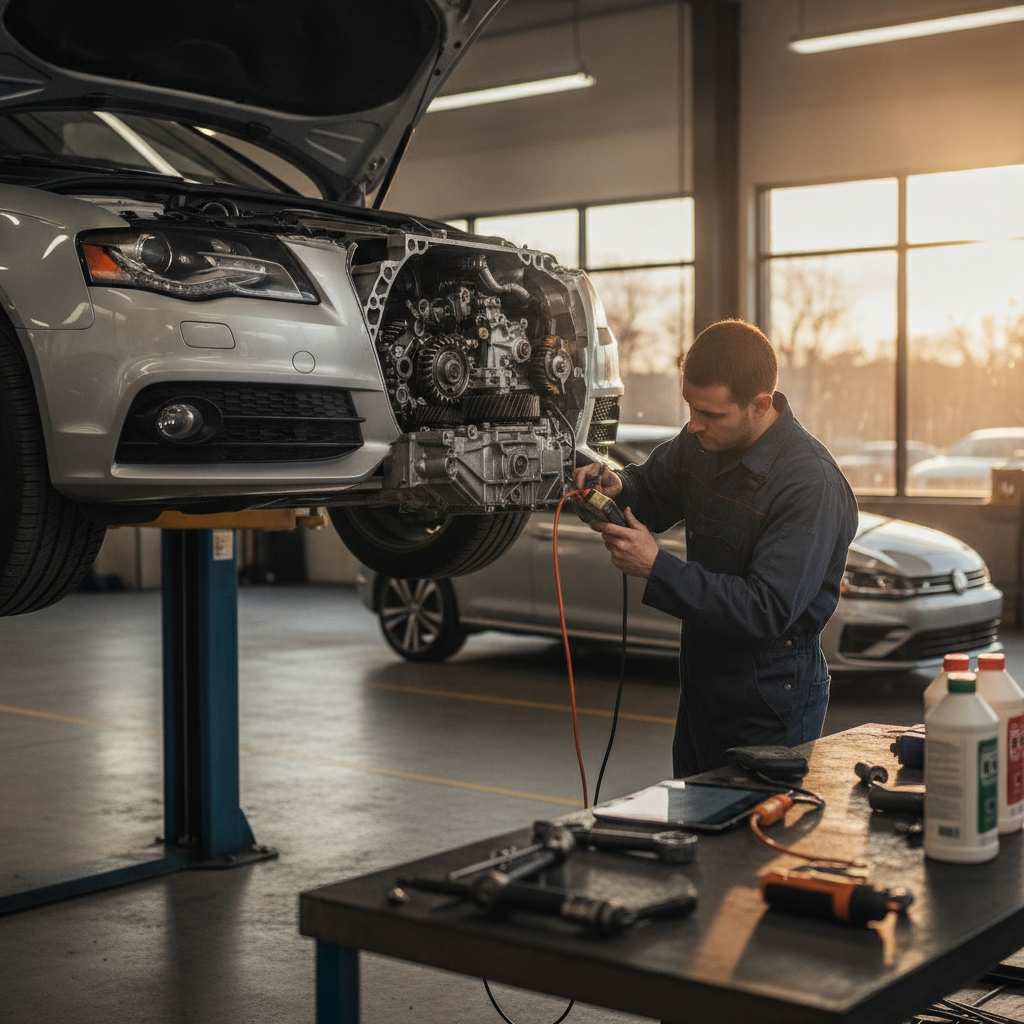
Proper diagnosis requires a factory-compatible scan tool — not a generic OBD-II reader — that can access DSG-specific fault codes, monitor live hydraulic pressure data, and evaluate solenoid response times. Without that capability, a shop is guessing.
DSG Service vs. Mechatronic Replacement: What You Actually Need
Not every shuddering DSG needs a mechatronic unit replacement. In many cases — particularly when the issue is caught early — a proper DSG service will resolve the problem. This involves draining and replacing the transmission fluid and filter with fluid that meets Volkswagen Group’s exact specification (typically VW G 052 182 A2 or equivalent), followed by an electronic adaptation reset using a factory-compatible scan tool to recalibrate the clutch engagement points.
If the shudder returns after a proper service, or if the fault codes point specifically to solenoid failure or internal pressure loss, mechatronic unit replacement becomes necessary. This is a more involved repair, but it is far less expensive than replacing the entire transmission assembly — which is the outcome when a failing mechatronic unit goes unaddressed for too long.
The difference between the right repair and the wrong one starts with accurate diagnostics. That is exactly what you get at Solo Motorsports Roswell, where our Audi repair and Volkswagen service technicians work with factory-level equipment and genuine OEM components — not generic aftermarket parts that may not meet Volkswagen Group tolerances.
What About Milton, Johns Creek, and Surrounding Areas?
If you are driving over from Milton, Johns Creek, or Sandy Springs and you have been quoted a full transmission replacement at a dealer for a shuddering DSG, it is worth getting a second opinion. In a significant number of cases, the transmission itself is fine — the mechatronic unit needs service or replacement, and the two are not the same thing in terms of cost or complexity. A specialist who understands the difference between a mechanical transmission failure and a mechatronic control failure can save you thousands of dollars.
Solo Motorsports Roswell serves the entire North Fulton and surrounding Atlanta metro area, and our transmission repair team has direct experience with DSG and S Tronic diagnosis across the full range of Volkswagen Group vehicles — Audi, Volkswagen, and beyond.
Frequently Asked Questions
How do I know if my DSG shudder is a mechatronic problem or a clutch pack problem?
A factory-compatible scan tool with DSG-specific diagnostics is the only reliable way to tell. Mechatronic faults typically produce solenoid-related codes and abnormal pressure readings. Clutch pack wear tends to show up differently — usually as slipping at higher speeds rather than low-speed judder. A proper inspection will identify which component is at fault before any parts are ordered.
Can I keep driving my Audi or VW if it’s shuddering in first gear?
You can, but you should not for long. A shudder in first or second gear indicates the transmission is struggling to engage the clutch properly at low speeds. Continuing to drive accelerates wear on the mechatronic unit and the clutch packs. If the transmission enters limp mode, stop driving and have it transported to a specialist.
How often should a DSG transmission be serviced?
Volkswagen Group recommends DSG fluid and filter changes every 40,000 miles under normal conditions — and more frequently if you drive in heavy stop-and-go traffic regularly. Many Roswell and Alpharetta owners are significantly overdue on this service, which is often the root cause of early mechatronic wear.
Is a mechatronic unit replacement covered under warranty?
If your vehicle is still under the manufacturer’s powertrain warranty, mechatronic unit failure is typically covered. Outside of warranty, extended service contracts vary. Solo Motorsports Roswell provides warranty-backed repairs using OEM components, so your repair is protected regardless of your vehicle’s age.
Can a general repair shop handle DSG or mechatronic repairs?
Not effectively. DSG and S Tronic transmissions require factory-compatible scan tools, VW Group-specified fluids, and technicians trained specifically on dual-clutch systems. A general shop using generic equipment and aftermarket fluid may temporarily mask the symptom without addressing the underlying fault — and may inadvertently cause additional damage.
Bring Your Audi or VW to a Specialist Who Actually Knows DSG
A shuddering transmission is not something to ignore or hand off to a shop that services everything from minivans to motorcycles. Your Audi or Volkswagen’s DSG is precision engineering, and it deserves a diagnosis from technicians who understand exactly what is happening inside that transmission before any parts are touched.
At Solo Motorsports Roswell, we use factory-level diagnostic equipment, genuine OEM components, and the correct VW Group-specified fluids. We will tell you exactly what is wrong, what it will cost, and what your options are — without upselling you a full transmission replacement when a mechatronic service is all you need.
Contact Solo Motorsports Roswell today to schedule your DSG diagnostic appointment. Owners from Roswell, Alpharetta, Johns Creek, Milton, Sandy Springs, and across North Fulton County trust us to get this right the first time.