
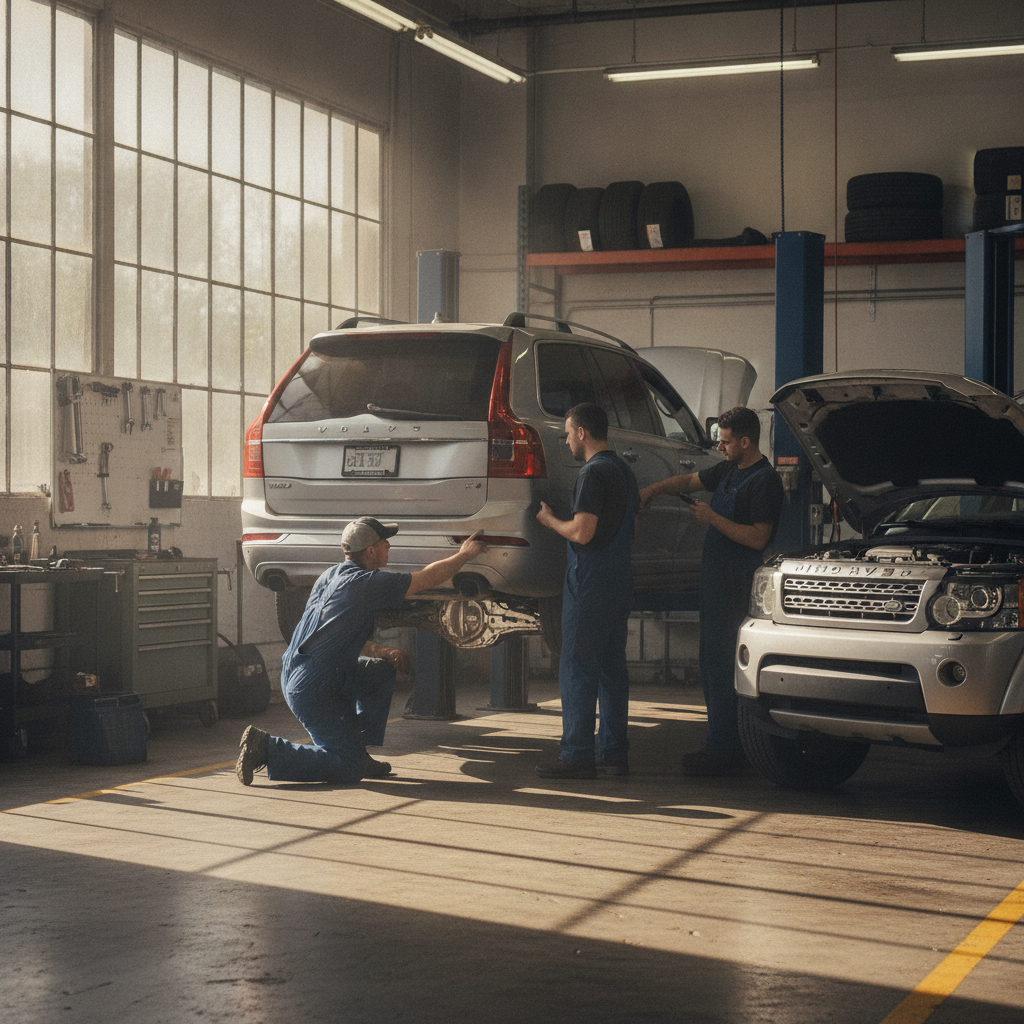
Why Is My Volvo or Land Rover’s Differential Making a Whining Noise? What Roswell Owners Should Know
If you’re hearing a persistent whine, hum, or growl coming from underneath your Volvo XC90, Land Rover Discovery, or Range Rover — a sound that changes pitch as your speed changes — your differential is telling you something is wrong. For Roswell owners who depend on these vehicles for daily GA-400 commutes, weekend family trips, or light off-road driving, catching a differential problem early is the difference between a manageable repair and a catastrophic drivetrain failure that sidelines your vehicle for weeks. This is not a noise to diagnose with a search engine and ignore. Here’s what’s actually happening, why it matters more on European AWD and 4WD platforms, and what a proper repair looks like.
What Does a Differential Actually Do?
Your differential — whether it’s front, rear, center, or all three in the case of a full-time 4WD Land Rover — manages how torque is distributed between your wheels. When you turn a corner, your inside and outside wheels need to rotate at different speeds. The differential allows that to happen smoothly without binding the drivetrain or scrubbing the tires. On a Volvo XC60 or XC90 with Haldex AWD, or a Range Rover Sport with Terrain Response, these systems are electronically managed and mechanically precise. They are not built the same way as a domestic truck differential, and they should not be serviced the same way.
Inside every differential is a set of ring and pinion gears, bearings, and a housing filled with specialized gear oil. When that fluid breaks down, becomes contaminated, or runs low — or when the bearings themselves wear — the gears run metal-on-metal. That’s where your whine starts. Left alone, it progresses to growling, clunking, and eventually, gear or bearing failure that can damage the driveshaft and other drivetrain components in the process.
Why Volvo and Land Rover Differentials Are More Vulnerable Than You Think
Both Volvo and Land Rover engineer their AWD and 4WD systems for sophisticated, electronically-managed torque distribution. That engineering sophistication is exactly what makes deferred maintenance so expensive. The fluid specifications for a Volvo Haldex coupling or a Land Rover Rear Differential are not generic gear oil — they are proprietary fluid formulations with specific viscosity, additive packages, and thermal properties. Using the wrong fluid is one of the most common mistakes general repair shops make, and it accelerates wear significantly.
North Fulton County’s driving conditions don’t help. Stop-and-go traffic on GA-400, sudden acceleration from ramps, and suburban driving with frequent low-speed turns puts constant load cycling on the differential. Atlanta’s summer heat also shortens the service life of differential fluid, because heat breaks down lubricants faster than mileage alone. If your Volvo or Land Rover is still running the original differential fluid at 60,000 or 80,000 miles — or if you bought it used and have no service records — there’s a real chance the fluid is already compromised.
How to Tell If It’s the Differential and Not Something Else
A differential whine is easy to confuse with a wheel bearing noise, a worn driveshaft, or even certain tire patterns. Here’s how to narrow it down before you bring your vehicle in:
- Speed-dependent pitch: Differential noise typically rises and falls directly with vehicle speed, not engine RPM. If the whine gets louder when you accelerate and quieter when you coast, that’s a classic differential wear pattern.
- Load-sensitive: Some differential problems are most obvious under acceleration or under a heavy load — towing, climbing a hill, or carrying passengers. If the noise gets worse when you’re putting the drivetrain under stress, the differential is a strong candidate.
- Location of the noise: Rear differential problems typically sound like they’re coming from behind you or under the cargo area. Front differential noise on an AWD Volvo may be harder to localize.
- Vibration accompanying the noise: If you feel a shudder or vibration along with the whine — especially on corners — the differential may already have bearing or gear damage rather than just fluid degradation.
None of these tests are definitive. A proper diagnostic requires lifting the vehicle, inspecting the differential housing, checking fluid condition and level, and in many cases running the drivetrain on a lift to isolate where the noise originates. A thorough multi-point inspection by a technician familiar with Land Rover and Volvo drivetrains will catch this and related issues at the same time.
The Repair: What to Expect and What It Actually Costs
The cost and complexity of differential repair depends entirely on how far the problem has progressed. There are three general scenarios:
- Fluid service only: If you catch the problem early and the noise is mild, draining and replacing the differential fluid with the correct OEM-specified lubricant may be sufficient to stop the progression and quiet the noise. This is the least expensive intervention and the most commonly deferred — which is why many vehicles come in needing more than this.
- Bearing replacement: Worn pinion or carrier bearings are a common cause of differential whine on both Land Rover and Volvo platforms. Bearing replacement requires disassembly of the differential, proper preload setting, and reassembly — this is precision work, not a quick turnaround job. Expect the repair to take at least a day, potentially more depending on parts availability for your specific model year.
- Ring and pinion or complete differential rebuild: If the gears themselves are damaged, you are looking at a full rebuild or replacement of the differential assembly. On a Land Rover Discovery or Range Rover with a locking rear differential, this repair can be substantial. OEM or genuine-spec parts matter here — aftermarket ring and pinion gear sets for European platforms vary wildly in quality.
Dealerships in Alpharetta and Sandy Springs will handle these repairs, but the labor rates and parts markups at the dealer level are significant. Owners in Johns Creek and Milton who have brought their Land Rovers to the dealer for drivetrain repairs know exactly what that bill looks like. An independent European specialist using genuine or OEM-equivalent parts, with factory-trained technicians, delivers the same quality of repair at a meaningfully lower total cost — and with more direct communication throughout the process.
The Gap Most Local Shops Leave Unfilled: Differential Fluid as Preventative Maintenance
Search through the websites of most European repair shops in the Roswell and Alpharetta corridor, and you’ll find brake pads, oil changes, and timing chains covered thoroughly. Differential fluid service — specifically for AWD Volvos and Land Rovers — is almost invisible in the local content landscape. That’s a problem, because this is one of the most commonly missed service intervals on both platforms.
Volvo recommends Haldex coupling fluid service approximately every 37,500 miles on most AWD models, though many owners go far longer without it. Land Rover’s recommended differential fluid change intervals vary by model and generation, but intervals of 30,000 to 60,000 miles are common depending on use. If you’re in a Volvo XC90 or a Discovery Sport that you use for mountain drives or any towing, you should be closer to the shorter end of that range. Preventative maintenance on these systems is dramatically cheaper than the repair that follows from ignoring them.
Frequently Asked Questions
Can I keep driving my Land Rover or Volvo if the differential is whining?
For a short time, in some cases — but not without risk. If the noise is mild and just started, you may have a window to get it diagnosed without causing additional damage. If the noise is loud, accompanied by vibration, or has been present for weeks or months, continued driving risks damaging surrounding drivetrain components and significantly increasing your repair cost. Get it inspected promptly.
Does a differential fluid change stop the whining noise?
If the noise is caused purely by degraded or incorrect fluid and the gears and bearings are not yet worn, a fluid change can reduce or eliminate the noise. If there is mechanical wear present, a fluid change will slow the progression but won’t repair the damage. Only a proper inspection can tell you which situation you’re in.
Is this covered under my Land Rover or Volvo warranty?
If your vehicle is still within the factory powertrain warranty period and the failure is not caused by neglect or improper fluid use, it may be covered. Extended warranties and third-party vehicle service contracts vary widely — you’ll need to check your specific coverage terms. An independent specialist can document the repair properly for warranty claim purposes if needed.
My Volvo AWD light is on along with the noise — are these related?
Yes, they can be. On Volvo’s Haldex-based AWD system, a failing coupling or differential issue can trigger the AWD warning light or disable the rear-axle drive to protect the system. Don’t ignore a warning light paired with a drivetrain noise — this combination warrants immediate diagnostic attention.
How long does a differential repair take at Solo Motorsports Roswell?
A differential fluid service is typically a same-day repair. Bearing replacement or a more involved rebuild depends on the severity and parts availability for your specific model. We give honest timelines upfront — not estimates that stretch out once the vehicle is already apart.
Get It Diagnosed Before the Whine Becomes a Grind
A differential noise on a Volvo or Land Rover is the kind of problem that rewards quick action and punishes procrastination. The longer you wait, the more components get involved, and the more the repair costs. At Solo Motorsports Roswell, our technicians have the factory-level training and the correct diagnostic equipment to evaluate your drivetrain accurately — not guess at it. We use genuine and OEM-specified parts, and we back our work with a warranty. You get the expertise of a dealership without the dealership experience of waiting three days for an appointment and leaving with a bill full of recommended services you didn’t ask for.
If your Volvo or Land Rover is making a noise you can’t explain, contact us to schedule a diagnostic appointment. We serve Roswell, Alpharetta, Johns Creek, Sandy Springs, Milton, and the surrounding North Fulton County area. Don’t let a fluid service interval turn into a drivetrain rebuild.