
Why Is My BMW or Mercedes Leaking Brake Fluid? What Sandy Springs and North Fulton Owners Should Know
If you’ve noticed a small puddle of clear or slightly yellowish fluid under your BMW or Mercedes-Benz, or if your brake pedal has started feeling spongy or requires more pressure than usual, there’s a real possibility you’re dealing with a brake fluid leak. This isn’t a warning you can sit on. Your braking system is entirely hydraulic — which means brake fluid is literally what makes your vehicle stop. When that fluid escapes the system, stopping distances increase, pedal response degrades, and under the right conditions, you can experience partial or complete brake failure. For drivers navigating stop-and-go traffic on GA-400 or the surface roads through Sandy Springs and North Fulton County, that’s a risk with serious consequences.
What Brake Fluid Leaks Actually Look Like — and Why They’re Easy to Miss
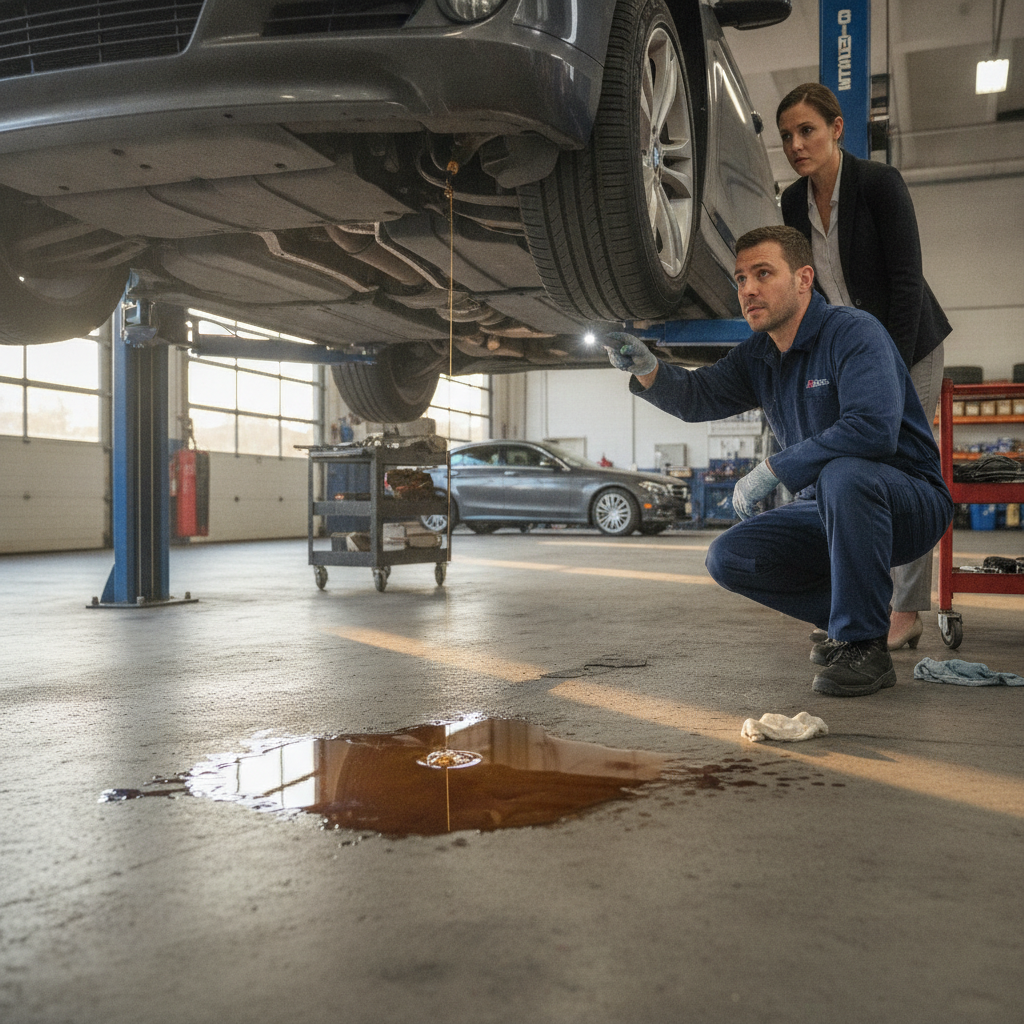
One reason brake fluid leaks catch owners off guard is that the fluid itself isn’t dramatic. It’s not neon green like coolant or dark brown-black like oil. Fresh brake fluid is nearly clear to light amber, with a slightly slippery texture and a faint chemical odor. Over time it darkens as it absorbs moisture — which brings up an important point we’ll address shortly. Because brake fluid can drip from multiple locations along the brake lines, calipers, or master cylinder, the puddle under your car may not always appear directly in front of where you’re parked. It can travel along the undercarriage before dripping.
The more reliable symptoms you’ll feel from inside the cabin:
- A soft or spongy brake pedal — especially if it improves with repeated pumping
- A low pedal that sinks toward the floor before engaging
- The brake warning light illuminating on your dashboard (this often corresponds to a low fluid level in the reservoir)
- Visible wetness or staining near any wheel, particularly around the caliper or brake line connections
- Uneven braking — the car pulling to one side when you apply the brakes
On a BMW or Mercedes-Benz, your instrument cluster or iDrive system may flag the issue before you notice it yourself. That’s one advantage of the sophisticated onboard diagnostics these vehicles carry. But don’t wait for the warning light if your pedal already feels off.
The Most Common Sources of Brake Fluid Leaks on European Vehicles
Not all brake fluid leaks are equal in severity, but all of them need professional diagnosis. Here’s where they typically originate on BMWs and Mercedes-Benz vehicles:
Brake Calipers
The calipers are the hydraulic clamps that squeeze your brake pads against the rotors. They contain rubber seals and pistons that deteriorate with age, heat cycling, and the corrosive nature of hygroscopic brake fluid. When a caliper seal fails, fluid weeps past the piston and leaks outward — often visible as staining on the inside face of the wheel or tire sidewall. This is one of the more common leak points on older BMWs and higher-mileage Mercedes models. Replacing a caliper with a genuine OEM unit ensures the seals, piston bore, and bleed nipple all meet the tolerances your hydraulic system was engineered around.
Brake Lines and Flexible Hoses
Your vehicle has a combination of hard steel brake lines and flexible rubber hoses that connect the rigid lines to each caliper. The flexible hoses are particularly vulnerable — they experience constant flexing and heat exposure, and over time the inner lining can crack or bubble, causing leaks or, in a different failure mode, acting as a one-way valve that traps pressure and causes brake drag. Hard lines can also corrode at fittings or where they’re routed near heat sources. This is a repair that demands exactness: the wrong fitting, incorrect flare type, or improper torque spec can result in a fitting that fails under braking pressure.
Brake Master Cylinder
The master cylinder sits in the engine bay and converts your foot pressure into hydraulic pressure that travels through the lines to each corner. When the internal seals wear out, fluid can leak externally — typically visible at the back of the master cylinder near the brake booster — or bypass internally, which is worse because you may not see any fluid outside the car. Internal bypass causes that sinking pedal feel where it slowly travels to the floor under steady pressure. On many BMWs and Mercedes platforms, the master cylinder is a safety-critical component that should only be replaced with an OEM or OEM-equivalent part. This is not an application for budget aftermarket components.
ABS Module and Hydraulic Control Unit
This is a less common but more expensive leak point — and one that general repair shops often overlook or misdiagnose. The ABS modulator contains internal seals that can fail, particularly in higher-mileage or aging vehicles. If fluid is tracking from somewhere near the firewall or the ABS unit on your BMW’s M-series or your Mercedes AMG, and you’re not finding an obvious source at the calipers or lines, the HCU deserves a closer look. Diagnosing this correctly requires factory-grade scan tools to rule out related ABS fault codes.
Why Moisture Matters: The Case for Regular Brake Fluid Flushes
Here’s an angle that most general repair shops never explain to European car owners — and one we rarely see addressed thoroughly on competitor sites serving the Roswell and Sandy Springs market. Brake fluid is hygroscopic, meaning it actively absorbs moisture from the atmosphere. Over time, water content in your brake fluid increases, which does two things: it lowers the fluid’s boiling point significantly, increasing the risk of vapor lock under hard braking, and it accelerates corrosion inside your brake lines, master cylinder, and calipers. That internal corrosion is frequently what causes the seals and fittings to fail in the first place.
BMW and Mercedes-Benz both specify brake fluid service intervals in their factory maintenance schedules — typically every two years regardless of mileage. This isn’t a upsell. It’s engineering reality. A fresh fluid flush is one of the most cost-effective things you can do to protect the long-term integrity of your hydraulic brake system. If you’re not sure when your vehicle last had a brake fluid change, that’s a question worth asking at your next service appointment.
You can learn more about what a thorough inspection covers — including brake fluid condition checks — on our multi-point inspection page.
What Roswell-Area Owners Should Do If They Suspect a Leak Right Now
If your pedal feels spongy, if your brake warning light is on, or if you’ve spotted fluid under your car and suspect it may be brake fluid, treat this as an urgent situation. Here’s what to do:
- Do not continue driving normally. If the pedal is low or soft, you need to get to a specialist or have the vehicle transported — not driven — until it’s been inspected.
- Check your brake fluid reservoir under the hood. On most BMWs and Mercedes models it’s a small translucent reservoir near the firewall. If the level is visibly low, that confirms fluid has left the system somewhere.
- Do not top off the reservoir and call it solved. Adding fluid addresses the symptom, not the cause. The leak will continue and the system is still compromised.
- Get a proper hydraulic system inspection from a shop with the diagnostic capability to pressure-test your brake lines and read ABS-related fault codes — not just a visual look-over.
Our team at Solo Motorsports Roswell performs comprehensive brake system diagnosis and repair for BMW, Mercedes-Benz, and other European makes — using OEM-grade components and factory diagnostic tools to locate the exact source of the leak before any repair begins.
Why This Isn’t the Repair to Outsource to a General Shop
European hydraulic brake systems are not interchangeable with domestic vehicle platforms. The fluid specifications, fitting types, caliper designs, ABS integration, and line routing on a BMW 5 Series or Mercedes E-Class are engineered to precise tolerances. A general shop that services everything from pickup trucks to minivans may not carry the correct brake line fittings, may not have access to OEM calipers for your specific platform, and may not have the scan tools required to properly bleed and calibrate the ABS system after a repair. Improper brake bleeding alone can introduce air into the system and leave you with the same spongy pedal you came in with — or worse, a compromised stopping capability you don’t discover until you really need it. Johns Creek and Alpharetta owners who’ve dealt with this know exactly what we mean.
Frequently Asked Questions
How can I tell brake fluid from other leaks under my BMW or Mercedes?
Brake fluid is clear to light amber, slightly slippery, and has a faint chemical smell — not the sweet smell of coolant or the burnt odor of oil. It’s typically found near the wheels, brake lines, or under the engine bay near the master cylinder. When in doubt, have it inspected immediately rather than guessing.
Is a small brake fluid leak something I can monitor for a few days?
No. Even a slow leak means fluid is leaving a closed system. As the level drops, your braking performance degrades — often gradually, which can give you false confidence. A brake fluid leak is a same-day concern, not a wait-and-see situation.
How often should brake fluid be changed on a BMW or Mercedes?
Most BMW and Mercedes factory maintenance schedules call for brake fluid service every two years regardless of mileage. This keeps moisture content low, maintains the fluid’s boiling point, and protects internal brake system components from corrosive degradation.
Can a brake fluid leak damage other components?
Yes. Brake fluid is highly corrosive to paint — if it’s leaking near a painted surface, it will damage the finish quickly. It can also degrade rubber components it contacts. Internally, old, moisture-laden fluid accelerates corrosion in calipers and brake lines, eventually causing the very leaks you’re trying to avoid.
Will my BMW or Mercedes warning light always come on if I have a brake fluid leak?
Not immediately. The warning light typically triggers when fluid drops below a threshold in the reservoir. A slow leak may not trip the light until significant fluid has already been lost. Symptoms like a soft pedal or pulling during braking may appear before any warning illuminates.
Let Solo Motorsports Roswell Diagnose It the Right Way
A brake fluid leak on a European vehicle isn’t something to hand off to the nearest general repair shop or address with a reservoir top-off and optimism. It requires the right diagnostic equipment, the right parts, and technicians who understand how BMW and Mercedes hydraulic systems are actually engineered. At Solo Motorsports Roswell, we’ve built our reputation in North Fulton County on exactly this kind of precision — dealership-level expertise without the dealership experience of waiting three days for a callback and paying for repairs you didn’t ask for.
If your brakes are showing any of the symptoms described here — or if you simply haven’t had your brake fluid serviced in the past two years — schedule an appointment with our team today. We’ll give you a straight answer about what’s happening, what it takes to fix it, and what it’s going to cost — before any work begins.