
Why Is My BMW or Mercedes AC Not Cooling? What Marietta and North Fulton Owners Should Know
If your BMW or Mercedes is blowing warm air in the middle of a Georgia summer, you already know how quickly that becomes unbearable — especially if you’re sitting in stop-and-go traffic on GA-400 or crawling through Marietta on a 95-degree afternoon. The short answer: a failing AC on a European vehicle is almost never just a refrigerant issue. Modern BMW and Mercedes-Benz climate systems are sophisticated, electronically controlled platforms with multiple failure points, and diagnosing them correctly requires more than a can of refrigerant and a pressure gauge from an auto parts store. Here’s what’s actually going on — and what to do about it.
Why European Car AC Systems Are Different From What You’re Used To
Domestic vehicles have relatively straightforward AC systems. European luxury vehicles — BMW, Mercedes-Benz, Audi, Volkswagen, and especially higher-end makes like Maserati or Porsche — integrate their climate control deeply with the vehicle’s main computer architecture. On a late-model BMW 5 Series or Mercedes E-Class, the AC compressor is often electrically driven, meaning it communicates directly with the ECU. If a fault code is stored elsewhere in the vehicle — even something unrelated to climate — the system may shut down cooling as a protective measure.
That means if a shop plugs in a basic code reader and tells you “no codes, must be low on refrigerant,” you could be paying for a recharge that won’t fix anything. A proper diagnosis requires factory-level diagnostic tools that can read manufacturer-specific data across all control modules — not just generic OBD-II codes.
The Most Common Reasons Your BMW or Mercedes AC Stops Cooling
There are several distinct failure modes you should understand before authorizing any repair:
- AC compressor failure: This is one of the most common and costly failures. On BMW models, the variable-displacement compressor is a frequent culprit, especially after 80,000 to 100,000 miles. When the compressor clutch fails or the compressor seizes, the system stops cycling refrigerant entirely. You’ll often hear a rattling or grinding noise when the AC is switched on — or nothing at all.
- Refrigerant leak: Small leaks develop over time from O-rings, hose connections, and the condenser — particularly after years of road debris impact. Georgia’s heat accelerates seal degradation. Simply recharging without locating the leak is money wasted; the refrigerant will escape again within weeks.
- Condenser damage: The condenser sits at the front of the vehicle behind the grille and is vulnerable to debris on Atlanta metro highways. A cracked or leaking condenser will prevent the system from holding pressure regardless of how much refrigerant is added.
- Expansion valve failure: This component regulates refrigerant flow into the evaporator. When it sticks open or closed, you get either no cooling or intermittent cooling — a symptom that owners often misattribute to low refrigerant.
- Blend door actuator malfunction: On Mercedes-Benz dual-zone climate systems, a failed blend door actuator means the system may blow warm on one side and cold on the other. This is an electronic and mechanical failure, not a refrigerant issue at all.
- Cabin air filter restriction: Severely clogged cabin filters reduce airflow through the evaporator core to the point that the system feels like it’s not cooling. It’s one of the simplest fixes — and one of the most overlooked during routine maintenance.
What a Proper AC Diagnosis Actually Looks Like
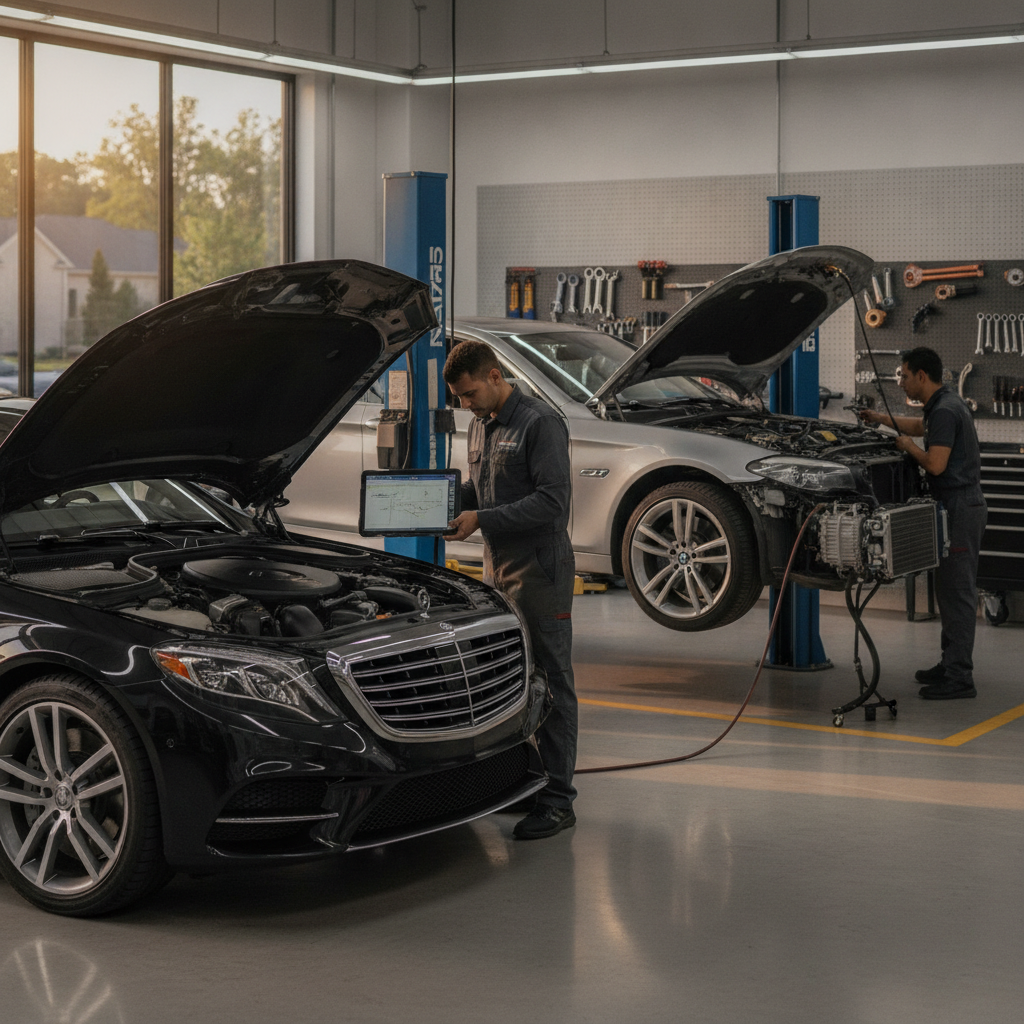
At Solo Motor Sports in Roswell, diagnosing an AC system on a European vehicle starts with a full system scan using manufacturer-level diagnostic equipment — the same tools your BMW or Mercedes dealer uses, without the dealer markup on your time. The technician checks refrigerant pressures on both the high and low sides, tests the compressor engagement, scans for stored fault codes across all relevant modules, and inspects the condenser, lines, and connections for signs of leakage or physical damage.
If a refrigerant leak is suspected, UV dye or electronic leak detection is used to pinpoint exactly where the system is losing pressure. You’ll know precisely what failed and why before any repair is recommended. That’s a meaningful difference from a shop that recharges first and asks questions later.
This level of precision matters even more for owners coming from Marietta, East Cobb, and Johns Creek who may have already had a general shop take a pass at the problem without resolving it. Our repair process is built around getting it right the first time — not cycling you through multiple attempts.
Georgia Heat and What It Does to European AC Systems
North Fulton County and the broader Atlanta metro run some of the hottest and most humid summers in the country. That environment puts real stress on AC components that are already engineering-intensive. Rubber O-rings and seals dry out faster. Condenser fins corrode from humidity and road grime. Compressors work harder and longer in extreme heat, which accelerates wear on internal components.
If your BMW or Mercedes has been sitting in the Georgia sun for three or four years without an AC system inspection, it’s not a question of whether something has degraded — it’s a question of which component went first. Proactive inspection before the system fails completely is almost always less expensive than an emergency repair in mid-July.
Why Most Shops Can’t Properly Diagnose a European AC System
This is the section that most competitors in the Roswell and Alpharetta corridor don’t address honestly. General repair shops — and even some import specialists — rely on generic diagnostic software that doesn’t fully communicate with BMW’s ISTA or Mercedes-Benz’s XENTRY platforms. Without those tools, you’re guessing. You might get lucky with a refrigerant recharge or a basic compressor swap, but you’re just as likely to misdiagnose a blend door actuator problem as a refrigerant issue and charge the customer accordingly.
Factory-trained technicians with make-specific diagnostic access aren’t just a marketing claim — they’re a functional requirement for accurately diagnosing European climate control systems. When a Sandy Springs or Johns Creek owner drives 20 minutes to a shop and pays for a repair that doesn’t fix the problem, they’ve lost both money and time. Getting the diagnosis right the first time isn’t just better service — it’s the only responsible way to work on these vehicles.
OEM Parts vs. Aftermarket: What It Means for Your AC Repair
When it comes to AC compressors, condensers, and expansion valves on BMW and Mercedes-Benz vehicles, OEM or OEM-equivalent parts matter significantly. Aftermarket compressors, in particular, vary widely in internal clearances and lubrication compatibility. A low-cost aftermarket compressor installed on an E-Class may last two summers — or fail in one. Worse, if an aftermarket compressor sheds metal debris internally, it can contaminate the entire AC circuit, requiring a full flush and replacement of the condenser, receiver-drier, and expansion valve as well.
Genuine parts carry the engineering tolerances your vehicle was designed around and typically come with a manufacturer warranty. That’s not upselling — it’s protecting the investment you’ve already made in the vehicle. You can learn more about how we approach preventative maintenance and parts quality on our site.
Frequently Asked Questions
Can I just recharge my BMW or Mercedes AC myself?
You can add refrigerant through a DIY kit, but it won’t fix an underlying leak, a failed compressor, or an electronic fault. On most modern European vehicles, the refrigerant type (R-1234yf on newer models) also requires equipment that isn’t available at the consumer level. A recharge without diagnosis is a short-term patch at best.
How long does an AC repair take on a BMW or Mercedes?
A straightforward refrigerant recharge with leak detection takes a few hours. A compressor replacement on a BMW 5 Series or Mercedes C-Class is typically a same-day repair. More complex repairs involving evaporator cores — which require partial dashboard removal — may take one to two days depending on the model.
Why does my Mercedes blow cold sometimes and warm other times?
Intermittent cooling is a classic sign of either a failing compressor clutch, a faulty pressure sensor cutting the system in and out, or a blend door actuator stuck in a partially open position. It requires live system data to diagnose accurately — not just a pressure test.
Is an AC repair covered under any warranty?
At Solo Motor Sports, repairs are backed by a warranty on both parts and labor. If you’ve had recent AC work done elsewhere and the problem has returned, bring it in for a second opinion — we’ll tell you honestly what was done, what failed, and what actually needs to be fixed.
Do you service AC systems on other European makes besides BMW and Mercedes?
Yes. We service climate control systems on Audi, Volkswagen, Porsche, Volvo, Land Rover, Maserati, and all other European and import makes we work on. Each manufacturer uses a different architecture, and we have the diagnostic tools and make-specific training to work on them correctly.
Schedule Your AC Diagnosis at Solo Motor Sports
If your BMW or Mercedes is struggling to keep up with Georgia summer heat — whether you’re in Marietta, Roswell, Alpharetta, Sandy Springs, or East Cobb — don’t settle for a refrigerant top-off and a hope. Bring it to a shop with the tools and training to diagnose it correctly the first time.
Solo Motor Sports is located at 11702 Alpharetta Hwy in Roswell, convenient to the GA-400 corridor and serving European and import vehicle owners across North Fulton County and beyond. Contact us today to schedule your AC diagnosis — and get back to actually enjoying your drive this summer.