
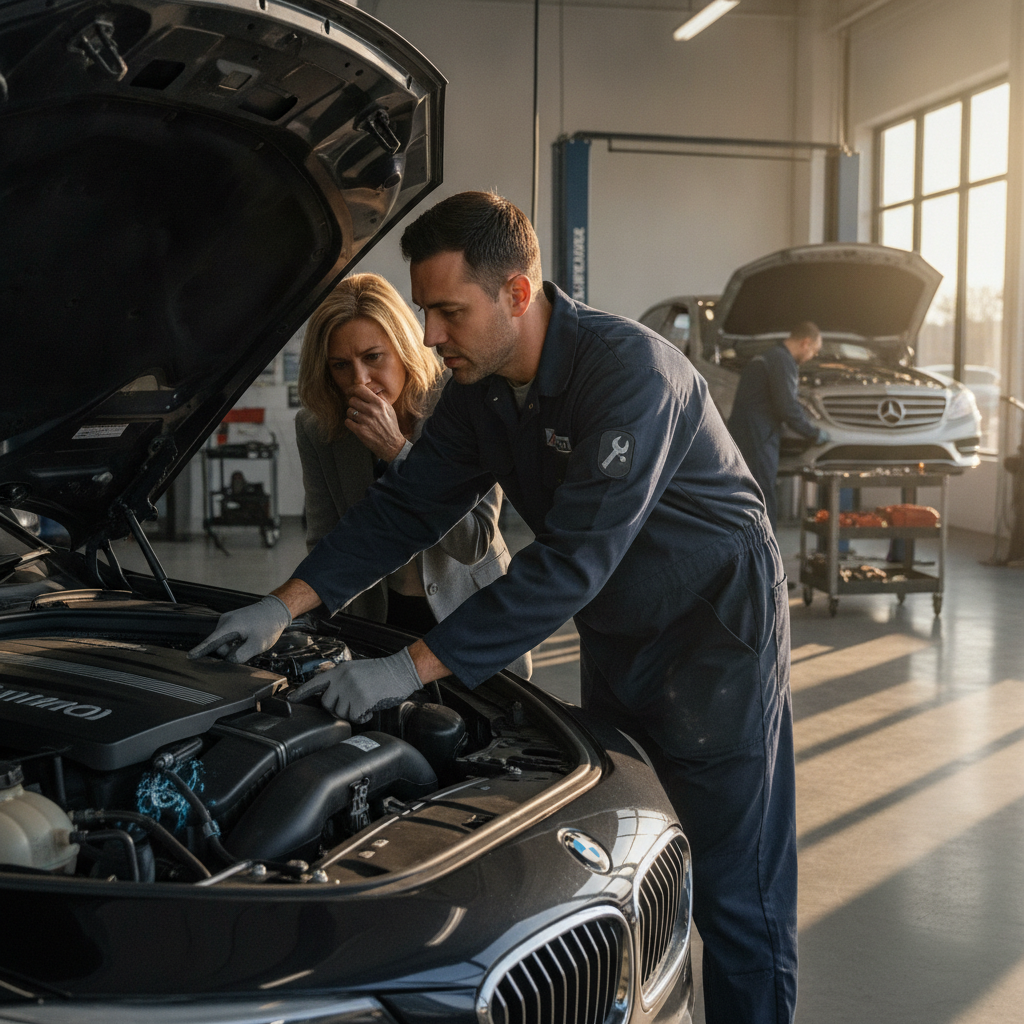
Why Is My BMW or Mercedes Burning a Coolant Smell but Not Overheating? What Milton and North Fulton Owners Should Know
If you’re catching that sweet, slightly chemical smell when you park or run the heater in your BMW or Mercedes-Benz — but your temperature gauge looks completely normal — you’re dealing with one of the most commonly misread warning signs in European vehicles. In short: the absence of an overheating warning does not mean your cooling system is fine. It often means the leak is small enough that your engine is managing, for now. Milton and North Fulton County owners who drive late-model BMWs, E-Class Mercedes, or anything with a turbocharged inline-six should take this seriously before the Georgia summer has a chance to turn a slow leak into a full failure.
What Causes a Coolant Smell Without an Overheating Warning?
European engines — especially BMW N55s, B58s, and Mercedes M276 and M256 platforms — run tight tolerances with complex cooling circuits. A small external leak can burn off on a hot exhaust component or turbocharger housing and produce a noticeable smell without ever building up enough heat to trigger your coolant temperature sensor. Here are the most likely culprits:
- Deteriorating coolant hoses or clamps: BMW and Mercedes use silicone and reinforced rubber hoses that degrade over time, especially when they’re subjected to repeated heat cycles. A hairline crack or a weeping clamp fitting can drip coolant directly onto a hot exhaust manifold — you smell it, but your reservoir level barely changes at first.
- Expansion tank failure: This is particularly common on BMW vehicles. The plastic expansion tank is under pressure and can develop micro-fractures that weep coolant slowly. By the time you notice the smell, you may already be running slightly low.
- Water pump seal leak: BMW’s electric water pumps and Mercedes’ mechanical water pumps both have seals that degrade. A leaking seal will often produce a smell before it produces visible puddling.
- Thermostat housing or coolant flange: On multiple BMW and Mercedes inline-six engines, a plastic thermostat housing or coolant distribution flange is a known weak point. These fittings can crack or warp from thermal stress — especially on vehicles that spend time sitting in stop-and-go GA-400 traffic, where engines cycle between high load and idle repeatedly.
- Heater core seepage: If the smell is strongest inside the cabin when you run the heat, the heater core may be weeping coolant into the HVAC system. This is more involved to repair but is also a clear early signal before a full heater core failure.
Why the “No Warning Light” Logic Will Cost You
Modern European vehicles have sophisticated temperature monitoring, but those sensors are calibrated to detect a dangerous heat threshold — not a slow drip. Your BMW or Mercedes can lose a meaningful amount of coolant over several weeks of commuting before the system registers anything on the dash. By the time the light comes on, you may already be dealing with air pockets in the cooling circuit, which creates hot spots that cause localized head gasket stress or cylinder liner damage.
This is especially true for turbocharged engines. Turbos run extremely hot, and they depend on coolant flow to cool down after the engine shuts off. A low coolant level combined with a compromised coolant flow path is one of the faster ways to shorten turbo life on a BMW 340i, Mercedes C43, or similar vehicle. If you’re regularly making the commute up and down GA-400 between Johns Creek and Atlanta, your turbos are working hard — and a marginally low cooling system is not giving them the protection they need.
What Proper Diagnosis Actually Looks Like
This is where most generic shops fall short — and it’s a gap that’s easy to see when you look at how European cooling system problems are handled by independent shops without factory-level tooling. A proper diagnosis for a coolant smell on a BMW or Mercedes is not a visual once-over. It involves:
- Pressure testing the cooling system to isolate where the loss is occurring, even if nothing is visibly dripping
- Checking coolant concentration and pH — degraded coolant becomes acidic and accelerates corrosion of aluminum components, which BMW and Mercedes use extensively throughout their cooling circuits
- Factory-level scan tool data to pull coolant temperature sensor history and identify any logged events that didn’t generate a dash warning
- Inspection of the expansion tank, all hose connections, and thermostat housing for discoloration, white residue, or micro-cracking
- Heater core function check if any cabin odor is present
At Solo Motorsports Roswell, the technicians use the same diagnostic platforms used by BMW and Mercedes-Benz dealer service departments. That matters because BMW’s ISTA and Mercedes’ XENTRY toolsets give you a level of system integration that a generic OBD-II reader simply cannot replicate. You see live data, sensor history, and guided fault analysis — not just a code read. Learn more about the full range of services available at Solo Motorsports Roswell.
OEM vs. Aftermarket Parts: It Matters More Than You Think on a Cooling System
One of the most common ways a cooling system repair goes wrong — especially on BMW and Mercedes — is when a shop installs a low-quality aftermarket expansion tank, thermostat housing, or water pump. These components are made from inferior plastic compounds that don’t tolerate the same pressure and heat cycling as OEM or genuine parts. You end up back in the shop six months later with the same problem.
BMW’s N-series engines in particular have a well-documented history of recurring cooling system failures when non-OEM parts are used for the repair. The same applies to the Mercedes OM651 diesel and M276 V6 gasoline platforms — the thermostatic components are calibrated to specific tolerances, and generic replacements often cause erratic temperature behavior even when there’s no visible leak.
Solo Motorsports Roswell uses genuine OEM and OEM-equivalent parts on all cooling system repairs, and every repair comes with a warranty. That’s not the norm at every shop in the Alpharetta and Milton corridor — it’s worth asking specifically before you authorize any cooling system work.
When to Stop Driving and Get It Looked At
If you’re smelling coolant occasionally but have no other symptoms, you likely have a window to schedule a proper inspection without it being an emergency. But watch carefully for these changes:
- The smell becomes stronger or more frequent
- Your temperature gauge moves at all — even briefly — above normal
- You notice steam from the hood or a white cloud from the exhaust on a warm day
- Your coolant reservoir level drops visibly between checks
- Your heater starts blowing lukewarm air when it should be hot
Any of those changes means the leak has progressed. At that point, continuing to drive risks air entering the cooling circuit — and on a BMW or Mercedes, that can escalate to a failed head gasket repair that costs significantly more than catching it early. Preventative maintenance is always the more affordable path.
Frequently Asked Questions
Can I top off the coolant myself and wait to get it inspected?
You can top off to maintain a safe level in the short term, but it is not a fix. Topping off without finding the source means you’ll keep losing fluid. On BMW and Mercedes, you also need to use the correct coolant specification — BMW recommends a blue or green silicate-free coolant, and Mercedes uses a specific MB 325.0 or 325.6 standard. Using the wrong coolant type can cause corrosion in aluminum components. Check your owner’s manual or ask a specialist before adding anything.
How much does it cost to fix a coolant leak on a BMW or Mercedes?
It depends entirely on the source. A failed expansion tank on a BMW is a straightforward repair. A leaking water pump or thermostat housing is more involved. A heater core is on the higher end of the cost range because of the labor required to access it. The best thing you can do is get a proper pressure test diagnosis first so you know exactly what you’re working with before committing to a repair estimate.
Is the coolant smell always a leak, or could it be something else?
A sweet, slightly syrupy smell is almost always coolant (ethylene glycol). Occasionally a small amount of coolant can be introduced into the combustion chamber through a compromised head gasket and burned off — that creates the same smell from the exhaust rather than from under the hood. A proper pressure test and a combustion leak test (checking for exhaust gases in the coolant) will differentiate between an external leak and an internal one.
Does Georgia’s summer heat make coolant leaks worse?
Yes, meaningfully. The heat and humidity in North Fulton County and the Atlanta metro accelerate the deterioration of rubber hoses, plastic housings, and coolant itself. Coolant that hasn’t been flushed on schedule becomes acidic, which speeds up corrosion inside the cooling circuit. Combine that with the thermal stress of stop-and-go traffic on surface roads and GA-400, and you have conditions that will expose any weakness in a cooling system faster than a milder climate would.
How often should I flush the coolant in my BMW or Mercedes?
Most BMW and Mercedes factory service intervals call for a coolant flush every 30,000 to 50,000 miles or every four to five years, whichever comes first. In Georgia’s climate, erring toward the shorter interval is smart. Degraded coolant not only loses its heat transfer efficiency — it also becomes corrosive. A flush that’s two years overdue is one of the most cost-effective things you can do to protect an engine that’s worth tens of thousands of dollars.
Get Your BMW or Mercedes Diagnosed by a Specialist in Roswell
If you’re in Milton, Alpharetta, Johns Creek, or anywhere in North Fulton County and you’re catching that telltale coolant smell, don’t wait for the overheating light to make the decision for you. Solo Motorsports Roswell is a European vehicle specialist serving the area with factory-trained, ASE-certified technicians, genuine OEM parts, and dealership-level diagnostic tools — without the dealership markup or the upsell pressure. Contact us today to schedule a cooling system inspection. Early diagnosis is always the smarter and more affordable option.